 Add to Chrome
 Add to Firefox
 Add to Edge
Vanishing L2 regularization for the softmax Multi Armed Bandit
May 05, 2026
Multi Armed Bandit (MAB) algorithms are a cornerstone of reinforcement learning and have been studied both theoretically and numerically. One of the most commonly used implementation uses a softmax mapping to prescribe the optimal policy and served as the foundation for downstream algorithms, including REINFORCE. Distinct from vanilla approaches, we consider here the L2 regularized softmax policy gradient where a quadratic term is subtracted from the mean reward. Previous studies exploiting convexity failed to identify a suitable theoretical framework to analyze its convergence when the regularization parameter vanishes. We prove here theoretical convergence results and confirm empirically that this regime makes the L2 regularization numerically advantageous on standard benchmarks.

Softmax gradient policy for variance minimization and risk-averse multi armed bandits
Mar 31, 2026Algorithms for the Multi-Armed Bandit (MAB) problem play a central role in sequential decision-making and have been extensively explored both theoretically and numerically. While most classical approaches aim to identify the arm with the highest expected reward, we focus on a risk-aware setting where the goal is to select the arm with the lowest variance, favoring stability over potentially high but uncertain returns. To model the decision process, we consider a softmax parameterization of the policy; we propose a new algorithm to select the minimal variance (or minimal risk) arm and prove its convergence under natural conditions. The algorithm constructs an unbiased estimate of the objective by using two independent draws from the current's arm distribution. We provide numerical experiments that illustrate the practical behavior of these algorithms and offer guidance on implementation choices. The setting also covers general risk-aware problems where there is a trade-off between maximizing the average reward and minimizing its variance.
Lyapunov weights to convey the meaning of time in physics-informed neural networks
Jul 31, 2024Time is not a dimension as the others. In Physics-Informed Neural Networks (PINN) several proposals attempted to adapt the time sampling or time weighting to take into account the specifics of this special dimension. But these proposals are not principled and need guidance to be used. We explain here theoretically why the Lyapunov exponents give actionable insights and propose a weighting scheme to automatically adapt to chaotic, periodic or stable dynamics. We characterize theoretically the best weighting scheme under computational constraints as a cumulative exponential integral of the local Lyapunov exponent estimators and show that it performs well in practice under the regimes mentioned above.
Optimal time sampling in physics-informed neural networks
Apr 29, 2024Physics-informed neural networks (PINN) is a extremely powerful paradigm used to solve equations encountered in scientific computing applications. An important part of the procedure is the minimization of the equation residual which includes, when the equation is time-dependent, a time sampling. It was argued in the literature that the sampling need not be uniform but should overweight initial time instants, but no rigorous explanation was provided for these choice. In this paper we take some prototypical examples and, under standard hypothesis concerning the neural network convergence, we show that the optimal time sampling follows a truncated exponential distribution. In particular we explain when the time sampling is best to be uniform and when it should not be. The findings are illustrated with numerical examples on linear equation, Burgers' equation and the Lorenz system.
Transformer for Times Series: an Application to the S&P500
Mar 04, 2024The transformer models have been extensively used with good results in a wide area of machine learning applications including Large Language Models and image generation. Here, we inquire on the applicability of this approach to financial time series. We first describe the dataset construction for two prototypical situations: a mean reverting synthetic Ornstein-Uhlenbeck process on one hand and real S&P500 data on the other hand. Then, we present in detail the proposed Transformer architecture and finally we discuss some encouraging results. For the synthetic data we predict rather accurately the next move, and for the S&P500 we get some interesting results related to quadratic variation and volatility prediction.
On the Convergence Rate of the Stochastic Gradient Descent and application to a modified policy gradient for the Multi Armed Bandit
Feb 09, 2024We present a self-contained proof of the convergence rate of the Stochastic Gradient Descent (SGD) when the learning rate follows an inverse time decays schedule; we next apply the results to the convergence of a modified form of policy gradient Multi-Armed Bandit (MAB) with $L2$ regularization.
Onflow: an online portfolio allocation algorithm
Dec 08, 2023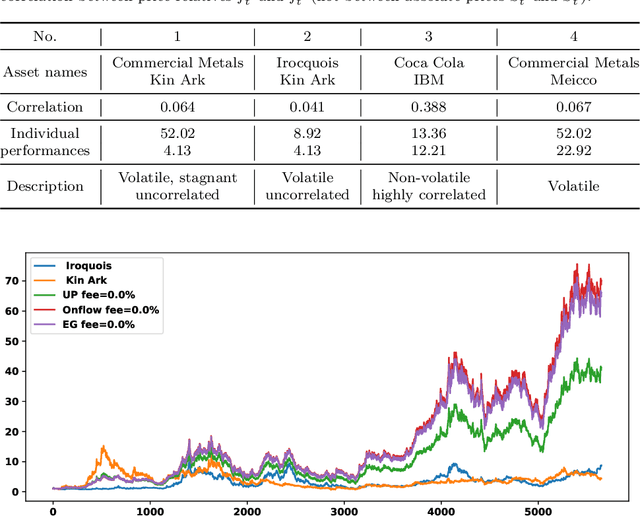
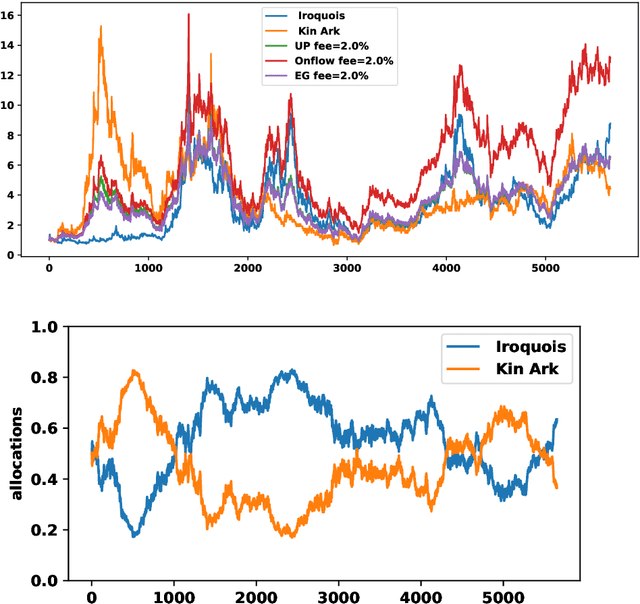
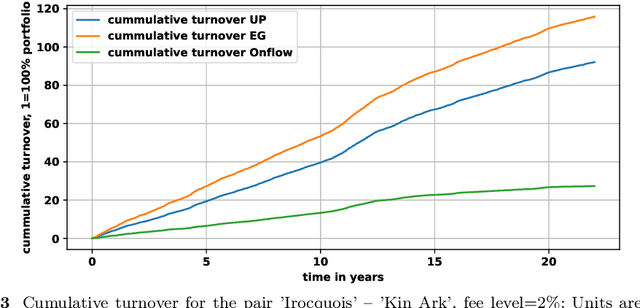
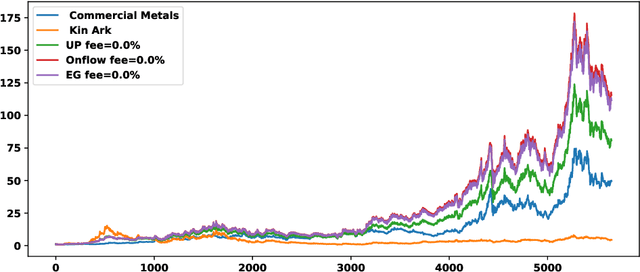
We introduce Onflow, a reinforcement learning technique that enables online optimization of portfolio allocation policies based on gradient flows. We devise dynamic allocations of an investment portfolio to maximize its expected log return while taking into account transaction fees. The portfolio allocation is parameterized through a softmax function, and at each time step, the gradient flow method leads to an ordinary differential equation whose solutions correspond to the updated allocations. This algorithm belongs to the large class of stochastic optimization procedures; we measure its efficiency by comparing our results to the mathematical theoretical values in a log-normal framework and to standard benchmarks from the 'old NYSE' dataset. For log-normal assets, the strategy learned by Onflow, with transaction costs at zero, mimics Markowitz's optimal portfolio and thus the best possible asset allocation strategy. Numerical experiments from the 'old NYSE' dataset show that Onflow leads to dynamic asset allocation strategies whose performances are: a) comparable to benchmark strategies such as Cover's Universal Portfolio or Helmbold et al. "multiplicative updates" approach when transaction costs are zero, and b) better than previous procedures when transaction costs are high. Onflow can even remain efficient in regimes where other dynamical allocation techniques do not work anymore. Therefore, as far as tested, Onflow appears to be a promising dynamic portfolio management strategy based on observed prices only and without any assumption on the laws of distributions of the underlying assets' returns. In particular it could avoid model risk when building a trading strategy.
Deep Conditional Measure Quantization
Jan 17, 2023The quantization of a (probability) measure is replacing it by a sum of Dirac masses that is close enough to it (in some metric space of probability measures). Various methods exists to do so, but the situation of quantizing a conditional law has been less explored. We propose a method, called DCMQ, involving a Huber-energy kernel-based approach coupled with a deep neural network architecture. The method is tested on several examples and obtains promising results.
Huber-energy measure quantization
Dec 15, 2022We describe a measure quantization procedure i.e., an algorithm which finds the best approximation of a target probability law (and more generally signed finite variation measure) by a sum of Q Dirac masses (Q being the quantization parameter). The procedure is implemented by minimizing the statistical distance between the original measure and its quantized version; the distance is built from a negative definite kernel and, if necessary, can be computed on the fly and feed to a stochastic optimization algorithm (such as SGD, Adam, ...). We investigate theoretically the fundamental questions of existence of the optimal measure quantizer and identify what are the required kernel properties that guarantee suitable behavior. We test the procedure, called HEMQ, on several databases: multi-dimensional Gaussian mixtures, Wiener space cubature, Italian wine cultivars and the MNIST image database. The results indicate that the HEMQ algorithm is robust and versatile and, for the class of Huber-energy kernels, it matches the expected intuitive behavior.
Diversity aware image generation
Feb 19, 2022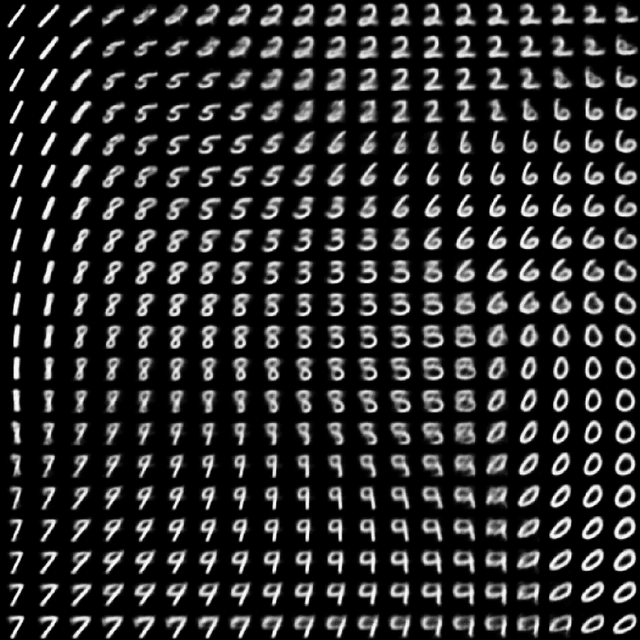
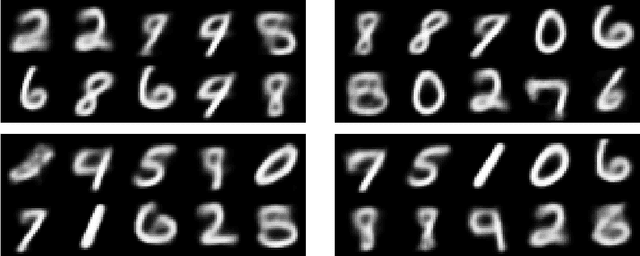
The machine learning generative algorithms such as GAN and VAE show impressive results in practice when constructing images similar to those in a training set. However, the generation of new images builds mainly on the understanding of the hidden structure of the training database followed by a mere sampling from a multi-dimensional normal variable. In particular each sample is independent from the other ones and can repeatedly propose same type of images. To cure this drawback we propose a kernel-based measure representation method that can produce new objects from a given target measure by approximating the measure as a whole and even staying away from objects already drawn from that distribution. This ensures a better variety of the produced images. The method is tested on some classic machine learning benchmarks.\end{abstract}