 Add to Chrome
 Add to Firefox
 Add to Edge
Merge before Forget: A Single LoRA Continual Learning via Continual Merging
Dec 28, 2025
Parameter-efficient continual learning has emerged as a promising approach for large language models (LLMs) to mitigate catastrophic forgetting while enabling adaptation to new tasks. Current Low-Rank Adaptation (LoRA) continual learning techniques often retain and freeze previously learned LoRAs or generate data representations to overcome forgetting, typically utilizing these to support new LoRAs learn new tasks. However, these methods not only ignore growing computational memory with tasks and limited storage space but also suffer from potential task interference due to the lack of effective LoRA merging mechanisms. In this paper, we propose a novel continual learning method that orthogonally initializes and sequentially merges LoRAs updates into a single unified LoRA. Our method leverages orthogonal basis extraction from previously learned LoRA to initialize the learning of new tasks, further exploits the intrinsic asymmetry property of LoRA components by using a time-aware scaling mechanism to balance new and old knowledge during continual merging. Our approach maintains constant memory complexity with respect to the number of tasks, minimizes interference between past and new tasks via orthogonal basis initialization, and improves performance over asymmetric LoRA merging via adaptive scaling. We provide theoretical analysis to justify our design and conduct extensive experiments across diverse continual learning benchmarks using various Llama models, demonstrating the effectiveness and efficiency of our method.

On the Convergence and Stability of Distributed Sub-model Training
Nov 08, 2025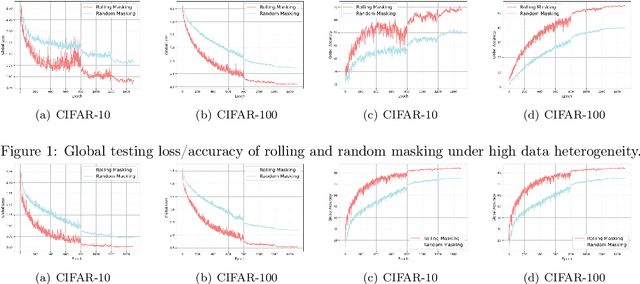
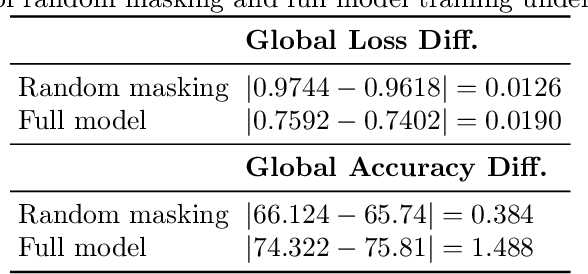
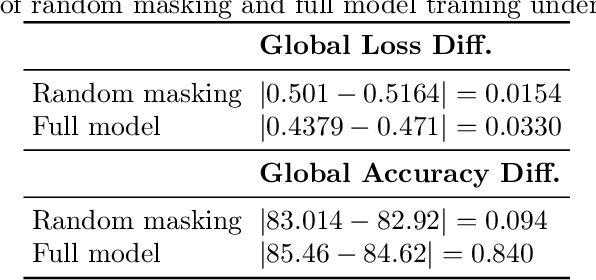

As learning models continue to grow in size, enabling on-device local training of these models has emerged as a critical challenge in federated learning. A popular solution is sub-model training, where the server only distributes randomly sampled sub-models to the edge clients, and clients only update these small models. However, those random sampling of sub-models may not give satisfying convergence performance. In this paper, observing the success of SGD with shuffling, we propose a distributed shuffled sub-model training, where the full model is partitioned into several sub-models in advance, and the server shuffles those sub-models, sends each of them to clients at each round, and by the end of local updating period, clients send back the updated sub-models, and server averages them. We establish the convergence rate of this algorithm. We also study the generalization of distributed sub-model training via stability analysis, and find that the sub-model training can improve the generalization via amplifying the stability of training process. The extensive experiments also validate our theoretical findings.
Stochastic Compositional Minimax Optimization with Provable Convergence Guarantees
Aug 22, 2024Stochastic compositional minimax problems are prevalent in machine learning, yet there are only limited established on the convergence of this class of problems. In this paper, we propose a formal definition of the stochastic compositional minimax problem, which involves optimizing a minimax loss with a compositional structure either in primal , dual, or both primal and dual variables. We introduce a simple yet effective algorithm, stochastically Corrected stOchastic gradient Descent Ascent (CODA), which is a descent ascent type algorithm with compositional correction steps, and establish its convergence rate in aforementioned three settings. In the presence of the compositional structure in primal, the objective function typically becomes nonconvex in primal due to function composition. Thus, we consider the nonconvex-strongly-concave and nonconvex-concave settings and show that CODA can efficiently converge to a stationary point. In the case of composition on the dual, the objective function becomes nonconcave in the dual variable, and we demonstrate convergence in the strongly-convex-nonconcave and convex-nonconcave setting. In the case of composition on both variables, the primal and dual variables may lose convexity and concavity, respectively. Therefore, we anaylze the convergence in weakly-convex-weakly-concave setting. We also give a variance reduction version algorithm, CODA+, which achieves the best known rate on nonconvex-strongly-concave and nonconvex-concave compositional minimax problem. This work initiates the theoretical study of the stochastic compositional minimax problem on various settings and may inform modern machine learning scenarios such as domain adaptation or robust model-agnostic meta-learning.