 Add to Chrome
 Add to Firefox
 Add to Edge
DeFed-GMM-DaDiL: A Decentralized Federated Framework for Domain Adaptation
May 05, 2026
Decentralized multi-source domain adaptation seeks to transfer knowledge from multiple heterogeneous and related source domains to an unlabeled target domain in a decentralized setting. We address this challenge through a fully decentralized federated approach, DeFed-GMM-DaDiL, an extension of the GMM-Dataset Dictionary Learning (DaDiL) framework. Each client models its dataset as a Gaussian Mixture Model (GMM), and the federation jointly approximates them via labeled Wasserstein barycenters of shared, learnable GMM atoms. This design enables adaptation without a central server while preserving clients' privacy. We empirically study the stability of the learned representations in scenarios where the target domain has missing classes. Empirical results demonstrate that DeFed-GMM-DaDiL maintains stable and consistent shared representations across clients, effectively reconstructs missing classes, and achieves competitive performance on multi-source domain adaptation benchmarks.

On the Role of DAG topology in Energy-Aware Cloud Scheduling : A GNN-Based Deep Reinforcement Learning Approach
Apr 10, 2026Cloud providers must assign heterogeneous compute resources to workflow DAGs while balancing competing objectives such as completion time, cost, and energy consumption. In this work, we study a single-workflow, queue-free scheduling setting and consider a graph neural network (GNN)-based deep reinforcement learning scheduler designed to minimize workflow completion time and energy usage. We identify specific out-of-distribution (OOD) conditions under which GNN-based deep reinforcement learning schedulers fail and provide a principled explanation of why these failures occur. Through controlled OOD evaluations, we demonstrate that performance degradation stems from structural mismatches between training and deployment environments, which disrupt message passing and undermine policy generalization. Our analysis exposes fundamental limitations of current GNN-based schedulers and highlights the need for more robust representations to ensure reliable scheduling performance under distribution shifts.
Unsupervised Dataset Dictionary Learning for domain shift robust clustering: application to sitting posture identification
Jun 24, 2025This paper introduces a novel approach, Unsupervised Dataset Dictionary Learning (U-DaDiL), for totally unsupervised robust clustering applied to sitting posture identification. Traditional methods often lack adaptability to diverse datasets and suffer from domain shift issues. U-DaDiL addresses these challenges by aligning distributions from different datasets using Wasserstein barycenter based representation. Experimental evaluations on the Office31 dataset demonstrate significant improvements in cluster alignment accuracy. This work also presents a promising step for addressing domain shift and robust clustering for unsupervised sitting posture identification
Unsupervised Anomaly Detection through Mass Repulsing Optimal Transport
Feb 18, 2025
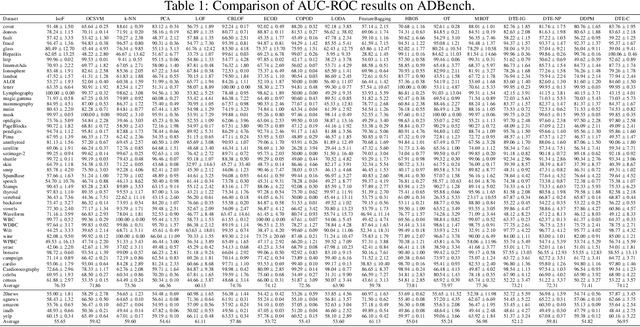
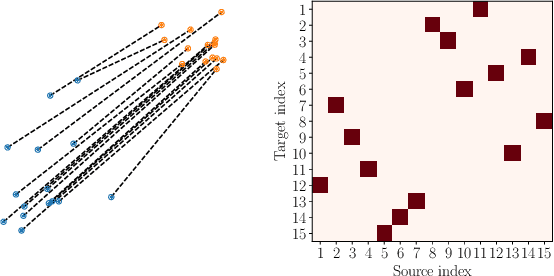
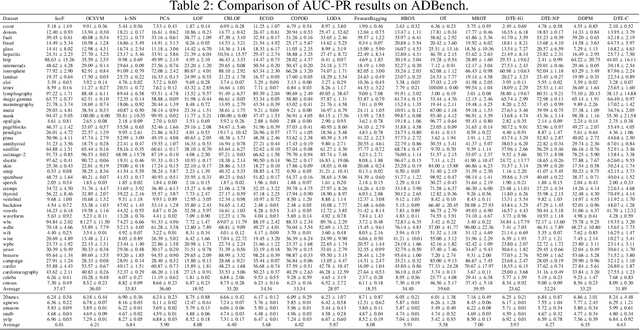
Detecting anomalies in datasets is a longstanding problem in machine learning. In this context, anomalies are defined as a sample that significantly deviates from the remaining data. Meanwhile, optimal transport (OT) is a field of mathematics concerned with the transportation, between two probability measures, at least effort. In classical OT, the optimal transportation strategy of a measure to itself is the identity. In this paper, we tackle anomaly detection by forcing samples to displace its mass, while keeping the least effort objective. We call this new transportation problem Mass Repulsing Optimal Transport (MROT). Naturally, samples lying in low density regions of space will be forced to displace mass very far, incurring a higher transportation cost. We use these concepts to design a new anomaly score. Through a series of experiments in existing benchmarks, and fault detection problems, we show that our algorithm improves over existing methods.