 Add to Chrome
 Add to Firefox
 Add to Edge
Digital Twins as Synthetic Controls in Single-Arm Trials
May 12, 2026
Single-arm trials are an important study design for evaluating drug efficacy and safety without enrolling patients into a control arm. Although they do not provide the gold-standard evidence of randomized controlled trials, they are increasingly used in clinical development as they offer an efficient, ethical, and practical alternative. A wide variety of approaches can be used to construct control comparators and estimate treatment effects, from fixed comparators informed by clinical knowledge to data-based and model-based patient-level comparators, also known as synthetic controls. Powerful and flexible machine learning models can allow outcome-model-based synthetic controls to overcome key limitations of direct data-based approaches, yield more robust estimates of treatment effects, and provide a principled way to incorporate corrections or encode additional assumptions when external data are not directly comparable. In this work, we argue that outcome-model-based synthetic control arms are an important tool for single-arm trials. We focus on digital twins, personalized predictions of disease progression generated from machine learning models trained on historical datasets, which naturally leverage these flexible approaches. We review doubly robust estimators, present power and sample size formulas, and discuss trade-offs in selecting historical data for training and analysis. We also outline practical considerations for deploying digital twins within the framework of recent FDA draft guidance on the use of artificial intelligence in drug development. Finally, we reanalyze data from trials in amyotrophic lateral sclerosis and Huntington's disease to demonstrate the proposed methods.

Digital Twin Generators for Disease Modeling
May 02, 2024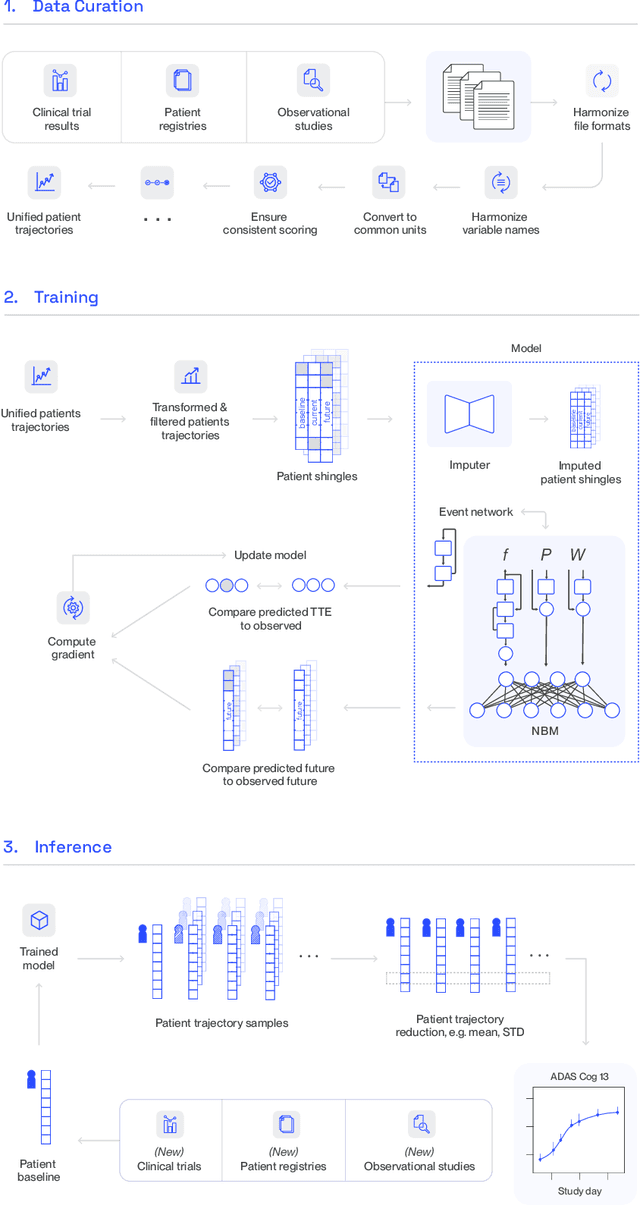
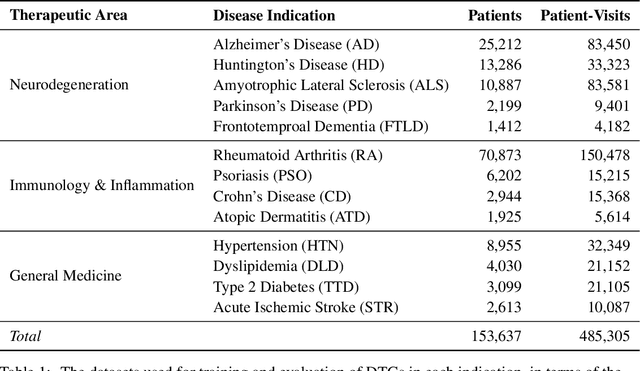
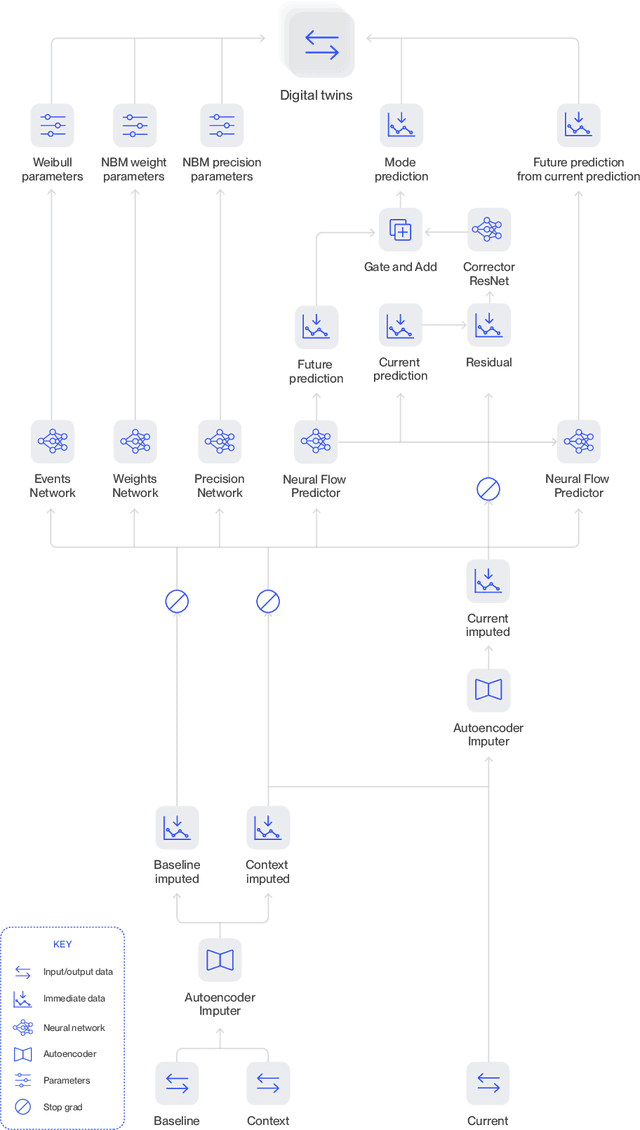
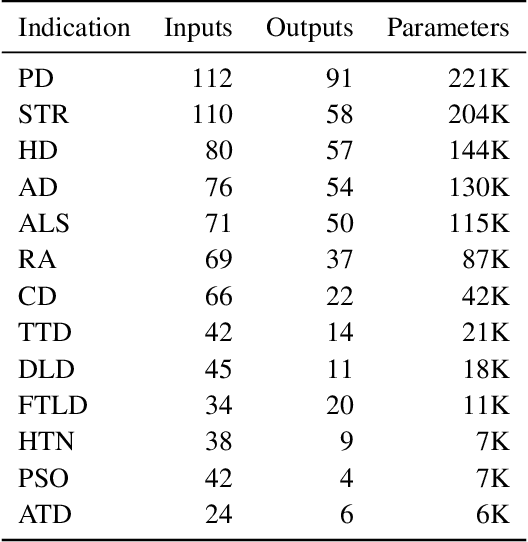
A patient's digital twin is a computational model that describes the evolution of their health over time. Digital twins have the potential to revolutionize medicine by enabling individual-level computer simulations of human health, which can be used to conduct more efficient clinical trials or to recommend personalized treatment options. Due to the overwhelming complexity of human biology, machine learning approaches that leverage large datasets of historical patients' longitudinal health records to generate patients' digital twins are more tractable than potential mechanistic models. In this manuscript, we describe a neural network architecture that can learn conditional generative models of clinical trajectories, which we call Digital Twin Generators (DTGs), that can create digital twins of individual patients. We show that the same neural network architecture can be trained to generate accurate digital twins for patients across 13 different indications simply by changing the training set and tuning hyperparameters. By introducing a general purpose architecture, we aim to unlock the ability to scale machine learning approaches to larger datasets and across more indications so that a digital twin could be created for any patient in the world.