 Add to Chrome
 Add to Firefox
 Add to Edge
Branch-Level Energy Localization in Three-Phase Loads: Resolving Indeterminacy in Time-Domain
Jun 05, 2026
This paper develops a branch-level energy-localization framework for three-phase loads. The instantaneous terminal power of an admissible lumped equivalent is decomposed uniquely as Joule dissipation plus magnetic and electric stored-energy rates, branch by branch. Three formal results are established: a Branch-Level Localization Theorem (uniqueness given an admissible topology); a Topology-Indeterminacy Theorem (multiple admissible topologies reproduce identical terminal data with distinct localizations); and a Generalized Energetic Duality Theorem that organizes classical electrical dualities (Norton-Thevenin, series--parallel, L vs C, R vs G) as restrictions to Linear Time Invariant (LTI) sinusoidal regimes of a single time-domain principle in which constant-parameter equivalence is replaced by time-varying parameters. The framework is exercised on six test cases including the de Leon--Cohen open-phase paradox, switched-resistive loads, three-wire delta-versus-wye-virtual indeterminacy, fluctuating-phase loads, and a four-wire nonlinear load with hysteretic, linear, and switched branches. The framework is positioned as complementary to IEEE Std. 1459, CPC, instantaneous p-q, and Fryze-Buchholz-Depenbrock: each answers a different question, and the apparent paradoxes vanish once the question is posed precisely.

Geometric Time-Domain Identification of Three-Phase Load Equivalents from Terminal Measurements
Jun 05, 2026This paper presents a geometric time-domain method for identifying three-phase load equivalents from instantaneous voltage and current measurements at the point of common coupling. Measured waveforms are interpreted as trajectories in Euclidean signal spaces, and load-equivalent parameters are recovered from the geometry of those trajectories. The method extends a previously published single-phase geometric identification formulation to three- and four-wire systems and places special emphasis on the three-wire case, where no neutral voltage is measured and the terminal data must satisfy coupled Kirchhoff constraints. The main advance over the earlier analytical formulation is a sampled-data implementation based on local time windows, normalized matrix equations, harmonic-projection derivative and primitive coordinates, explicit geometric identifiability tests, passivity constraints, and energy/Kirchhoff residuals. The method does not force a model when the measured trajectory lacks enough information; instead, it reports low-rank or ill-conditioned windows as low-confidence evidence. Numerical simulations with clean data, measurement noise, window-length sweeps, and sensor delay show that the method accurately identifies informative three-phase trajectories and exposes structurally degenerate cases such as pure single-frequency excitation for higher-order three-wire models. For a given admissible topology the identified circuit closes the instantaneous terminal energy balance of the measured load over the analysis window.
A self-organizing multi-agent system for distributed voltage regulation
Feb 01, 2022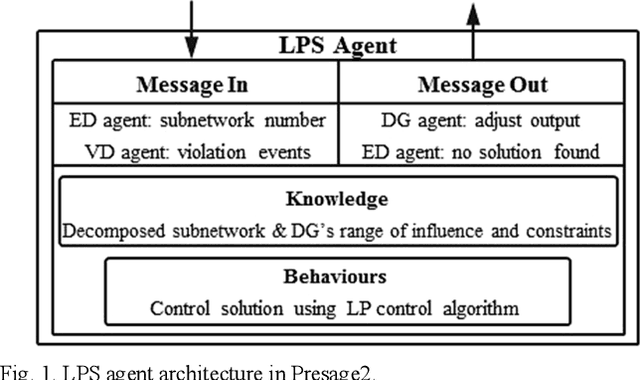
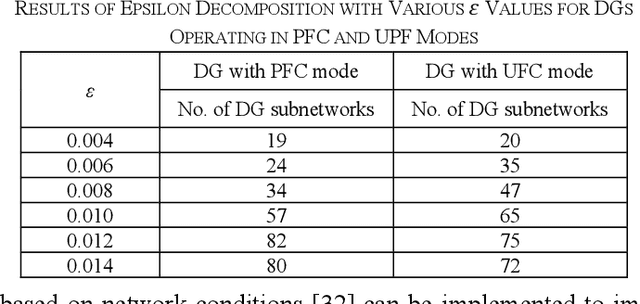
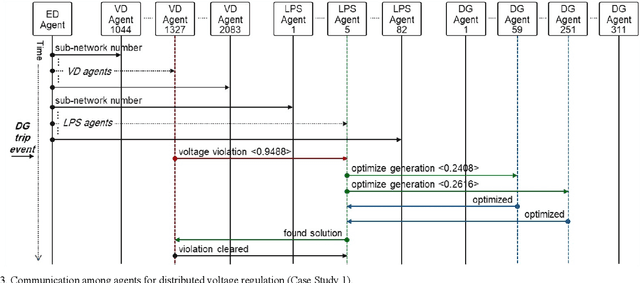
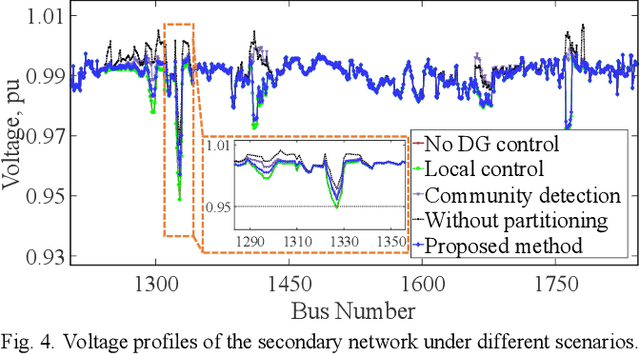
This paper presents a distributed voltage regulation method based on multi-agent system control and network self-organization for a large distribution network. The network autonomously organizes itself into small subnetworks through the epsilon decomposition of the sensitivity matrix, and agents group themselves into these subnetworks with the communication links being autonomously determined. Each subnetwork controls its voltage by locating the closest local distributed generation and optimizing their outputs. This simplifies and reduces the size of the optimization problem and the interaction requirements. This approach also facilitates adaptive grouping of the network by self-reorganizing to maintain a stable state in response to time-varying network requirements and changes. The effectiveness of the proposed approach is validated through simulations on a model of a real heavily-meshed secondary distribution network. Simulation results and comparisons with other methods demonstrate the ability of the subnetworks to autonomously and independently regulate the voltage and to adapt to unpredictable network conditions over time, thereby enabling autonomous and flexible distribution networks.