 Add to Chrome
 Add to Firefox
 Add to Edge
Pre-Fault Voltage Discrimination and Time-Domain Protection for Distribution Networks with Inverter-Based Resources
Jun 09, 2026
The increasing proliferation of inverter-based resources (IBRs) in distribution networks is presenting a major challenge for phasor-based overcurrent protection. This challenge stems from IBRs' lack of short-circuit current sourcing capacity. As a result, traditional overcurrent protection functions (e.g., ANSI 51) are inadequate in such scenarios, and warrant alternative approaches. Time-domain protection, for example, shows promise in overcoming this challenge. In this paper we propose a pre-fault voltage discrimination (PVD) strategy whose role is to detect faults and discriminate normal switching and transformer inrush disturbances from actual faults. The use of PVD allows for the design of a simple, yet effective fault detection algorithm by using time-domain protection principles for distribution networks containing IBRs. The introduction of PVD provides for faster fault detection without reducing security and dependability. Offline simulation experiments and controller hardware-in-the-loop real-time simulation validate the effectiveness of the proposed algorithm against various fault and normal switching events.

A Comparative Study of Polynomial Chaos Expansion-Based Methods for Global Sensitivity Analysis in Power System Uncertainty Control
Jul 13, 2023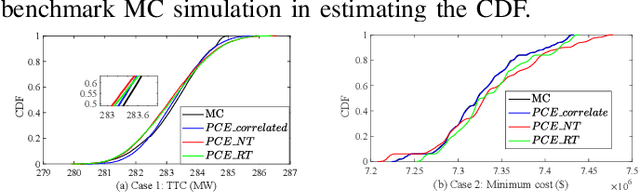
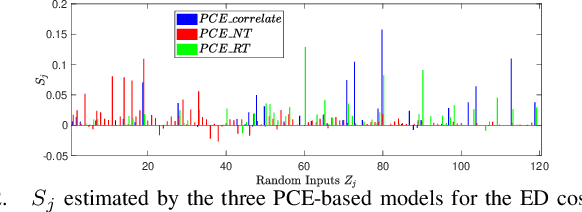
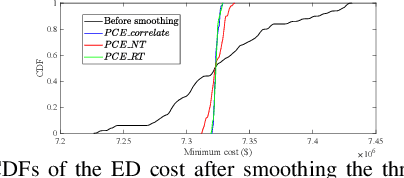
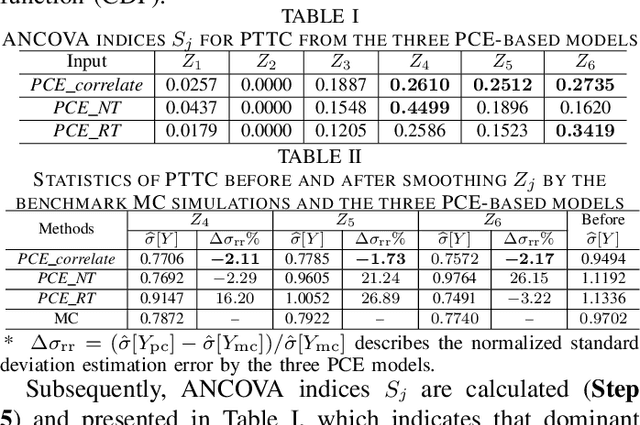
In this letter, we compare three polynomial chaos expansion (PCE)-based methods for ANCOVA (ANalysis of COVAriance) indices based global sensitivity analysis for correlated random inputs in two power system applications. Surprisingly, the PCE-based models built with independent inputs after decorrelation may not give the most accurate ANCOVA indices, though this approach seems to be the most correct one and was applied in [1] in the field of civil engineering. In contrast, the PCE model built using correlated random inputs directly yields the most accurate ANCOVA indices for global sensitivity analysis. Analysis and discussions about the errors of different PCE-based models will also be presented. These results provide important guidance for uncertainty management and control in power system operation and security assessment.
A Data-Driven Uncertainty Quantification Method for Stochastic Economic Dispatch
Sep 16, 2021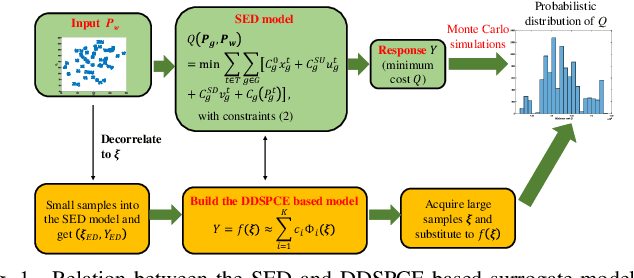
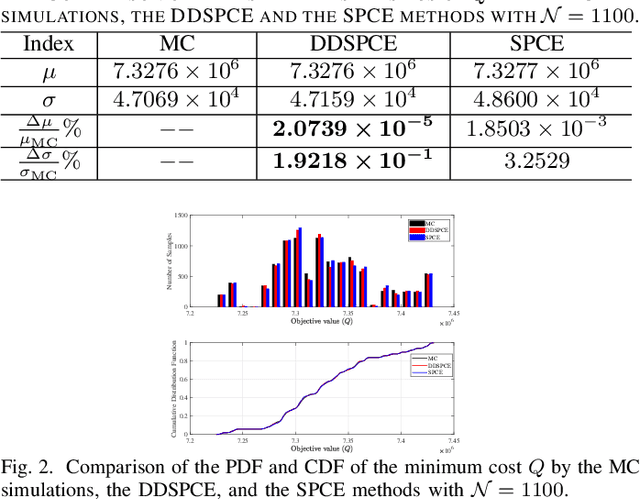
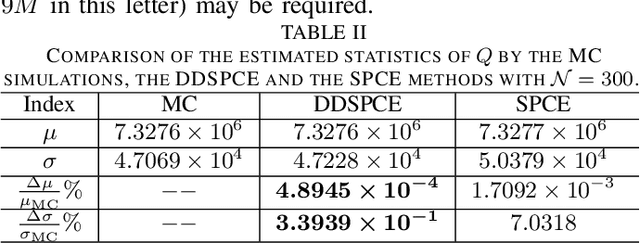
This letter proposes a data-driven sparse polynomial chaos expansion-based surrogate model for the stochastic economic dispatch problem considering uncertainty from wind power. The proposed method can provide accurate estimations for the statistical information (e.g., mean, variance, probability density function, and cumulative distribution function) for the stochastic economic dispatch solution efficiently without requiring the probability distributions of random inputs. Simulation studies on an integrated electricity and gas system (IEEE 118-bus system integrated with a 20-node gas system are presented, demonstrating the efficiency and accuracy of the proposed method compared to the Monte Carlo simulations.