 Add to Chrome
 Add to Firefox
 Add to Edge
Rule Based Learning with Dynamic (Graph) Neural Networks
Jun 14, 2024
A common problem of classical neural network architectures is that additional information or expert knowledge cannot be naturally integrated into the learning process. To overcome this limitation, we propose a two-step approach consisting of (1) generating rule functions from knowledge and (2) using these rules to define rule based layers -- a new type of dynamic neural network layer. The focus of this work is on the second step, i.e., rule based layers that are designed to dynamically arrange learnable parameters in the weight matrices and bias vectors depending on the input samples. Indeed, we prove that our approach generalizes classical feed-forward layers such as fully connected and convolutional layers by choosing appropriate rules. As a concrete application we present rule based graph neural networks (RuleGNNs) that overcome some limitations of ordinary graph neural networks. Our experiments show that the predictive performance of RuleGNNs is comparable to state-of-the-art graph classifiers using simple rules based on Weisfeiler-Leman labeling and pattern counting. Moreover, we introduce new synthetic benchmark graph datasets to show how to integrate expert knowledge into RuleGNNs making them more powerful than ordinary graph neural networks.

Maximal Closed Set and Half-Space Separations in Finite Closure Systems
Jan 13, 2020
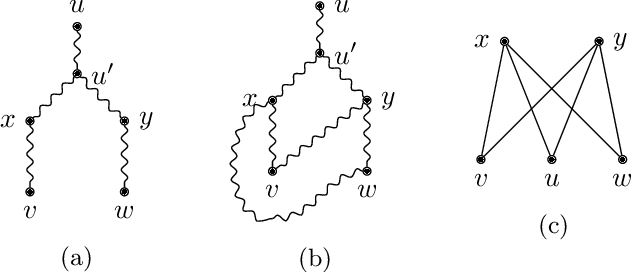
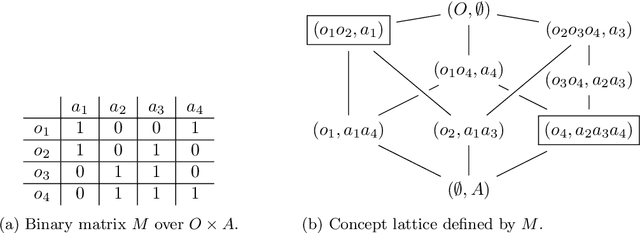
We investigate some algorithmic properties of closed set and half-space separation in abstract closure systems. Assuming that the underlying closure system is finite and given by the corresponding closure operator, we show that the half-space separation problem is NP-complete. In contrast, for the relaxed problem of maximal closed set separation we give a greedy algorithm using linear number of queries (i.e., closure operator calls) and show that this bound is sharp. For a second direction to overcome the negative result above, we consider Kakutani closure systems and prove that they are algorithmically characterized by the greedy algorithm. As one of the major potential application fields, we then focus on Kakutani closure systems over graphs and generalize a fundamental characterization result based on the Pasch axiom to graph structured partitioning of finite sets. In addition, we give a sufficient condition for Kakutani closure systems over graphs in terms of graph minors. For a second application field, we consider closure systems over finite lattices, present an adaptation of the generic greedy algorithm to this kind of closure systems, and consider two potential applications. We show that for the special case of subset lattices over finite ground sets, e.g., for formal concept lattices, its query complexity is only logarithmic in the size of the lattice. The second application is concerned with finite subsumption lattices in inductive logic programming. We show that our method for separating two sets of first-order clauses from each other extends the traditional approach based on least general generalizations of first-order clauses. Though our primary focus is on the generality of the results obtained, we experimentally demonstrate the practical usefulness of the greedy algorithm on binary classification problems in Kakutani and non-Kakutani closure systems.