 Add to Chrome
 Add to Firefox
 Add to Edge
Uncertainty-Aware Crossmodal Fusion for Classification of Animal Behavior
Aug 03, 2026
Artificial intelligence offers substantial potential for acoustic monitoring of animals, from welfare assessment in precision livestock farming to wildlife conservation and ecological research, where vocalizations can indicate health, stress, and social states earlier and at lower cost than manual observation. However, recordings in these settings are obtained under uncontrolled conditions, including environmental noise, reverberation, overlapping calls, and sensors that degrade without notice. As a consequence, automated classification of animal vocalizations remains challenging, and the two dominant acoustic representations show complementary limitations: raw waveforms preserve temporal microstructure but degrade under clipping and reverberation, while log-Mel spectrograms capture harmonic organization but lose phase information and are sensitive to broadband noise. To address these challenges, we propose Uncertainty-Aware Fusion (UAF), a dual-stream framework that estimates Gaussian uncertainty for each representation and fuses them via uncertainty weighting. This mechanism assigns greater weight to the more confident representation with no reliability labels required. In a cross-species, identity-based evaluation excluding all individuals seen during training, UAF (mean pooling) achieves 59.4\% accuracy / 39.7\% macro F1 on the 17-class SoundWel pig vocalization benchmark and 73.1\% accuracy / 71.5\% macro F1 on the 3-class DogBark dataset, outperforming static-concatenation fusion by 15.7\% and 20.4\% relative macro F1, respectively. Ablations over four temporal aggregation strategies show that uncertainty fusion, rather than the temporal characteristics of animal calls, is the primary driver of the performance gain.

Deep learning-based hierarchical insect classification using camera trap imagery
Jul 30, 2026Declining insect populations make reliable biodiversity monitoring increasingly urgent, yet monitoring of insect biodiversity is hampered by a lack of standardised data and by costly and time-consuming manual identification by expert entomologists. Deep learning-based image classifiers, processing data from automated non-lethal camera traps, have the potential to transform and scale insect biodiversity monitoring. However, challenges remain in acquiring expert-annotated datasets, developing model architectures that generalise well across diverse taxonomic levels and training models on highly imbalanced data. Hierarchical data also benefits from designing models that default to higher-confidence, coarser-level predictions, when uncertain about finer taxonomic levels. In this paper we address these challenges with a deep learning-based hierarchical classification model. First, we present a manually curated, long-tailed dataset of around one million images of insects, extracted from 1,801 camera-trap video recordings and annotated with a five-level, 34-class hierarchy. Further, we adapt a hierarchical classification model architecture to a five-level variable-depth hierarchy, with class-balanced weighting. Our model improves on non-hierarchical classifiers by leveraging biological taxonomy to extract granularity-specific visual features and makes hierarchy-consistent predictions to the deepest taxonomic level that meets a confidence threshold (T = 0.6). Our model achieved a per-level accuracy of 80-99% on test data, across five levels of hierarchy. Furthermore ...
FETS Benchmark: Foundation Models Outperform Dataset-specific Machine Learning in Energy Time Series Forecasting
Apr 24, 2026Driven by the transition towards a climate-neutral energy system, accurate energy time series forecasting is critical for planning and operation. Yet, it remains largely a dataset-specific task, requiring comprehensive training data, limiting scalability, and resulting in high model development and maintenance effort. Recently, foundation models that aim to learn generalizable patterns via extensive pretraining have shown superior performance in multiple prediction tasks. Despite their success and strong potential to address challenges in energy forecasting, their application in this domain remains largely unexplored. We address this gap by presenting the Foundation Models in Energy Time Series Forecasting (FETS) benchmark. We (1) provide a structured overview of energy forecasting use cases along three main dimensions: stakeholders, attributes, and data categories; (2) collect and analyze 54 datasets across 9 data categories, guided by typical stakeholder interests; (3) benchmark foundation models against classical machine learning approaches across different forecasting settings. Foundation models consistently outperform dataset-specific optimized machine learning approaches across all settings and data categories, despite the latter having seen the full historic target data during training. In particular, covariate-informed foundation models achieve the strongest performance. Further analysis reveals a strong correlation between predictive performance and spectral entropy, performance saturation beyond a certain context length, and improved performance at higher aggregation levels such as national load, district heating, and power grid data. Overall, our findings highlight the strong potential of foundation models as scalable and generalizable forecasting solutions for the energy domain, particularly in data-constrained and privacy-sensitive settings.
EVARS-GPR: EVent-triggered Augmented Refitting of Gaussian Process Regression for Seasonal Data
Jul 06, 2021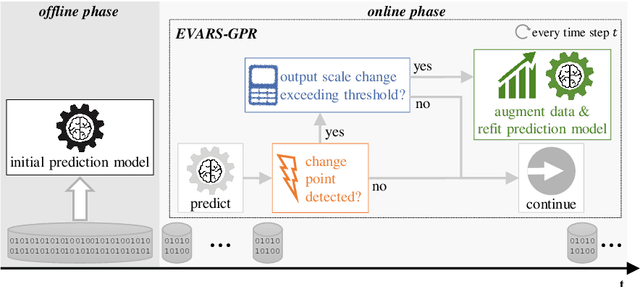
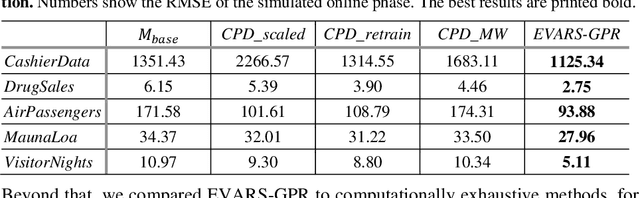
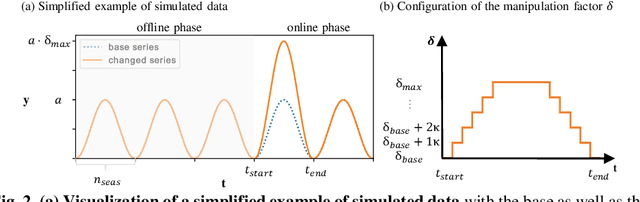
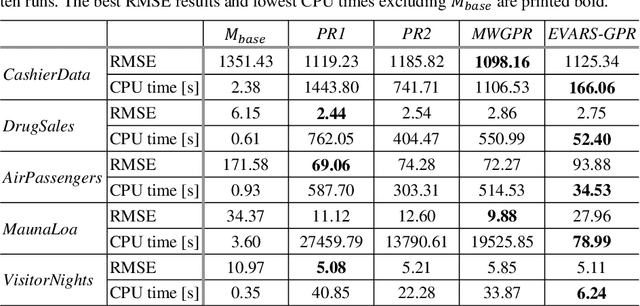
Time series forecasting is a growing domain with diverse applications. However, changes of the system behavior over time due to internal or external influences are challenging. Therefore, predictions of a previously learned fore-casting model might not be useful anymore. In this paper, we present EVent-triggered Augmented Refitting of Gaussian Process Regression for Seasonal Data (EVARS-GPR), a novel online algorithm that is able to handle sudden shifts in the target variable scale of seasonal data. For this purpose, EVARS-GPR com-bines online change point detection with a refitting of the prediction model using data augmentation for samples prior to a change point. Our experiments on sim-ulated data show that EVARS-GPR is applicable for a wide range of output scale changes. EVARS-GPR has on average a 20.8 % lower RMSE on different real-world datasets compared to methods with a similar computational resource con-sumption. Furthermore, we show that our algorithm leads to a six-fold reduction of the averaged runtime in relation to all comparison partners with a periodical refitting strategy. In summary, we present a computationally efficient online fore-casting algorithm for seasonal time series with changes of the target variable scale and demonstrate its functionality on simulated as well as real-world data. All code is publicly available on GitHub: https://github.com/grimmlab/evars-gpr.