 Add to Chrome
 Add to Firefox
 Add to Edge
Wasserstein Parallel Transport for Predicting the Dynamics of Statistical Systems
Mar 24, 2026
Many scientific systems, such as cellular populations or economic cohorts, are naturally described by probability distributions that evolve over time. Predicting how such a system would have evolved under different forces or initial conditions is fundamental to causal inference, domain adaptation, and counterfactual prediction. However, the space of distributions often lacks the vector space structure on which classical methods rely. To address this, we introduce a general notion of parallel dynamics at a distributional level. We base this principle on parallel transport of tangent dynamics along optimal transport geodesics and call it ``Wasserstein Parallel Trends''. By replacing the vector subtraction of classic methods with geodesic parallel transport, we can provide counterfactual comparisons of distributional dynamics in applications such as causal inference, domain adaptation, and batch-effect correction in experimental settings. The main mathematical contribution is a novel notion of fanning scheme on the Wasserstein manifold that allows us to efficiently approximate parallel transport along geodesics while also providing the first theoretical guarantees for parallel transport in the Wasserstein space. We also show that Wasserstein Parallel Trends recovers the classic parallel trends assumption for averages as a special case and derive closed-form parallel transport for Gaussian measures. We deploy the method on synthetic data and two single-cell RNA sequencing datasets to impute gene-expression dynamics across biological systems.

disco: Distributional Synthetic Controls
Jan 15, 2025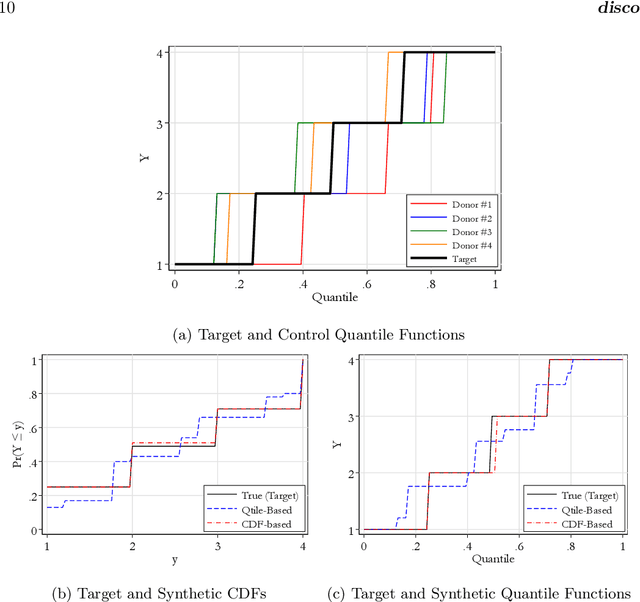
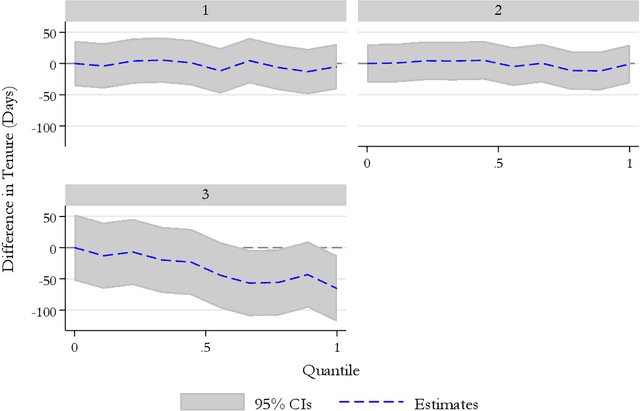
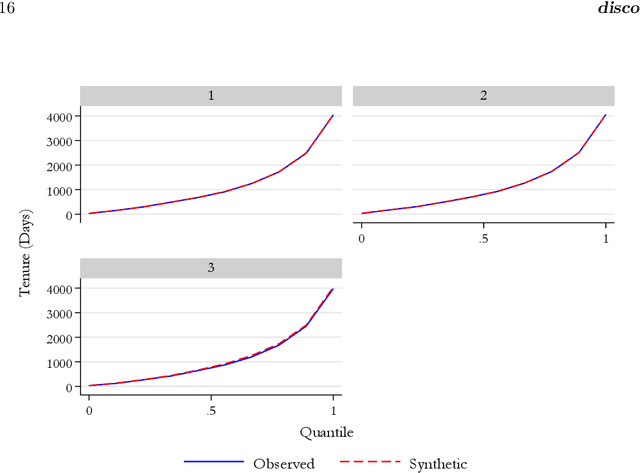
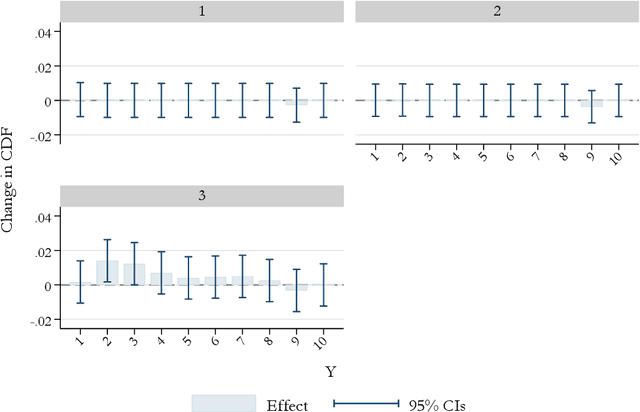
The method of synthetic controls is widely used for evaluating causal effects of policy changes in settings with observational data. Often, researchers aim to estimate the causal impact of policy interventions on a treated unit at an aggregate level while also possessing data at a finer granularity. In this article, we introduce the new disco command, which implements the Distributional Synthetic Controls method introduced in Gunsilius (2023). This command allows researchers to construct entire synthetic distributions for the treated unit based on an optimally weighted average of the distributions of the control units. Several aggregation schemes are provided to facilitate clear reporting of the distributional effects of the treatment. The package offers both quantile-based and CDF-based approaches, comprehensive inference procedures via bootstrap and permutation methods, and visualization capabilities. We empirically illustrate the use of the package by replicating the results in Van Dijcke et al. (2024).
Free Discontinuity Design: With an Application to the Economic Effects of Internet Shutdowns
Sep 26, 2023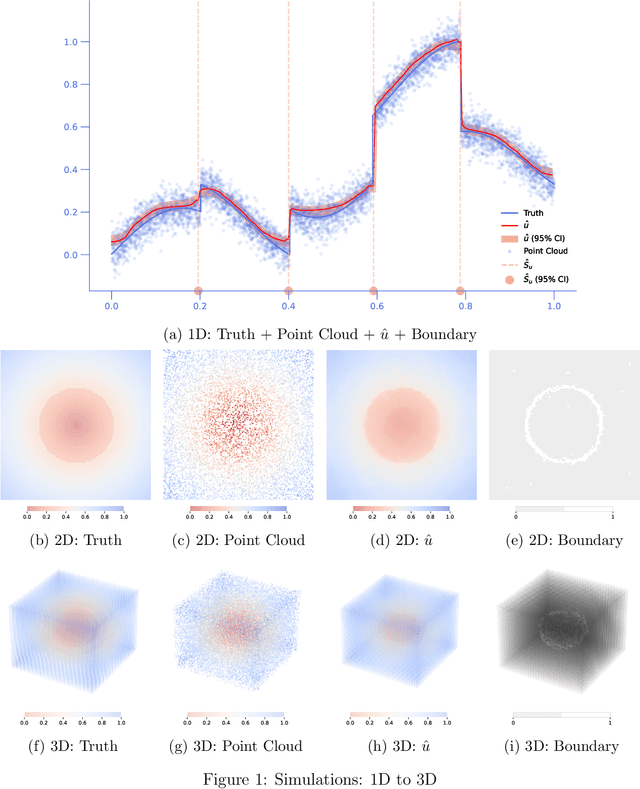
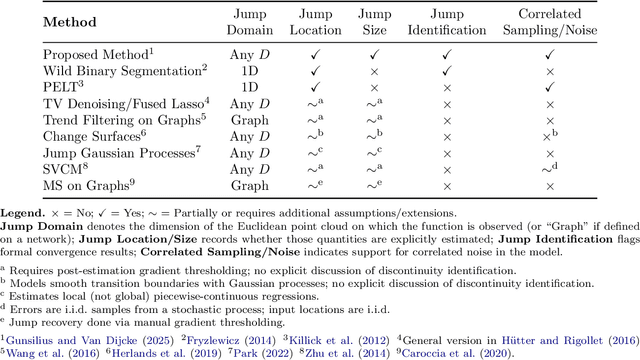
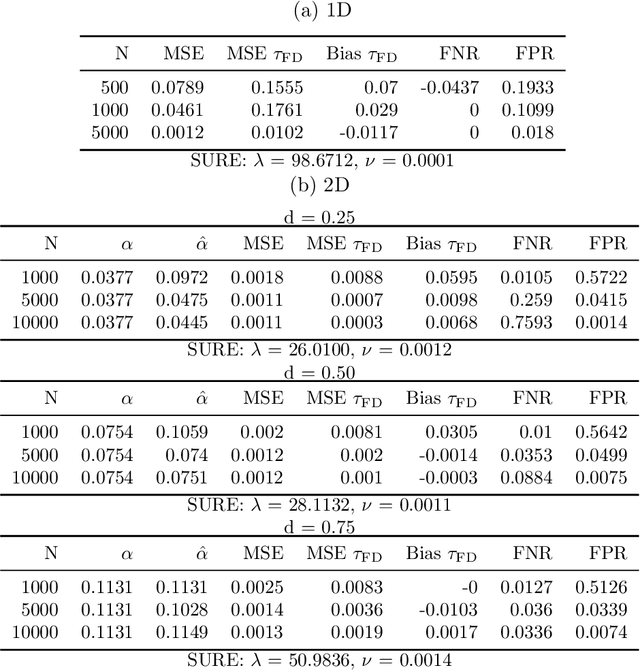
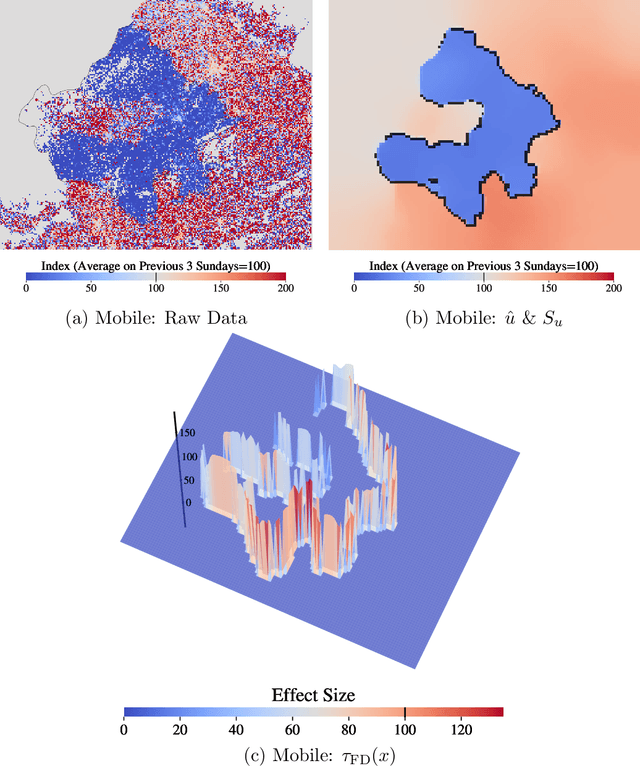
Thresholds in treatment assignments can produce discontinuities in outcomes, revealing causal insights. In many contexts, like geographic settings, these thresholds are unknown and multivariate. We propose a non-parametric method to estimate the resulting discontinuities by segmenting the regression surface into smooth and discontinuous parts. This estimator uses a convex relaxation of the Mumford-Shah functional, for which we establish identification and convergence. Using our method, we estimate that an internet shutdown in India resulted in a reduction of economic activity by over 50%, greatly surpassing previous estimates and shedding new light on the true cost of such shutdowns for digital economies globally.
Tangential Wasserstein Projections
Aug 02, 2022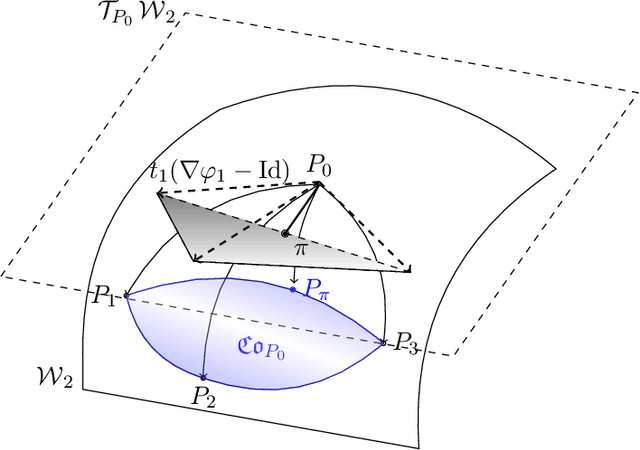


We develop a notion of projections between sets of probability measures using the geometric properties of the 2-Wasserstein space. It is designed for general multivariate probability measures, is computationally efficient to implement, and provides a unique solution in regular settings. The idea is to work on regular tangent cones of the Wasserstein space using generalized geodesics. Its structure and computational properties make the method applicable in a variety of settings, from causal inference to the analysis of object data. An application to estimating causal effects yields a generalization of the notion of synthetic controls to multivariate data with individual-level heterogeneity, as well as a way to estimate optimal weights jointly over all time periods.
Matching for causal effects via multimarginal optimal transport
Dec 08, 2021

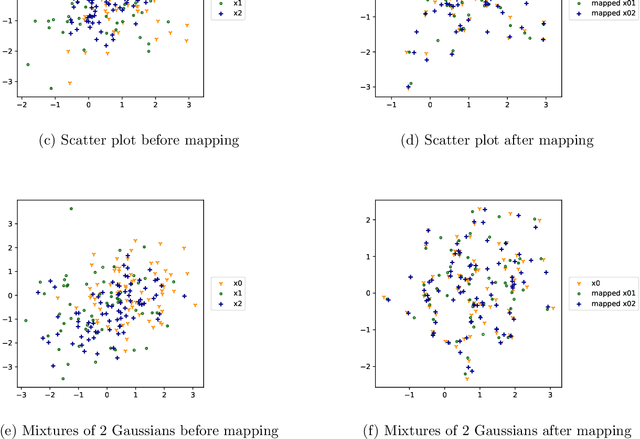
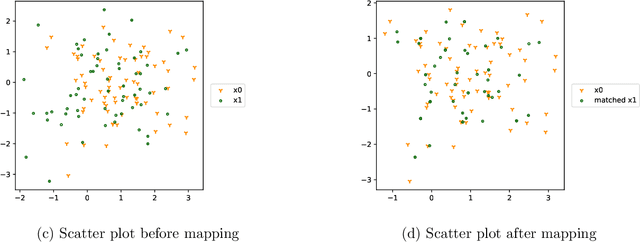
Matching on covariates is a well-established framework for estimating causal effects in observational studies. The principal challenge in these settings stems from the often high-dimensional structure of the problem. Many methods have been introduced to deal with this challenge, with different advantages and drawbacks in computational and statistical performance and interpretability. Moreover, the methodological focus has been on matching two samples in binary treatment scenarios, but a dedicated method that can optimally balance samples across multiple treatments has so far been unavailable. This article introduces a natural optimal matching method based on entropy-regularized multimarginal optimal transport that possesses many useful properties to address these challenges. It provides interpretable weights of matched individuals that converge at the parametric rate to the optimal weights in the population, can be efficiently implemented via the classical iterative proportional fitting procedure, and can even match several treatment arms simultaneously. It also possesses demonstrably excellent finite sample properties.