 Add to Chrome
 Add to Firefox
 Add to Edge
A Benchmark for Strategic Auditee Gaming Under Continuous Compliance Monitoring
May 07, 2026
Continuous post-deployment compliance audits, mandated by emerging regulations such as the EU AI Act and Digital Services Act, create a class of strategic gaming distinct from the one-shot input/output gaming studied in prior work. Regulated systems can delay outcome reporting, drift their reports within plausible noise envelopes, exploit longitudinal sample attrition, and cherry-pick among ambiguous metric definitions. We formalize continuous auditing as a $T$-round Stackelberg game between an auditor that commits to a temporal policy and an adaptive auditee, and identify a structural feature of any noise-aware static-auditor design: a cover regime in which coverage gaps and granularity gaps cannot be closed simultaneously. We make this formal as Observation 1 and show that two minimal extension policies, each derived from the observation, close the regime along orthogonal axes: a sample-size-aware static rule (Periodic-with-floor) closes the granularity-failure case, while a history-conditioned suspicion-escalation policy closes the coverage-failure case for the naive Drift strategy -- and neither closes both, exactly as the observation predicts; an audit-aware OffAuditDrift strategy that exploits Stackelberg commitment defeats both. To support empirical study we contribute a non-additive harm decomposition (welfare loss $W$, coverage loss $C$) that exposes how attrition shifts harm from the regulator-accountable surface to a regulator-invisible one; an initial library of five auditee strategies (Delay, Drift, Cherry-pick, Attrition, OffAuditDrift) and five auditor policies, calibrated to summary statistics from published audits of the DSA Transparency Database; and a reproducible simulator with a small, extensible Python interface.

Measuring Evaluation-Context Divergence in Open-Weight LLMs: A Paired-Prompt Protocol with Pilot Evidence of Alignment-Pipeline-Specific Heterogeneity
May 07, 2026Safety benchmarks are routinely treated as evidence about how a language model will behave once deployed, but this inference is fragile if behavior depends on whether a prompt looks like an evaluation. We define evaluation-context divergence as an observable within-item change in behavior induced by framing a fixed task as an evaluation, a live deployment interaction, or a neutral request, and present a paired-prompt protocol that measures it in open-weight LLMs while controlling for paraphrase variation, benchmark familiarity, and judge framing-sensitivity. Across five instruction-tuned checkpoints from four open-weight families plus a matched OLMo-3 base/instruct ablation ($20$ paired items, $840$ generations per checkpoint), we find striking heterogeneity. OLMo-3-Instruct alone is eval-cautious -- evaluation framing raises refusal vs. neutral by $11.8$pp ($p=0.007$) and reduces harmful compliance vs. deployment by $3.6$pp ($p=0.024$, $0/20$ items inverted) -- while Mistral-Small-3.2, Phi-3.5-mini, and Llama-3.1-8B are deployment-cautious}, with marginal eval-vs-deployment refusal effects of $-9$ to $-20$pp. The matched OLMo-3 base also exhibits the deployment-cautious pattern, identifying alignment as the inversion stage; within Llama-3.1, the $70$B model preserves direction with attenuated magnitude, ruling out a simple ``small-model effect that reverses at scale.'' One caveat: the cross-family heterogeneity is judge-dependent. Re-judging with a different-family safety classifier (Llama-Guard-3-8B) preserves the within-OLMo eval-cautious direction but flattens the cross-family contrast, indicating that the two judges operationalize distinct constructs.
Gaming the Metric, Not the Harm: Certifying Safety Audits against Strategic Platform Manipulation
May 07, 2026Online-safety regulation under the UK Online Safety Act and the EU Digital Services Act increasingly treats scalar metrics as compliance evidence. Once announced, such a metric also becomes an optimization target: a strategic platform can improve its score by routing recommendations through semantically equivalent content variants, without reducing true harm. We ask when such an audit metric can still certify a genuine reduction in harm. The protocol is modeled as a published transformation graph whose connected components form semantic classes, and the metric itself is treated as a security object. Three results follow. First, any metric that scores variants directly is manipulable as soon as two equivalent variants in a harmful class disagree in score. Second, the semantic-envelope lift, which assigns each variant the maximum score in its class, is the unique pointwise minimum among conservative classwise-constant repairs. Third, a class-stratified certificate, $H^\star(x) \le (1/\hatα) M_{\mathrm{Env}(m)}(x) + \barη$, holds for every platform strategy, with $\barη$ absorbing annotation and protocol error. We check the claims at three levels: exhaustive enumeration on a finite-state grid of mixed strategies, an SMT encoding in Z3 cross-replayed in cvc5, and a bounded single-player MDP encoded in PRISM-games. The fragile metric fails manipulation invariance and cannot support the same useful predeclared class-coverage certificate; under the envelope-level certificate, it produces large violations at every tested instance, with a large mean gaming gap across random catalogs at a fixed audit budget. The semantic-envelope metric exhibits no such violation in the tested instances.
QUIVER: Cost-Aware Adaptive Preference Querying in Surrogate-Assisted Evolutionary Multi-Objective Optimization
May 05, 2026Interactive multi-objective optimization systems face a budget allocation dilemma: one can spend resources on expensive objective evaluations or on eliciting decision-maker preferences that identify the relevant region of the Pareto set. Moreover, preference elicitation itself spans modalities with different information content and cognitive burden, ranging from cheap, noisy pairwise preference statements (PS) to richer but costlier indifference adjustments (IA). We study cost-aware optimization under an unknown scalarization and introduce QUIVER (Query-Informed Value Estimation for Regret), a surrogate-assisted evolutionary multi-objective optimizer that adaptively chooses between objective evaluations and heterogeneous preference queries. At each step, QUIVER selects the next action by maximizing the expected decision-quality improvement per unit total cost. Across DTLZ and WFG benchmarks under synthetic decision-maker models, QUIVER achieves the lowest final utility regret on challenging WFG problems (utility regret of 2.14 on WFG4, 2.82 on WFG9: a 25% improvement over baselines), outperforming all single-modality baselines. We analyze how the optimal mix of PS and IA adapts to problem difficulty: on easy problems (DTLZ2), QUIVER selects 80\% PS queries; on hard problems (WFG9), it shifts to 35% IA queries. This adaptive modality selection demonstrates cost-aware preference learning in action.
Regulatory gray areas of LLM Terms
Jan 13, 2026Large Language Models (LLMs) are increasingly integrated into academic research pipelines; however, the Terms of Service governing their use remain under-examined. We present a comparative analysis of the Terms of Service of five major LLM providers (Anthropic, DeepSeek, Google, OpenAI, and xAI) collected in November 2025. Our analysis reveals substantial variation in the stringency and specificity of usage restrictions for general users and researchers. We identify specific complexities for researchers in security research, computational social sciences, and psychological studies. We identify `regulatory gray areas' where Terms of Service create uncertainty for legitimate use. We contribute a publicly available resource comparing terms across platforms (OSF) and discuss implications for general users and researchers navigating this evolving landscape.
The Accountability Paradox: How Platform API Restrictions Undermine AI Transparency Mandates
May 16, 2025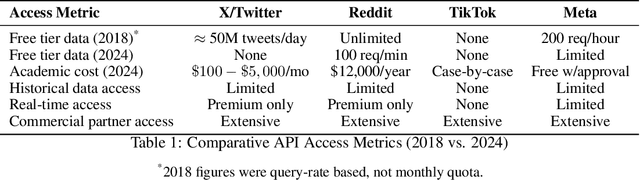

Recent application programming interface (API) restrictions on major social media platforms challenge compliance with the EU Digital Services Act [20], which mandates data access for algorithmic transparency. We develop a structured audit framework to assess the growing misalignment between regulatory requirements and platform implementations. Our comparative analysis of X/Twitter, Reddit, TikTok, and Meta identifies critical ``audit blind-spots'' where platform content moderation and algorithmic amplification remain inaccessible to independent verification. Our findings reveal an ``accountability paradox'': as platforms increasingly rely on AI systems, they simultaneously restrict the capacity for independent oversight. We propose targeted policy interventions aligned with the AI Risk Management Framework of the National Institute of Standards and Technology [80], emphasizing federated access models and enhanced regulatory enforcement.