 Add to Chrome
 Add to Firefox
 Add to Edge
Automated Testbed for Repeatable Evaluation of Ultra-Wideband Localization Performance
Mar 04, 2026
Testing Ultra-Wideband (UWB) systems is challenging, as multiple devices need to coordinate over lossy links and the systems' behavior is influenced by timing, synchronization, and environmental factors. Traditional testing is often insufficient to capture these complex interactions, highlighting the need for an overarching testbed infrastructure that can manage devices, control the environment, and make measurements and test scenarios repeatable. In this work, we present a highly automated testbed architecture built on Robot Operating System Version 2, integrating device management with environmental control and measurement systems. It includes an optical reference system, a controllable Autonomous Guided Vehicle to position devices within the environment, and time synchronization via Network Time Protocol (NTP). The testbed achieves a Root Mean Squared Error of 4.8 mm for positioning repeatability and 0.493$°$ for the orientation, and our NTP-based synchronization approach achieves a timing accuracy of below 1 ms. All testbed functionality can be controlled remotely through simple Python scripts to allow automated orchestration tasks such as conducting complex measurement scenarios. We demonstrate this with a measurement campaign on UWB localization, showing how it enables repeatable, observable, and fully controlled wireless experiments.

Robust Localization of Key Fob Using Channel Impulse Response of Ultra Wide Band Sensors for Keyless Entry Systems
Jan 16, 2024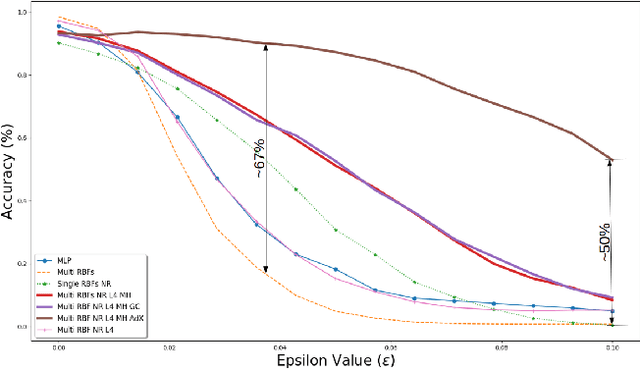
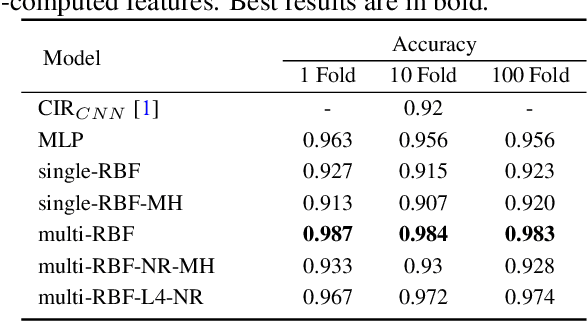
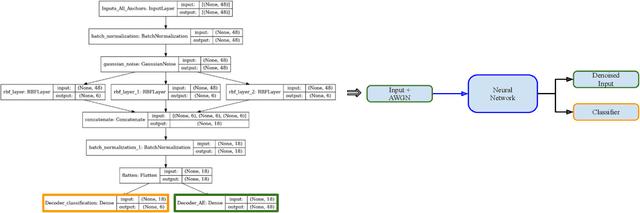
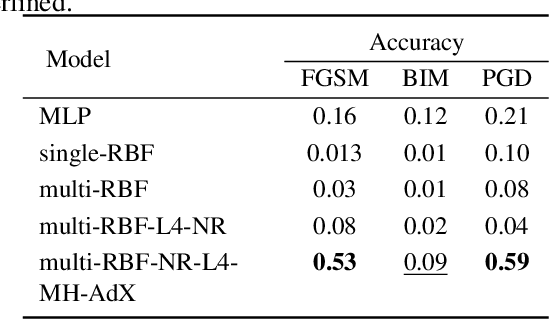
Using neural networks for localization of key fob within and surrounding a car as a security feature for keyless entry is fast emerging. In this paper we study: 1) the performance of pre-computed features of neural networks based UWB (ultra wide band) localization classification forming the baseline of our experiments. 2) Investigate the inherent robustness of various neural networks; therefore, we include the study of robustness of the adversarial examples without any adversarial training in this work. 3) Propose a multi-head self-supervised neural network architecture which outperforms the baseline neural networks without any adversarial training. The model's performance improved by 67% at certain ranges of adversarial magnitude for fast gradient sign method and 37% each for basic iterative method and projected gradient descent method.