 Add to Chrome
 Add to Firefox
 Add to Edge
Geometric Self-Supervised Pre-training for Neural Combinatorial Optimization
Jul 31, 2026
Neural Combinatorial Optimization (NCO) techniques have emerged as a highly efficient alternative to traditional exact algorithms for solving routing problems such as the Traveling Salesman Problem (TSP). However, the generalization capabilities of these Reinforcement Learning-based models are severely hindered when scaling to high-dimensional instances. This issue has been mitigated in other domains, like computer vision and natural language processing, by adopting a self-supervised pre-training strategy. Nevertheless, its application to routing graphs, which lack complex topological attributes beyond 2D spatial coordinates, remains a challenge. In this paper, we propose a geometric self-supervised pre-training framework specifically designed to capture spatial invariance and global relative distance distributions. By applying isometric transformations, such as rotations and axial reflections, the model learns robust structural representations prior to the policy optimization phase. Empirical results demonstrate that this strategy consistently outperforms models trained from scratch (baselines), achieving a 7.23\% improvement in tour length for massive zero-shot extrapolation scenarios (TSP1,000). Furthermore, the proposed model exhibits remarkable computational efficiency, delivering speedups of up to two orders of magnitude over the exact solver Concorde at massive scales. The source code and pre-trained models are publicly available at https://github.com/davidaguadocosano/TSP-GeoPretrain.git.

On the Effectiveness of Pretraining for Graph Combinatorial Optimization
Jul 21, 2026This paper introduces a self-supervised pretraining framework for graph combinatorial optimization specifically designed to address the nature of routing problems like the Traveling Salesman Problem. By utilizing graph contrastive learning with geometric augmentations (specifically, rotations and axial reflections) the model is forced to learn invariant structural representations and global relative distance distributions. Results demonstrate that this pretraining strategy outperforms non-pretrained models across various problem scales. Notably, the hybrid strategy (combining rotation and reflection) achieved a 6.57% improvement in tour length for TSP1000, proving that geometric pretraining is an important inductive bias for effectively scaling neural solvers to high-dimensional instances.
Enhancing Transformer-based Routing by Encoding Distance via Relative Positional Encoding
Jul 21, 2026This paper explores Relative Positional Encoding (RPE) as an additive bias in Transformer architectures to solve the Team Orienteering Problem. By embedding in the attention mechanism pairwise spatial relationships among nodes of the graph that represents the routing problem, the transformer encoder can compute a richer spatial-aware graph embedding that allows the decoder to estimate better routes. Experimental results involving instances up to 100 nodes demonstrate consistent improvements in collected rewards and optimality gaps over vanilla Transformer architectures used by other state-of-the-art works. These findings highlight that explicit relational modeling significantly enhances scalability and generalization for complex combinatorial optimization.
Hand Trajectory Fusion for Egocentric Natural Language Query Grounding
Jun 01, 2026Egocentric Natural Language Query (NLQ) grounding asks a model to localize, in a long first-person video, the temporal interval that answers a free-form text query. Existing methods fuse video appearance with the query but ignore hand motion, despite the fact that roughly 41% of Ego4D NLQ queries are answered at a moment of hand--object manipulation or their immediate outcomes.We propose a hand-trajectory encoder for converting a sequence of hand skeletons into highly-semantic hand kinematic features, which are then aligned and combined with pretrained video--text features through a cross-attention fusion strategy with adaptive gating. On the Ego4D NLQ v2 validation split, the clearest gains appear for Hand-Object Interaction queries (+2.54 R1@IoU=0.3) and Quantity/State queries (+4.32 R1@IoU=0.3), indicating that hand trajectory provides grounding cues beyond appearance alone.
AnimalMotionCLIP: Embedding motion in CLIP for Animal Behavior Analysis
Apr 30, 2025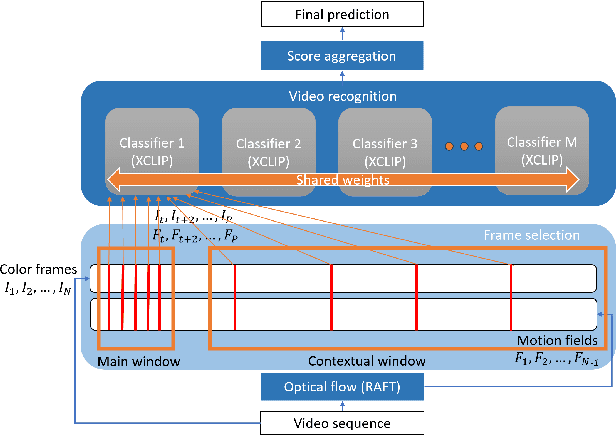
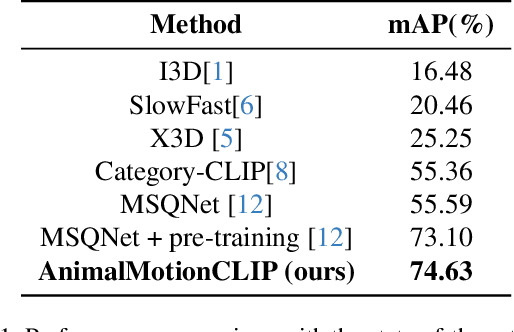
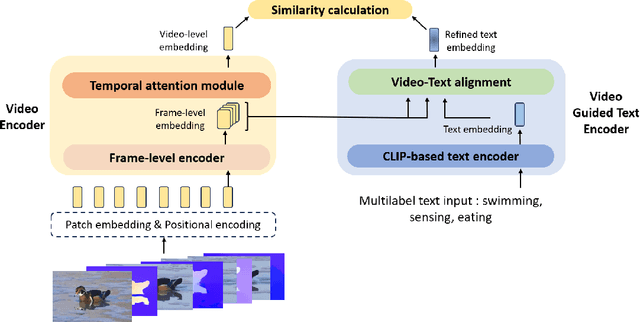
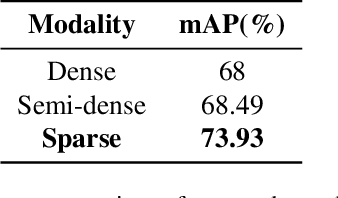
Recently, there has been a surge of interest in applying deep learning techniques to animal behavior recognition, particularly leveraging pre-trained visual language models, such as CLIP, due to their remarkable generalization capacity across various downstream tasks. However, adapting these models to the specific domain of animal behavior recognition presents two significant challenges: integrating motion information and devising an effective temporal modeling scheme. In this paper, we propose AnimalMotionCLIP to address these challenges by interleaving video frames and optical flow information in the CLIP framework. Additionally, several temporal modeling schemes using an aggregation of classifiers are proposed and compared: dense, semi dense, and sparse. As a result, fine temporal actions can be correctly recognized, which is of vital importance in animal behavior analysis. Experiments on the Animal Kingdom dataset demonstrate that AnimalMotionCLIP achieves superior performance compared to state-of-the-art approaches.
A Video-Aware FEC-Based Unequal Loss Protection System for Video Streaming over RTP
Feb 07, 2024
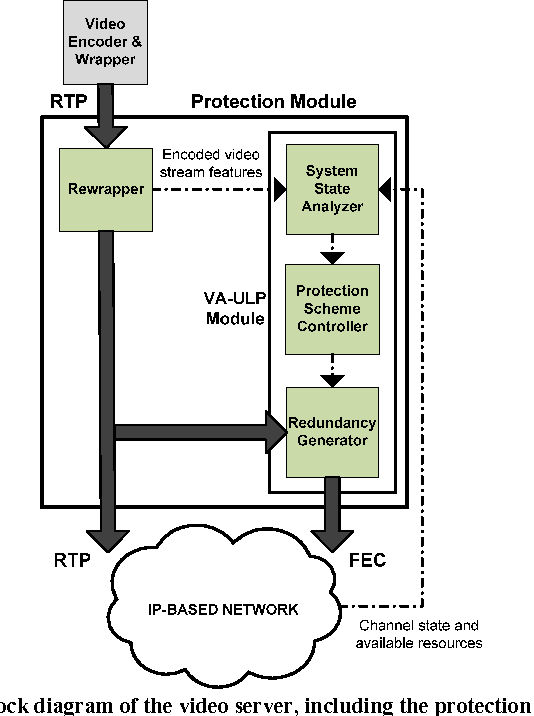
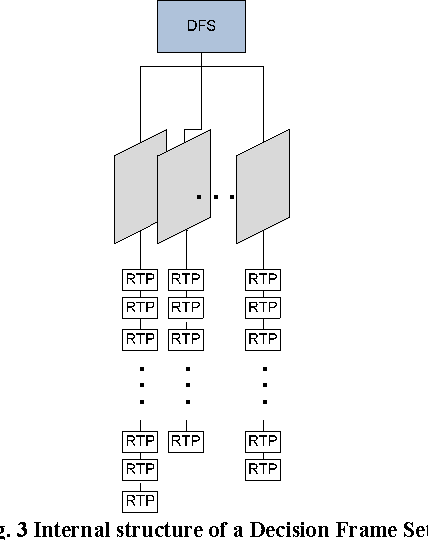
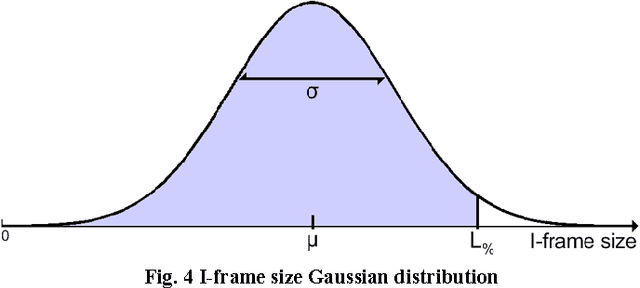
A video-aware unequal loss protection (ULP) system for protecting RTP video streaming in bursty packet loss networks is proposed. Considering the relevance of the frame, the state of the channel, and the bitrate constraints of the protection bitstream, our algorithm selects in real time the most suitable frames to be protected through forward error protection (FEC) techniques. It benefits from a wise RTP encapsulation that allows working at a frame level without requiring any further process than that of parsing RTP headers. This makes our system straightforward and fast, perfectly suitable to be included in commercial video streaming servers. Simulation results show how our technique outperforms other proposed ULP schemes.
Application-Layer FEC Scheme Configuration Optimization via Hybrid Simulated Annealing
Feb 07, 2024An optimization technique based on an adapted combination of simulated annealing (SA) and tabu search (TS) is presented. This method aims at finding near-optimal unequal error protection (UEP) application-layer FEC code configurations. This approach is intended to smartly protect audio and video transmission over IP networks when hard time restrictions apply. The considered code is a UEP version of the widely-used Pro-MPEG COP3 codes enabling the use of several matrices of dissimilar size and thus of unequal recovery capability. Finding the optimal configuration frequently requires the evaluation of a large solution space. So, to fulfill the imposed constraints, SA is adapted to the specifics of the scenario. In particular, the annealing schedule is conditioned by the real-time restrictions. Furthermore, solution neighborhood structures are determined by a proposed definition of distance between protection configurations, which, jointly with TS, conditions the selection of candidate solutions. Experimental results show a significantly improved performance of the optimization process, which invariably fulfills imposed timing constraints, at the expense of a very low distortion increase, when compared to using exhaustive search. These results allow the use of UEP Pro-MPEG COP3 codes for protecting video and audio transmission, which distinctly outperforms the standard code in a wide range of scenarios.
Solving the Team Orienteering Problem with Transformers
Dec 01, 2023


Route planning for a fleet of vehicles is an important task in applications such as package delivery, surveillance, or transportation. This problem is usually modeled as a Combinatorial Optimization problem named as Team Orienteering Problem. The most popular Team Orienteering Problem solvers are mainly based on either linear programming, which provides accurate solutions by employing a large computation time that grows with the size of the problem, or heuristic methods, which usually find suboptimal solutions in a shorter amount of time. In this paper, a multi-agent route planning system capable of solving the Team Orienteering Problem in a very fast and accurate manner is presented. The proposed system is based on a centralized Transformer neural network that can learn to encode the scenario (modeled as a graph) and the context of the agents to provide fast and accurate solutions. Several experiments have been performed to demonstrate that the presented system can outperform most of the state-of-the-art works in terms of computation speed. In addition, the code is publicly available at http://gti.ssr.upm.es/data.