 Add to Chrome
 Add to Firefox
 Add to Edge
Learning Physics-Informed Surrogate Model of Linear Elastic Displacement Fields from Geometry
Jul 10, 2026
This work aims to develop a fast and physically consistent surrogate model for real-time structural health monitoring of fractured elastic domains. We propose a physics-informed DeepONet framework that predicts displacement fields from both boundary conditions and fracture geometry, using a dedicated encoding strategy for the latter and without relying on finite-element-generated training data. The traction-free condition on the fracture boundary is imposed weakly through a localized penalty term. The presented numerical example focuses on one representative fracture geometry, demonstrating the feasibility of the formulation and laying the groundwork for extensions to surrogate modeling across diverse fracture geometries.

Fault Detection and Monitoring using an Information-Driven Strategy: Method, Theory, and Application
May 06, 2024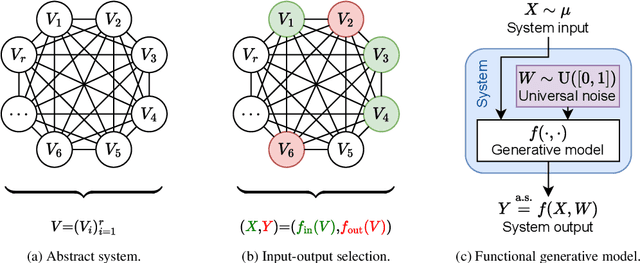
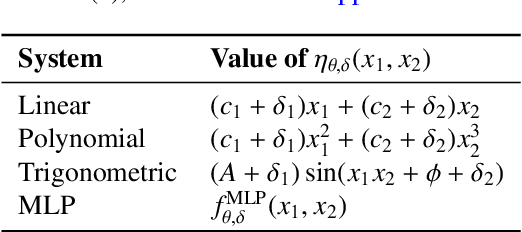
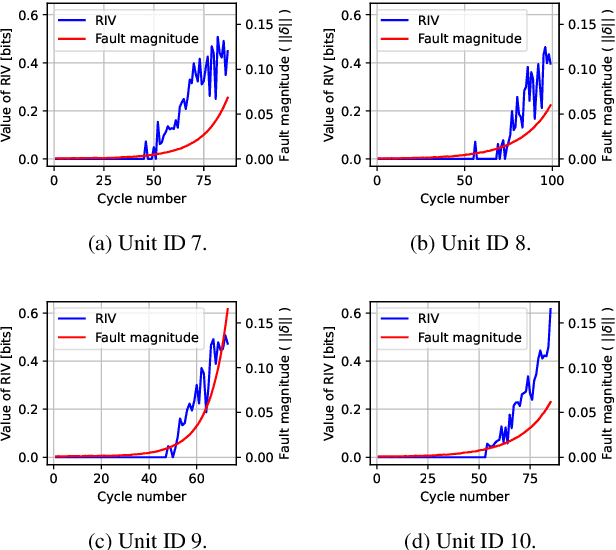
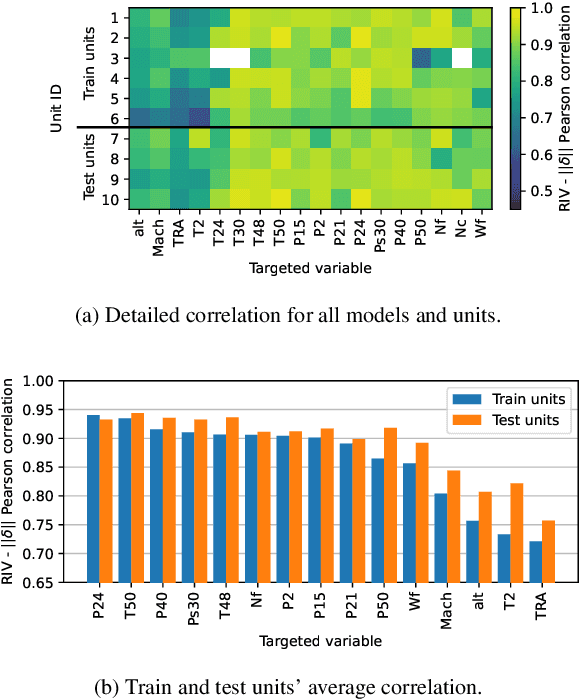
The ability to detect when a system undergoes an incipient fault is of paramount importance in preventing a critical failure. In this work, we propose an information-driven fault detection method based on a novel concept drift detector. The method is tailored to identifying drifts in input-output relationships of additive noise models (i.e., model drifts) and is based on a distribution-free mutual information (MI) estimator. Our scheme does not require prior faulty examples and can be applied distribution-free over a large class of system models. Our core contributions are twofold. First, we demonstrate the connection between fault detection, model drift detection, and testing independence between two random variables. Second, we prove several theoretical properties of the proposed MI-based fault detection scheme: (i) strong consistency, (ii) exponentially fast detection of the non-faulty case, and (iii) control of both significance levels and power of the test. To conclude, we validate our theory with synthetic data and the benchmark dataset N-CMAPSS of aircraft turbofan engines. These empirical results support the usefulness of our methodology in many practical and realistic settings, and the theoretical results show performance guarantees that other methods cannot offer.