 Add to Chrome
 Add to Firefox
 Add to Edge
Wasserstein Distributionally Robust Risk-Sensitive Estimation via Conditional Value-at-Risk
Apr 20, 2026
We propose a distributionally robust approach to risk-sensitive estimation of an unknown signal x from an observed signal y. The unknown signal and observation are modeled as random vectors whose joint probability distribution is unknown, but assumed to belong to a given type-2 Wasserstein ball of distributions, termed the ambiguity set. The performance of an estimator is measured according to the conditional value-at-risk (CVaR) of the squared estimation error. Within this framework, we study the problem of computing affine estimators that minimize the worst-case CVaR over all distributions in the given ambiguity set. As our main result, we show that, when the nominal distribution at the center of the Wasserstein ball is finitely supported, such estimators can be exactly computed by solving a tractable semidefinite program. We evaluate the proposed estimators on a wholesale electricity price forecasting task using real market data and show that they deliver lower out-of-sample CVaR of squared error compared to existing methods.

Distributionally Robust Regret Optimal Control Under Moment-Based Ambiguity Sets
Dec 11, 2025
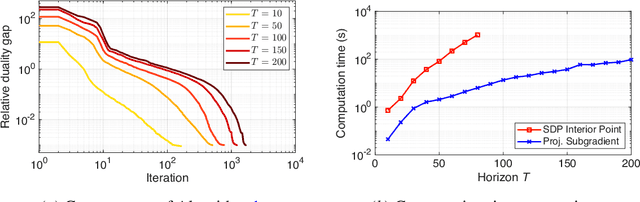
In this paper, we consider a class of finite-horizon, linear-quadratic stochastic control problems, where the probability distribution governing the noise process is unknown but assumed to belong to an ambiguity set consisting of all distributions whose mean and covariance lie within norm balls centered at given nominal values. To address the distributional ambiguity, we explore the design of causal affine control policies to minimize the worst-case expected regret over all distributions in the given ambiguity set. The resulting minimax optimal control problem is shown to admit an equivalent reformulation as a tractable convex program that corresponds to a regularized version of the nominal linear-quadratic stochastic control problem. While this convex program can be recast as a semidefinite program, semidefinite programs are typically solved using primal-dual interior point methods that scale poorly with the problem size in practice. To address this limitation, we propose a scalable dual projected subgradient method to compute optimal controllers to an arbitrary accuracy. Numerical experiments are presented to benchmark the proposed method against state-of-the-art data-driven and distributionally robust control design approaches.
A Distributionally Robust Approach to Regret Optimal Control using the Wasserstein Distance
Apr 13, 2023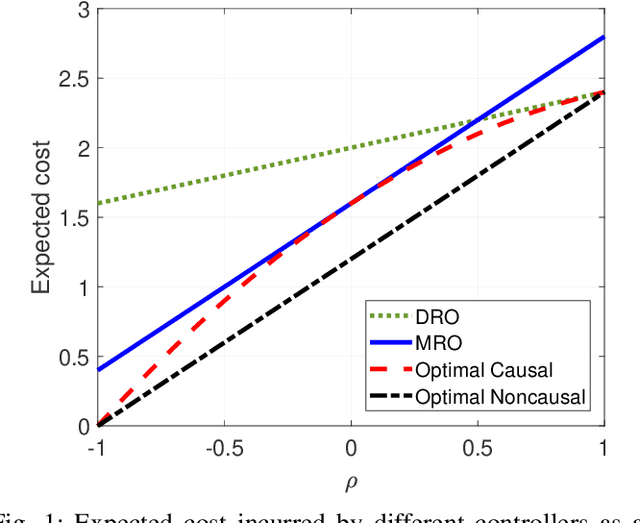
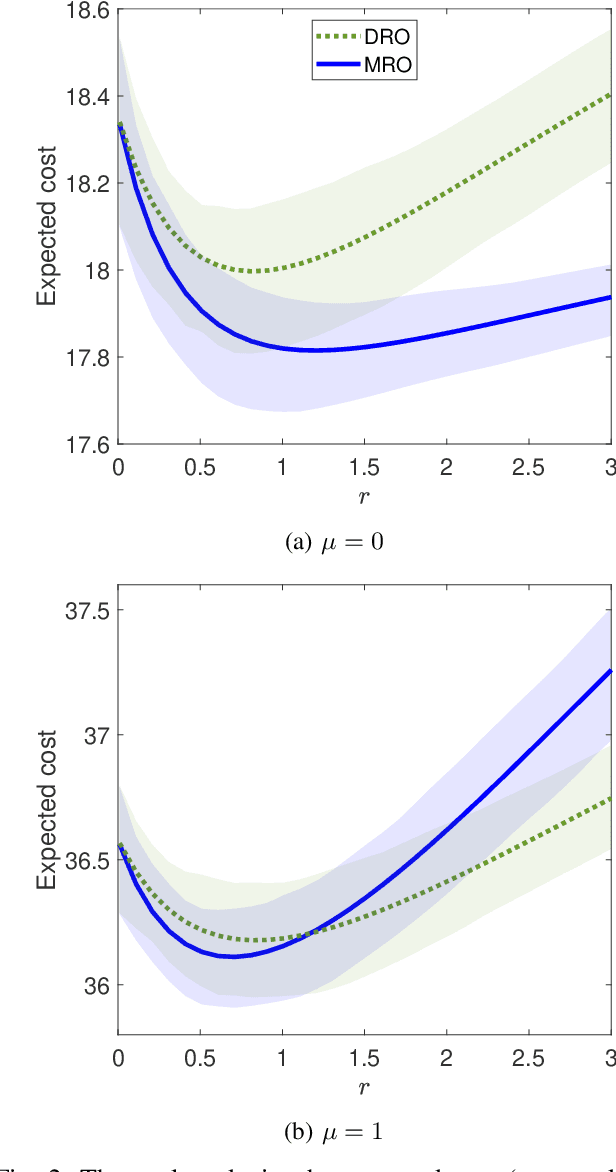
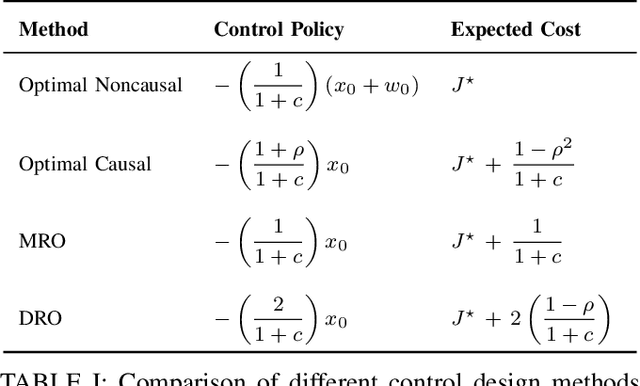
This paper proposes a distributionally robust approach to regret optimal control of discrete-time linear dynamical systems with quadratic costs subject to stochastic additive disturbance on the state process. The underlying probability distribution of the disturbance process is unknown, but assumed to lie in a given ball of distributions defined in terms of the type-2 Wasserstein distance. In this framework, strictly causal linear disturbance feedback controllers are designed to minimize the worst-case expected regret. The regret incurred by a controller is defined as the difference between the cost it incurs in response to a realization of the disturbance process and the cost incurred by the optimal noncausal controller which has perfect knowledge of the disturbance process realization at the outset. Building on a well-established duality theory for optimal transport problems, we show how to equivalently reformulate this minimax regret optimal control problem as a tractable semidefinite program. The equivalent dual reformulation also allows us to characterize a worst-case distribution achieving the worst-case expected regret in relation to the distribution at the center of the Wasserstein ball.