 Add to Chrome
 Add to Firefox
 Add to Edge
Parallax in angular sensitive powder diffraction tomography
Aug 30, 2024
While a few methods for the determination of depth-resolved strain distributions each with inherent limitations are available, tomographic reconstruction has been applied to this problem in only a limited sense. One of the challenges was the potential impact of geometric parallax, which constitutes a non-negligible lateral offset of diffraction information arising from different sample depths at the detector. Here, the effect of parallax was investigated and two main results have emerged. First, the impact of parallax was found to be additive to other offset contributions, which implies a straightforward correction. Second, for tomographic scans utilizing a full 360{\deg} rotation parallax has been found to have no impact on reconstructions of angular information.

Ptychographic reconstruction with wavefront initialization
May 22, 2022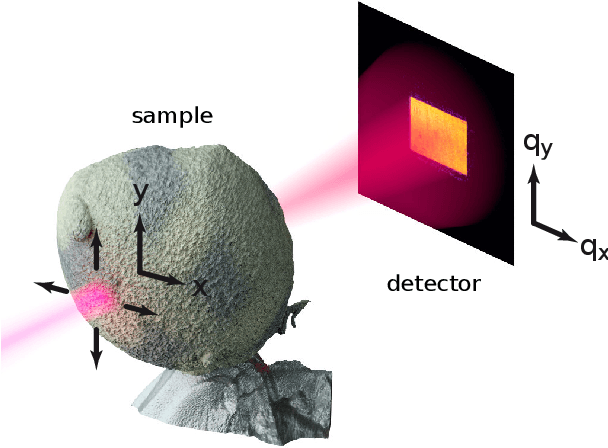
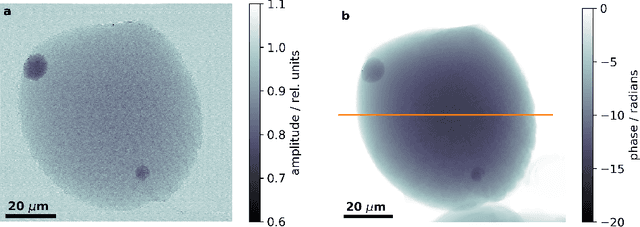
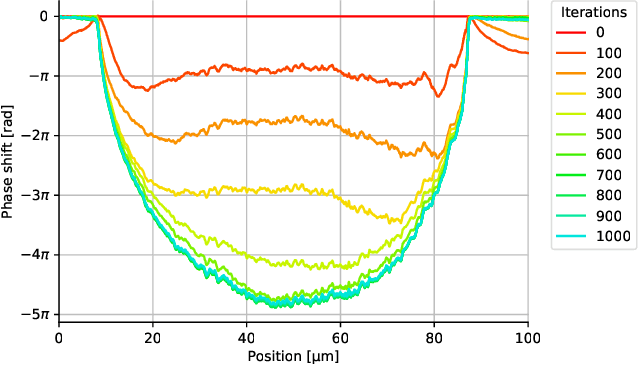
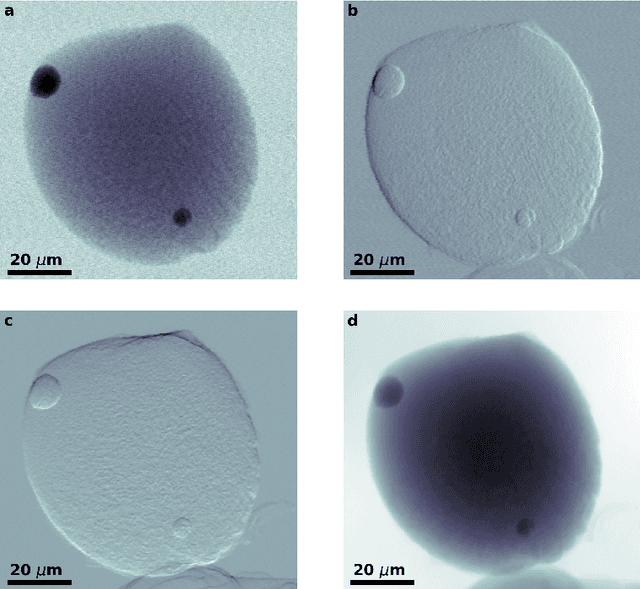
X-ray ptychography is a cutting edge imaging technique providing ultra-high spatial resolutions. In ptychography, phase retrieval, i.e., the recovery of a complex valued signal from intensity-only measurements, is enabled by exploiting a redundancy of information contained in diffraction patterns measured with overlapping illuminations. For samples that are considerably larger than the probe we show that during the iteration the bulk information has to propagate from the sample edges to the center. This constitutes an inherent limitation of reconstruction speed for algorithms that use a flat initialization. Here, we experimentally demonstrate that a considerable improvement of computational speed can be achieved by utilizing a low resolution sample wavefront retrieved from measured diffraction patterns as initialization. In addition, we show that this approach avoids phase singularity artifacts due to strong phase gradients. Wavefront initialization is computationally fast and compatible with non-bulky samples. Therefore, the presented approach is readily adaptable with established ptychographic reconstruction algorithms implying a wide spread use.