 Add to Chrome
 Add to Firefox
 Add to Edge
VDAWorld: World Modelling via VLM-Directed Abstraction and Simulation
Dec 11, 2025
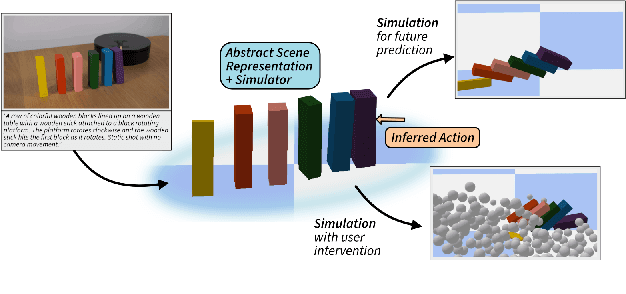
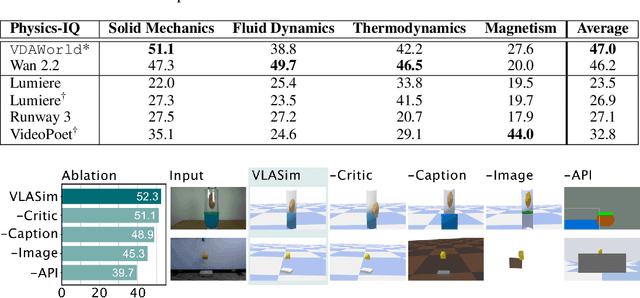
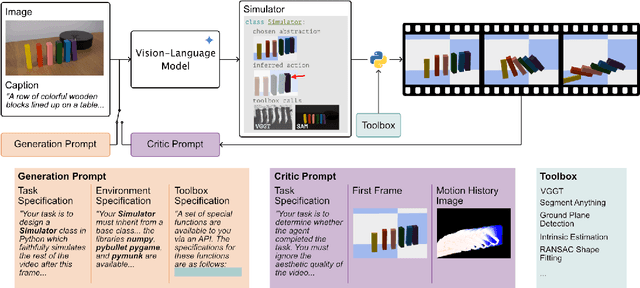
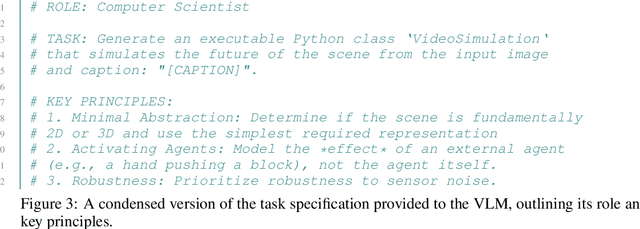
Generative video models, a leading approach to world modeling, face fundamental limitations. They often violate physical and logical rules, lack interactivity, and operate as opaque black boxes ill-suited for building structured, queryable worlds. To overcome these challenges, we propose a new paradigm focused on distilling an image caption pair into a tractable, abstract representation optimized for simulation. We introduce VDAWorld, a framework where a Vision-Language Model (VLM) acts as an intelligent agent to orchestrate this process. The VLM autonomously constructs a grounded (2D or 3D) scene representation by selecting from a suite of vision tools, and accordingly chooses a compatible physics simulator (e.g., rigid body, fluid) to act upon it. VDAWorld can then infer latent dynamics from the static scene to predict plausible future states. Our experiments show that this combination of intelligent abstraction and adaptive simulation results in a versatile world model capable of producing high quality simulations across a wide range of dynamic scenarios.

Color Equivariant Network
Jun 13, 2024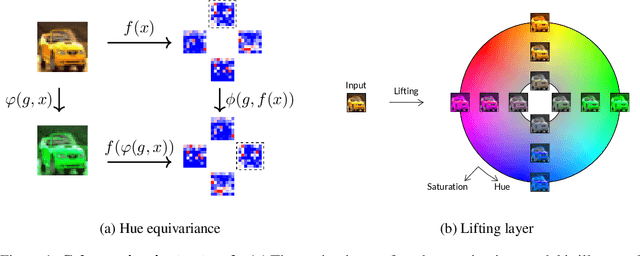
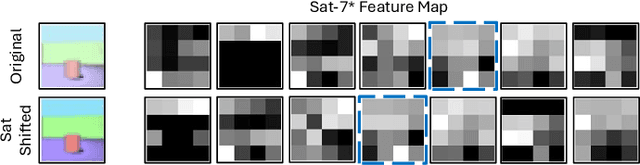

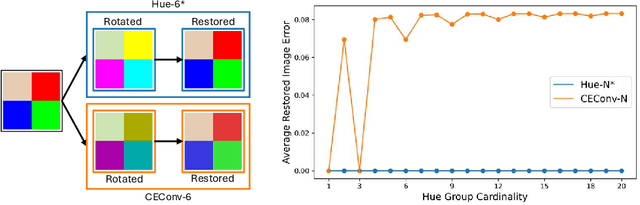
Group equivariant convolutional neural networks have been designed for a variety of geometric transformations from 2D and 3D rotation groups, to semi-groups such as scale. Despite the improved interpretability, accuracy and generalizability afforded by these architectures, group equivariant networks have seen limited application in the context of perceptual quantities such as hue and saturation, even though their variation can lead to significant reductions in classification performance. In this paper, we introduce convolutional neural networks equivariant to variations in hue and saturation by design. To achieve this, we leverage the observation that hue and saturation transformations can be identified with the 2D rotation and 1D translation groups respectively. Our hue-, saturation-, and fully color-equivariant networks achieve equivariance to these perceptual transformations without an increase in network parameters. We demonstrate the utility of our networks on synthetic and real world datasets where color and lighting variations are commonplace.