 Add to Chrome
 Add to Firefox
 Add to Edge
Topology-Aware Global-Local Mamba Networks for Palm Vein Biometrics
Aug 09, 2026
Palm-vein recognition is a fine-grained biometric task in which both local vascular texture and the global layout of the vessel tree carry discriminative information, while public datasets remain limited. We propose a topology-aware global-local backbone that combines multi-scale local features, a structureguided directional stream built on a fixed Sobel-magnitude edge prior, and a four-direction state-space scan global pathway within six Topology-Aware Blocks. A staged gated fusion integrates local, structural, and global representations in that order. On HKPUNIR, our method achieves 99.13% top-1 accuracy and 0.08% EER with 7.2 M parameters; on VERA Palm Vein, it achieves 92.42% accuracy and 0.61% EER. Across both datasets it attains the lowest EER among ResNet50, Vim-S, ViT-S, and GLVM at the smallest parameter count, while GLVM remains the strongest in top-1 accuracy and the cheapest in FLOPs. Code is available upon request.

Visualising Model Training via Vowel Space for Text-To-Speech Systems
Aug 21, 2022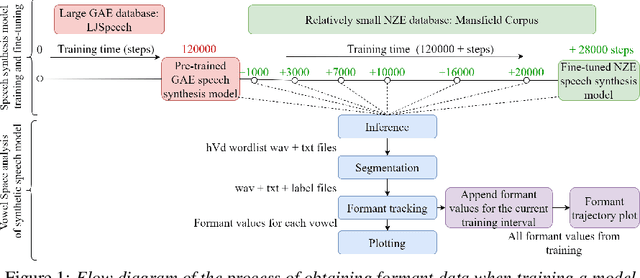
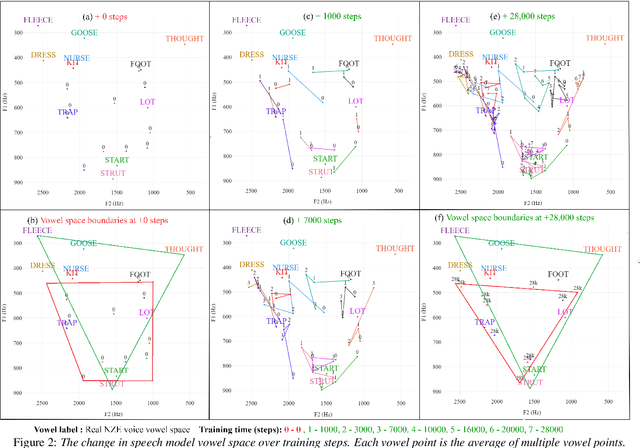
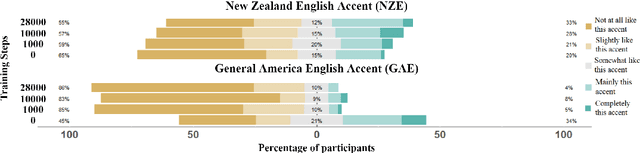
With the recent developments in speech synthesis via machine learning, this study explores incorporating linguistics knowledge to visualise and evaluate synthetic speech model training. If changes to the first and second formant (in turn, the vowel space) can be seen and heard in synthetic speech, this knowledge can inform speech synthesis technology developers. A speech synthesis model trained on a large General American English database was fine-tuned into a New Zealand English voice to identify if the changes in the vowel space of synthetic speech could be seen and heard. The vowel spaces at different intervals during the fine-tuning were analysed to determine if the model learned the New Zealand English vowel space. Our findings based on vowel space analysis show that we can visualise how a speech synthesis model learns the vowel space of the database it is trained on. Perception tests confirmed that humans could perceive when a speech synthesis model has learned characteristics of the speech database it is training on. Using the vowel space as an intermediary evaluation helps understand what sounds are to be added to the training database and build speech synthesis models based on linguistics knowledge.
N-shot Palm Vein Verification Using Siamese Networks
Sep 27, 2021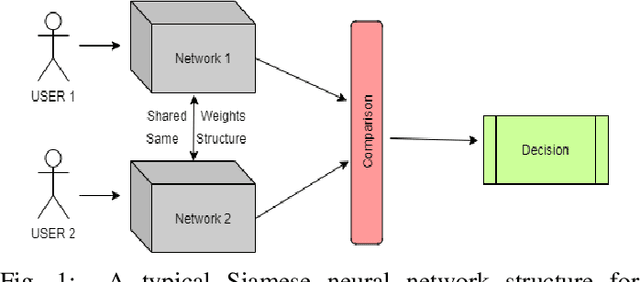
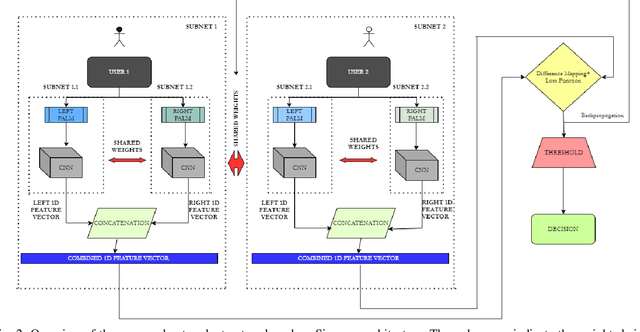
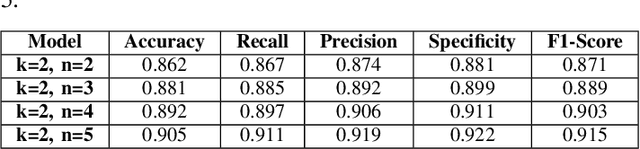
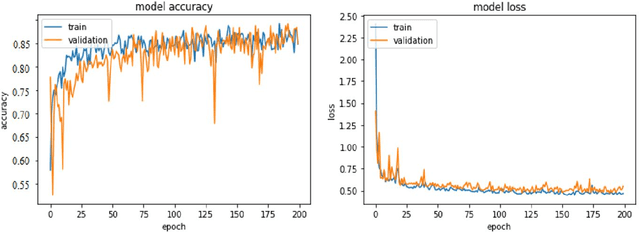
The use of deep learning methods to extract vascular biometric patterns from the palm surface has been of interest among researchers in recent years. In many biometric recognition tasks, there is a limit in the number of training samples. This is because of limited vein biometric databases being available for research. This restricts the application of deep learning methods to design algorithms that can effectively identify or authenticate people for vein recognition. This paper proposes an architecture using Siamese neural network structure for few shot palm vein identification. The proposed network uses images from both the palms and consists of two sub-nets that share weights to identify a person. The architecture performance was tested on the HK PolyU multi spectral palm vein database with limited samples. The results suggest that the method is effective since it has 91.9% precision, 91.1% recall, 92.2% specificity, 91.5%, F1-Score, and 90.5% accuracy values.