 Add to Chrome
 Add to Firefox
 Add to Edge
Detecting Silent Failures in Multi-Agentic AI Trajectories
Nov 06, 2025
Multi-Agentic AI systems, powered by large language models (LLMs), are inherently non-deterministic and prone to silent failures such as drift, cycles, and missing details in outputs, which are difficult to detect. We introduce the task of anomaly detection in agentic trajectories to identify these failures and present a dataset curation pipeline that captures user behavior, agent non-determinism, and LLM variation. Using this pipeline, we curate and label two benchmark datasets comprising \textbf{4,275 and 894} trajectories from Multi-Agentic AI systems. Benchmarking anomaly detection methods on these datasets, we show that supervised (XGBoost) and semi-supervised (SVDD) approaches perform comparably, achieving accuracies up to 98% and 96%, respectively. This work provides the first systematic study of anomaly detection in Multi-Agentic AI systems, offering datasets, benchmarks, and insights to guide future research.

ITBench: Evaluating AI Agents across Diverse Real-World IT Automation Tasks
Feb 07, 2025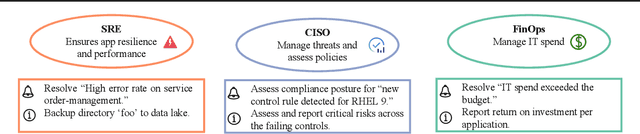

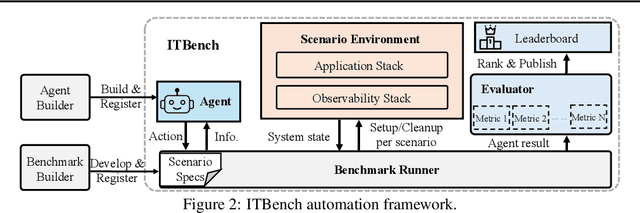
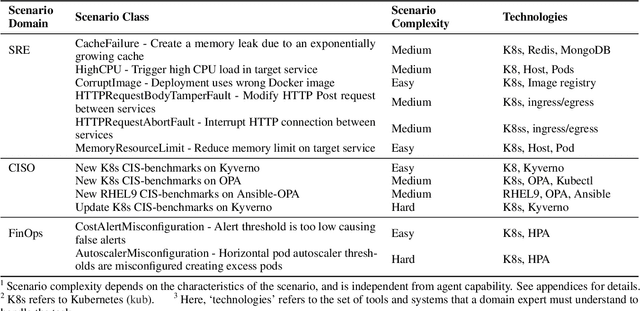
Realizing the vision of using AI agents to automate critical IT tasks depends on the ability to measure and understand effectiveness of proposed solutions. We introduce ITBench, a framework that offers a systematic methodology for benchmarking AI agents to address real-world IT automation tasks. Our initial release targets three key areas: Site Reliability Engineering (SRE), Compliance and Security Operations (CISO), and Financial Operations (FinOps). The design enables AI researchers to understand the challenges and opportunities of AI agents for IT automation with push-button workflows and interpretable metrics. ITBench includes an initial set of 94 real-world scenarios, which can be easily extended by community contributions. Our results show that agents powered by state-of-the-art models resolve only 13.8% of SRE scenarios, 25.2% of CISO scenarios, and 0% of FinOps scenarios. We expect ITBench to be a key enabler of AI-driven IT automation that is correct, safe, and fast.