 Add to Chrome
 Add to Firefox
 Add to Edge
Quantum Kernel Machine Learning for Autonomous Materials Science
Jan 16, 2026
Autonomous materials science, where active learning is used to navigate large compositional phase space, has emerged as a powerful vehicle to rapidly explore new materials. A crucial aspect of autonomous materials science is exploring new materials using as little data as possible. Gaussian process-based active learning allows effective charting of multi-dimensional parameter space with a limited number of training data, and thus is a common algorithmic choice for autonomous materials science. An integral part of the autonomous workflow is the application of kernel functions for quantifying similarities among measured data points. A recent theoretical breakthrough has shown that quantum kernel models can achieve similar performance with less training data than classical models. This signals the possible advantage of applying quantum kernel machine learning to autonomous materials discovery. In this work, we compare quantum and classical kernels for their utility in sequential phase space navigation for autonomous materials science. Specifically, we compute a quantum kernel and several classical kernels for x-ray diffraction patterns taken from an Fe-Ga-Pd ternary composition spread library. We conduct our study on both IonQ's Aria trapped ion quantum computer hardware and the corresponding classical noisy simulator. We experimentally verify that a quantum kernel model can outperform some classical kernel models. The results highlight the potential of quantum kernel machine learning methods for accelerating materials discovery and suggest complex x-ray diffraction data is a candidate for robust quantum kernel model advantage.

Human-In-the-Loop for Bayesian Autonomous Materials Phase Mapping
Jun 17, 2023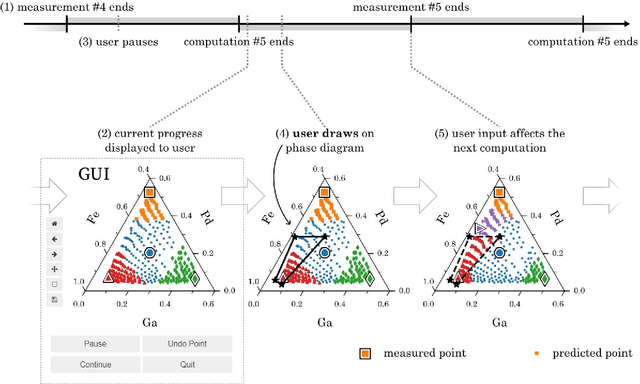
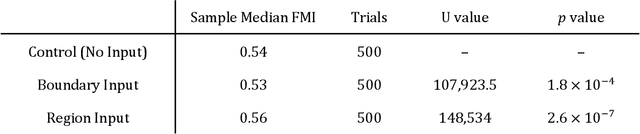
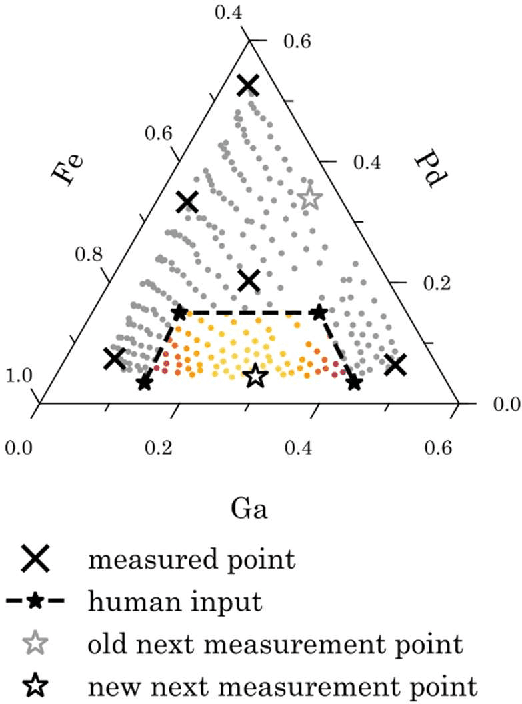
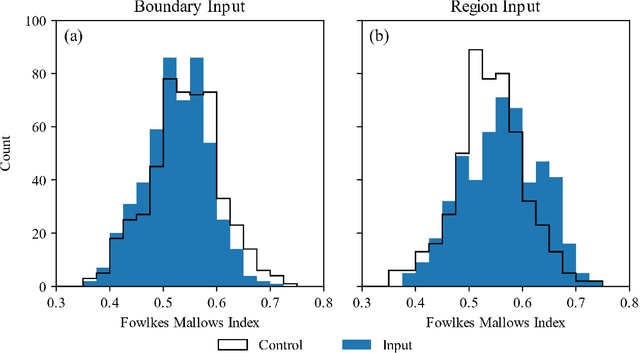
Autonomous experimentation (AE) combines machine learning and research hardware automation in a closed loop, guiding subsequent experiments toward user goals. As applied to materials research, AE can accelerate materials exploration, reducing time and cost compared to traditional Edisonian studies. Additionally, integrating knowledge from diverse sources including theory, simulations, literature, and domain experts can boost AE performance. Domain experts may provide unique knowledge addressing tasks that are difficult to automate. Here, we present a set of methods for integrating human input into an autonomous materials exploration campaign for composition-structure phase mapping. The methods are demonstrated on x-ray diffraction data collected from a thin film ternary combinatorial library. At any point during the campaign, the user can choose to provide input by indicating regions-of-interest, likely phase regions, and likely phase boundaries based on their prior knowledge (e.g., knowledge of the phase map of a similar material system), along with quantifying their certainty. The human input is integrated by defining a set of probabilistic priors over the phase map. Algorithm output is a probabilistic distribution over potential phase maps, given the data, model, and human input. We demonstrate a significant improvement in phase mapping performance given appropriate human input.