 Add to Chrome
 Add to Firefox
 Add to Edge
Quantum Enhanced Anomaly Detection for ADS-B Data using Hybrid Deep Learning
Sep 19, 2025
The emerging field of Quantum Machine Learning (QML) has shown promising advantages in accelerating processing speed and effectively handling the high dimensionality associated with complex datasets. Quantum Computing (QC) enables more efficient data manipulation through the quantum properties of superposition and entanglement. In this paper, we present a novel approach combining quantum and classical machine learning techniques to explore the impact of quantum properties for anomaly detection in Automatic Dependent Surveillance-Broadcast (ADS-B) data. We compare the performance of a Hybrid-Fully Connected Quantum Neural Network (H-FQNN) with different loss functions and use a publicly available ADS-B dataset to evaluate the performance. The results demonstrate competitive performance in detecting anomalies, with accuracies ranging from 90.17% to 94.05%, comparable to the performance of a traditional Fully Connected Neural Network (FNN) model, which achieved accuracies between 91.50% and 93.37%.

Vehicle Detection and Tracking From Surveillance Cameras in Urban Scenes
Sep 25, 2021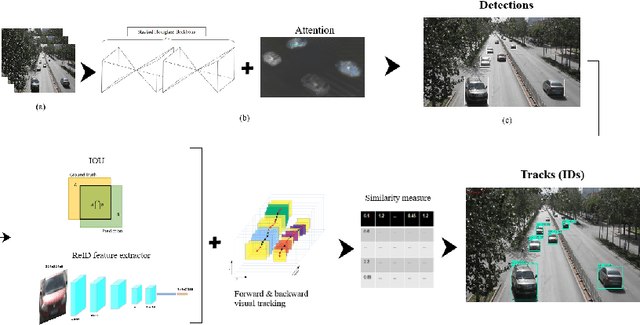
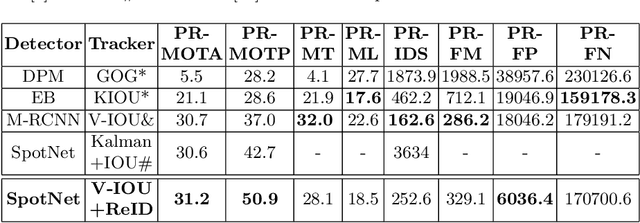
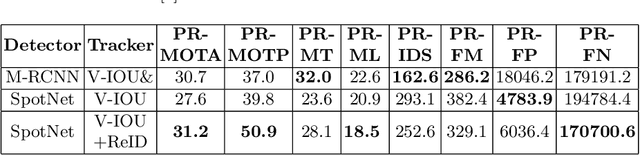
Detecting and tracking vehicles in urban scenes is a crucial step in many traffic-related applications as it helps to improve road user safety among other benefits. Various challenges remain unresolved in multi-object tracking (MOT) including target information description, long-term occlusions and fast motion. We propose a multi-vehicle detection and tracking system following the tracking-by-detection paradigm that tackles the previously mentioned challenges. Our MOT method extends an Intersection-over-Union (IOU)-based tracker with vehicle re-identification features. This allows us to utilize appearance information to better match objects after long occlusion phases and/or when object location is significantly shifted due to fast motion. We outperform our baseline MOT method on the UA-DETRAC benchmark while maintaining a total processing speed suitable for online use cases.