 Add to Chrome
 Add to Firefox
 Add to Edge
Towards Autonomous Mathematics Research
Feb 12, 2026
Recent advances in foundational models have yielded reasoning systems capable of achieving a gold-medal standard at the International Mathematical Olympiad. The transition from competition-level problem-solving to professional research, however, requires navigating vast literature and constructing long-horizon proofs. In this work, we introduce Aletheia, a math research agent that iteratively generates, verifies, and revises solutions end-to-end in natural language. Specifically, Aletheia is powered by an advanced version of Gemini Deep Think for challenging reasoning problems, a novel inference-time scaling law that extends beyond Olympiad-level problems, and intensive tool use to navigate the complexities of mathematical research. We demonstrate the capability of Aletheia from Olympiad problems to PhD-level exercises and most notably, through several distinct milestones in AI-assisted mathematics research: (a) a research paper (Feng26) generated by AI without any human intervention in calculating certain structure constants in arithmetic geometry called eigenweights; (b) a research paper (LeeSeo26) demonstrating human-AI collaboration in proving bounds on systems of interacting particles called independent sets; and (c) an extensive semi-autonomous evaluation (Feng et al., 2026a) of 700 open problems on Bloom's Erdos Conjectures database, including autonomous solutions to four open questions. In order to help the public better understand the developments pertaining to AI and mathematics, we suggest quantifying standard levels of autonomy and novelty of AI-assisted results, as well as propose a novel concept of human-AI interaction cards for transparency. We conclude with reflections on human-AI collaboration in mathematics and share all prompts as well as model outputs at https://github.com/google-deepmind/superhuman/tree/main/aletheia.

Emergence of meta-stable clustering in mean-field transformer models
Oct 30, 2024

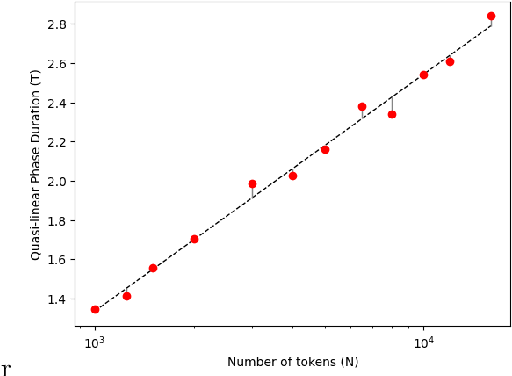

We model the evolution of tokens within a deep stack of Transformer layers as a continuous-time flow on the unit sphere, governed by a mean-field interacting particle system, building on the framework introduced in (Geshkovski et al., 2023). Studying the corresponding mean-field Partial Differential Equation (PDE), which can be interpreted as a Wasserstein gradient flow, in this paper we provide a mathematical investigation of the long-term behavior of this system, with a particular focus on the emergence and persistence of meta-stable phases and clustering phenomena, key elements in applications like next-token prediction. More specifically, we perform a perturbative analysis of the mean-field PDE around the iid uniform initialization and prove that, in the limit of large number of tokens, the model remains close to a meta-stable manifold of solutions with a given structure (e.g., periodicity). Further, the structure characterizing the meta-stable manifold is explicitly identified, as a function of the inverse temperature parameter of the model, by the index maximizing a certain rescaling of Gegenbauer polynomials.