 Add to Chrome
 Add to Firefox
 Add to Edge
Learning Spectral and Polarimetric Clues for One-to-Multimodal Novel View Synthesis
Jul 02, 2026
Neural rendering techniques allow for accurate reconstruction of the geometry and color appearance of 3D scenes. Some methods have extended their use to additional imaging modalities, such as multispectral, infrared, or polarimetric data. However, all of these approaches require expensive sensors and calibrated setups to capture new multimodal frames for each new scene. We propose Spectral and Polarimetric Implicit Learned Representation (SPoILeR), a novel method to obtain multi-view consistent renderings of unconventional modalities for scenes where either only RGB frames or very few of the additional modalities are available. Thanks to a multimodal pre-training phase, the model learns the mutual correlation between different modalities. This step allows predicting accurate renderings of unconventional modalities during a fine-tuning phase supervised only by RGB images. Experimental results show that the approach can accurately render infrared, polarimetric, and multispectral frames for scenes where no input sample captured by these types of sensors is provided.

MultimodalStudio: A Heterogeneous Sensor Dataset and Framework for Neural Rendering across Multiple Imaging Modalities
Mar 25, 2025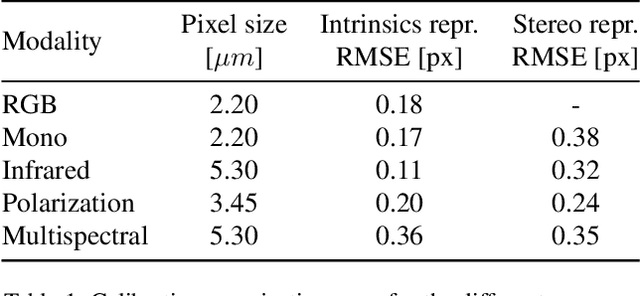
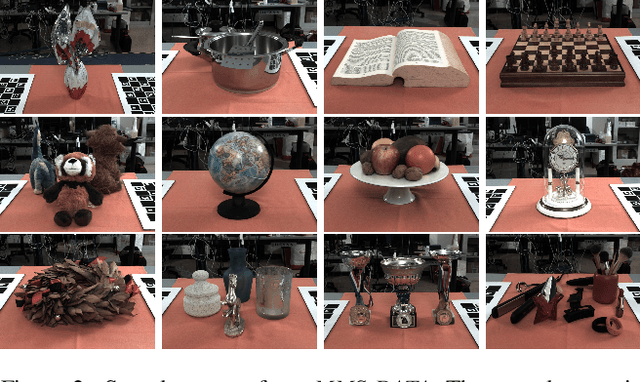
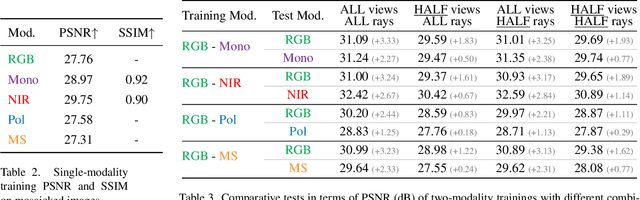
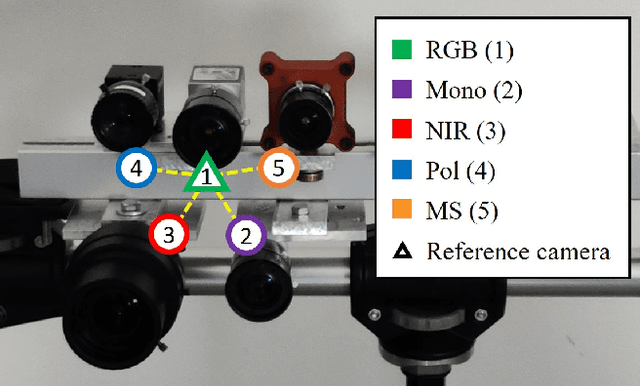
Neural Radiance Fields (NeRF) have shown impressive performances in the rendering of 3D scenes from arbitrary viewpoints. While RGB images are widely preferred for training volume rendering models, the interest in other radiance modalities is also growing. However, the capability of the underlying implicit neural models to learn and transfer information across heterogeneous imaging modalities has seldom been explored, mostly due to the limited training data availability. For this purpose, we present MultimodalStudio (MMS): it encompasses MMS-DATA and MMS-FW. MMS-DATA is a multimodal multi-view dataset containing 32 scenes acquired with 5 different imaging modalities: RGB, monochrome, near-infrared, polarization and multispectral. MMS-FW is a novel modular multimodal NeRF framework designed to handle multimodal raw data and able to support an arbitrary number of multi-channel devices. Through extensive experiments, we demonstrate that MMS-FW trained on MMS-DATA can transfer information between different imaging modalities and produce higher quality renderings than using single modalities alone. We publicly release the dataset and the framework, to promote the research on multimodal volume rendering and beyond.
Exploiting Multiple Priors for Neural 3D Indoor Reconstruction
Sep 13, 2023Neural implicit modeling permits to achieve impressive 3D reconstruction results on small objects, while it exhibits significant limitations in large indoor scenes. In this work, we propose a novel neural implicit modeling method that leverages multiple regularization strategies to achieve better reconstructions of large indoor environments, while relying only on images. A sparse but accurate depth prior is used to anchor the scene to the initial model. A dense but less accurate depth prior is also introduced, flexible enough to still let the model diverge from it to improve the estimated geometry. Then, a novel self-supervised strategy to regularize the estimated surface normals is presented. Finally, a learnable exposure compensation scheme permits to cope with challenging lighting conditions. Experimental results show that our approach produces state-of-the-art 3D reconstructions in challenging indoor scenarios.