 Add to Chrome
 Add to Firefox
 Add to Edge
Scalable and Distributed Silhouette Approximation
Jul 02, 2026
The silhouette is one of the most widely used measures to assess the quality of a $k$-clustering of a dataset of $n$ elements. Its evaluation requires no information beyond the clustering assignment. In addition, the silhouette is extremely easy to interpret, providing a score to measure the quality of a clustering as a whole or for each element. The exact computation of the: (i) silhouette of each element of a dataset; and (ii) the global silhouette of the clustering; require $Θ(n^2)$ distance calculations, under general metrics. The quadratic complexity $Θ(n^2)$ is extremely prohibitive, especially on massive modern datasets. Surprisingly, existing approximate methods using $O(n^2)$ distance calculations are heuristics not offering provable and controllable guarantees on the quality of their results. We introduce the first rigorous and efficient algorithms to estimate: (i) the (local) silhouette of each element of a dataset; and (ii) the (global) silhouette; of any metric $k$-clustering. Our methods, based on sampling, perform $O(nk\varepsilon^{-2}\ln (nk/δ))$ distance computations, and provide estimates with additive error $O(\varepsilon)$ with probability at least $1-δ$. That is, parameters $\varepsilon$ and $δ$ in $(0,1)$ control the trade-off between accuracy and efficiency. We also introduce a scalable and distributed design of our methods for the MapReduce and Massively Parallel Computing (MPC) frameworks. Our distributed algorithms use a constant number of rounds and sublinear local memory. Finally, we perform extensive experiments against state-of-the-art approaches. The results show that our new techniques yield the best trade-off between accuracy and efficiency for both local and global silhouette estimation. In addition, our methods scale efficiently to massive datasets for which an exact computation of the silhouette is not practical.

Scalable Distributed Approximation of Internal Measures for Clustering Evaluation
Mar 03, 2020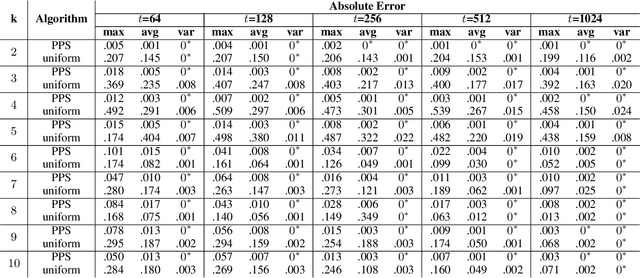
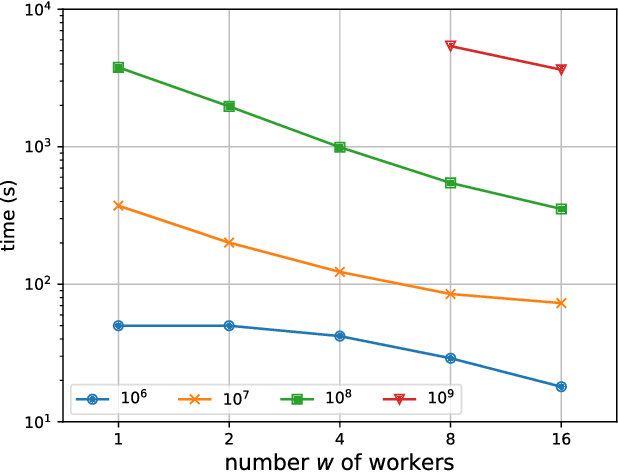
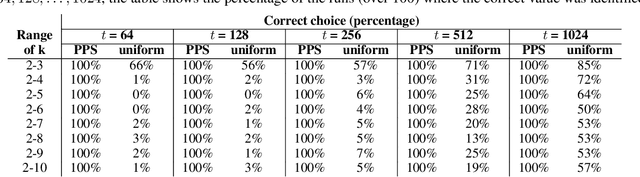
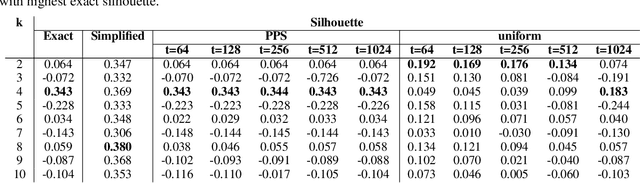
The most widely used internal measure for clustering evaluation is the silhouette coefficient, whose naive computation requires a quadratic number of distance calculations, which is clearly unfeasible for massive datasets. Surprisingly, there are no known general methods to efficiently approximate the silhouette coefficient of a clustering with rigorously provable high accuracy. In this paper, we present the first scalable algorithm to compute such a rigorous approximation for the evaluation of clusterings based on any metric distances. Our algorithm hinges on a Probability Proportional to Size (PPS) sampling scheme, and, for any fixed $\varepsilon, \delta \in (0,1)$, it approximates the silhouette coefficient within a mere additive error $O(\varepsilon)$ with probability $1-\delta$, using a very small number of distance calculations. We also prove that the algorithm can be adapted to obtain rigorous approximations of other internal measures of clustering quality, such as cohesion and separation. Importantly, we provide a distributed implementation of the algorithm using the MapReduce model, which runs in constant rounds and requires only sublinear local space at each worker, which makes our estimation approach applicable to big data scenarios. We perform an extensive experimental evaluation of our silhouette approximation algorithm, comparing its performance to a number of baseline heuristics on real and synthetic datasets. The experiments provide evidence that, unlike other heuristics, our estimation strategy not only provides tight theoretical guarantees but is also able to return highly accurate estimations while running in a fraction of the time required by the exact computation, and that its distributed implementation is highly scalable, thus enabling the computation of internal measures for very large datasets for which the exact computation is prohibitive.