 Add to Chrome
 Add to Firefox
 Add to Edge
Collaborative Agents for Automated Program Repair in Ruby
Nov 06, 2025
Automated Program Repair (APR) has advanced rapidly with Large Language Models (LLMs), but most existing methods remain computationally expensive, and focused on a small set of languages. Ruby, despite its widespread use in web development and the persistent challenges faced by its developers, has received little attention in APR research. In this paper, we introduce RAMP, a novel lightweight framework that formulates program repair as a feedback-driven, iterative process for Ruby. RAMP employs a team of collaborative agents that generate targeted tests, reflect on errors, and refine candidate fixes until a correct solution is found. Unlike prior approaches, RAMP is designed to avoid reliance on large multilingual repair databases or costly fine-tuning, instead operating directly on Ruby through lightweight prompting and test-driven feedback. Evaluation on the XCodeEval benchmark shows that RAMP achieves a pass@1 of 67% on Ruby, outper-forming prior approaches. RAMP converges quickly within five iterations, and ablation studies confirm that test generation and self-reflection are key drivers of its performance. Further analysis shows that RAMP is particularly effective at repairing wrong answers, compilation errors, and runtime errors. Our approach provides new insights into multi-agent repair strategies, and establishes a foundation for extending LLM-based debugging tools to under-studied languages.

Investigating the Efficacy of Large Language Models for Code Clone Detection
Jan 30, 2024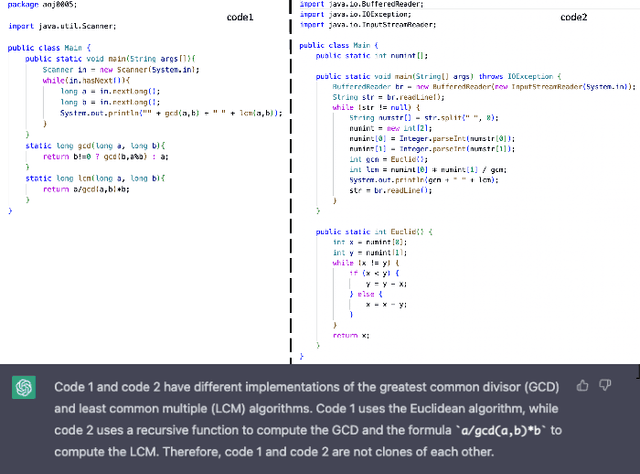
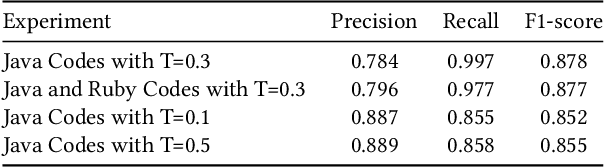
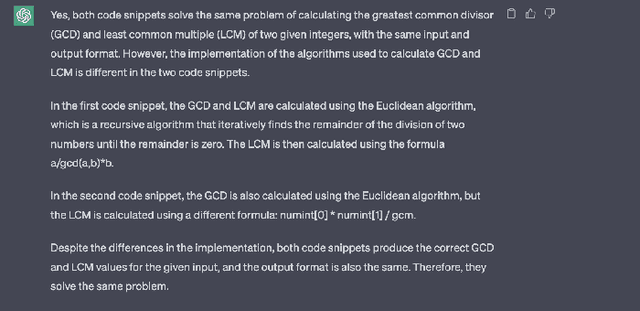
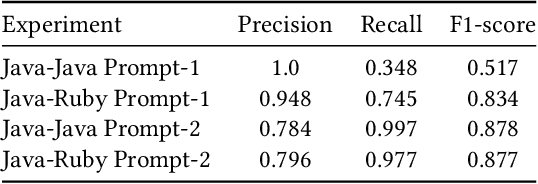
Large Language Models (LLMs) have demonstrated remarkable success in various natural language processing and software engineering tasks, such as code generation. The LLMs are mainly utilized in the prompt-based zero/few-shot paradigm to guide the model in accomplishing the task. GPT-based models are one of the popular ones studied for tasks such as code comment generation or test generation. These tasks are `generative' tasks. However, there is limited research on the usage of LLMs for `non-generative' tasks such as classification using the prompt-based paradigm. In this preliminary exploratory study, we investigated the applicability of LLMs for Code Clone Detection (CCD), a non-generative task. By building a mono-lingual and cross-lingual CCD dataset derived from CodeNet, we first investigated two different prompts using ChatGPT to detect Type-4 code clones in Java-Java and Java-Ruby pairs in a zero-shot setting. We then conducted an analysis to understand the strengths and weaknesses of ChatGPT in CCD. ChatGPT surpasses the baselines in cross-language CCD attaining an F1-score of 0.877 and achieves comparable performance to fully fine-tuned models for mono-lingual CCD, with an F1-score of 0.878. Also, the prompt and the difficulty level of the problems has an impact on the performance of ChatGPT. Finally we provide insights and future directions based on our initial analysis