 Add to Chrome
 Add to Firefox
 Add to Edge
When Prompts Become Payloads: A Framework for Mitigating SQL Injection Attacks in Large Language Model-Driven Applications
May 11, 2026
Natural language interfaces to structured databases are becoming increasingly common, largely due to advances in large language models (LLMs) that enable users to query data using conversational input rather than formal query languages such as SQL. While this paradigm significantly improves usability and accessibility, it introduces new security risks, particularly the amplification of SQL injection vulnerabilities through the prompt-to-SQL translation process. Malicious users can exploit these mechanisms by crafting adversarial prompts that manipulate model behavior and generate unsafe queries. In this work, we propose a multi-layered security framework designed to detect and mitigate LLM-mediated SQL injection attacks. The framework integrates a front-end security shield for prompt sanitization, an advanced threat detection model for behavioral and semantic anomaly identification, and a signature-based control layer for known attack patterns. We evaluate the proposed framework under diverse and realistic attack scenarios, including prompt injection, obfuscated SQL payloads, and context-manipulation attacks. To ensure robustness, we generate and curate a comprehensive benchmark dataset of adversarial prompts and assess performance across a fine-tuned LLM configuration. Experimental results demonstrate that the proposed approach achieves high detection accuracy while maintaining low false-positive rates, significantly improving the secure deployment of LLM-powered database applications.
* 11 pages

Large Language Models in Cybersecurity: State-of-the-Art
Jan 30, 2024
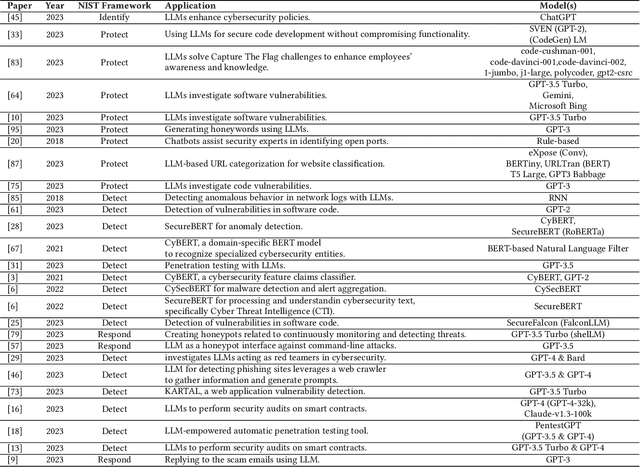
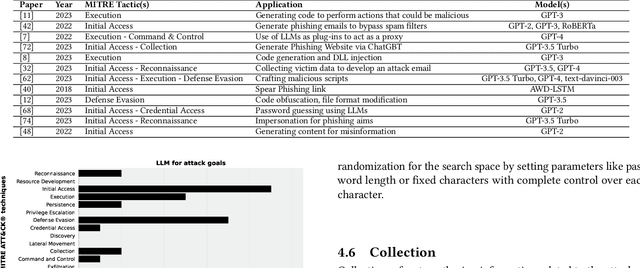
The rise of Large Language Models (LLMs) has revolutionized our comprehension of intelligence bringing us closer to Artificial Intelligence. Since their introduction, researchers have actively explored the applications of LLMs across diverse fields, significantly elevating capabilities. Cybersecurity, traditionally resistant to data-driven solutions and slow to embrace machine learning, stands out as a domain. This study examines the existing literature, providing a thorough characterization of both defensive and adversarial applications of LLMs within the realm of cybersecurity. Our review not only surveys and categorizes the current landscape but also identifies critical research gaps. By evaluating both offensive and defensive applications, we aim to provide a holistic understanding of the potential risks and opportunities associated with LLM-driven cybersecurity.