 Add to Chrome
 Add to Firefox
 Add to Edge
A Novel Reinforcement Learning Routing Algorithm for Congestion Control in Complex Networks
Dec 30, 2023

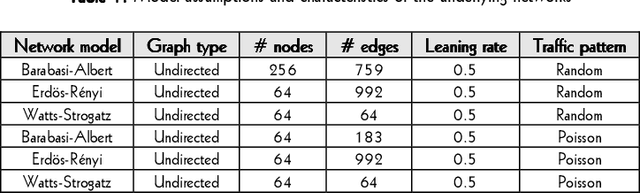
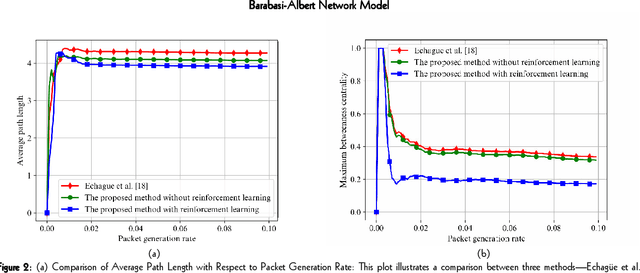
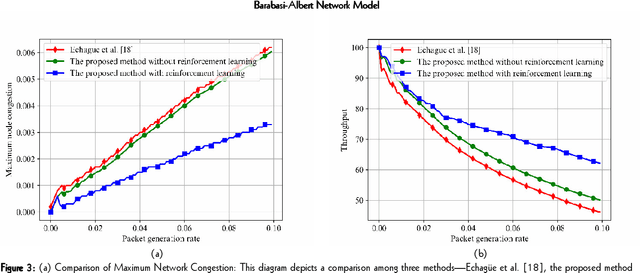
Despite technological advancements, the significance of interdisciplinary subjects like complex networks has grown. Exploring communication within these networks is crucial, with traffic becoming a key concern due to the expanding population and increased need for connections. Congestion tends to originate in specific network areas but quickly proliferates throughout. Consequently, understanding the transition from a flow-free state to a congested state is vital. Numerous studies have delved into comprehending the emergence and control of congestion in complex networks, falling into three general categories: soft strategies, hard strategies, and resource allocation strategies. This article introduces a routing algorithm leveraging reinforcement learning to address two primary objectives: congestion control and optimizing path length based on the shortest path algorithm, ultimately enhancing network throughput compared to previous methods. Notably, the proposed method proves effective not only in Barab\'asi-Albert scale-free networks but also in other network models such as Watts-Strogatz (small-world) and Erd\"os-R\'enyi (random network). Simulation experiment results demonstrate that, across various traffic scenarios and network topologies, the proposed method can enhance efficiency criteria by up to 30% while reducing maximum node congestion by five times.

Autism Spectrum Disorder Screening Using Discriminative Brain Sub-Networks: An Entropic Approach
Mar 25, 2021


Autism is one of the most important neurological disorders which leads to problems in a person's social interactions. Improvement of brain imaging technologies and techniques help us to build brain structural and functional networks. Finding networks topology pattern in each of the groups (autism and healthy control) can aid us to achieve an autism disorder screening model. In the present study, we have utilized the genetic algorithm to extract a discriminative sub-network that represents differences between two groups better. In the fitness evaluation phase, for each sub-network, a machine learning model was trained using various entropy features of the sub-network and its performance was measured. Proper model performance implies extracting a good discriminative sub-network. Network entropies can be used as network topological descriptors. The evaluation results indicate the acceptable performance of the proposed screening method based on extracted discriminative sub-networks and the machine learning models succeeded in obtaining a maximum accuracy of 73.1% in structural networks of the UCLA dataset, 82.2% in functional networks of the UCLA dataset, and 66.1% in functional networks of ABIDE datasets.