 Add to Chrome
 Add to Firefox
 Add to Edge
Creating Group Rules with AI: Human-AI Collaboration in WhatsApp Moderation
May 12, 2026
WhatsApp is one of the most widely used messaging platforms globally, with billions of users sharing information in private groups. Yet, it offers little infrastructure to support moderation and group governance. In the absence of platform-level oversight, group admins bear the responsibility of governing group behavior. In this paper, we explore how WhatsApp group admins collaborate with AI tools to create, enforce, and maintain group rules. Drawing on a two-phase speculative design study with 20 admins in India, we examine how participants interacted with an AI assistant (Meta AI) to co-create rules and responded to a series of probes illustrating AI-assisted moderation features. Our findings show that while admins appreciated the AI's ability to surface overlooked rules and reduce their moderation burden, they were highly sensitive to issues of relational trust, data privacy, tone, and social context. We identify how group type and admin style shaped their willingness to delegate authority, and surface the limitations of current chatbot interfaces in supporting collaborative rule-making. We conclude with design implications for building moderation tools that center human judgment, relational nuance, contextual adaptability, and collective governance.

Think Outside the Data: Colonial Biases and Systemic Issues in Automated Moderation Pipelines for Low-Resource Languages
Jan 23, 2025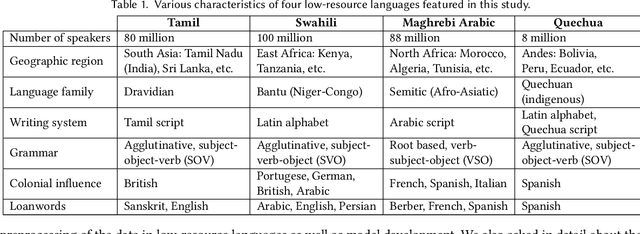
Most social media users come from non-English speaking countries in the Global South. Despite the widespread prevalence of harmful content in these regions, current moderation systems repeatedly struggle in low-resource languages spoken there. In this work, we examine the challenges AI researchers and practitioners face when building moderation tools for low-resource languages. We conducted semi-structured interviews with 22 AI researchers and practitioners specializing in automatic detection of harmful content in four diverse low-resource languages from the Global South. These are: Tamil from South Asia, Swahili from East Africa, Maghrebi Arabic from North Africa, and Quechua from South America. Our findings reveal that social media companies' restrictions on researchers' access to data exacerbate the historical marginalization of these languages, which have long lacked datasets for studying online harms. Moreover, common preprocessing techniques and language models, predominantly designed for data-rich English, fail to account for the linguistic complexity of low-resource languages. This leads to critical errors when moderating content in Tamil, Swahili, Arabic, and Quechua, which are morphologically richer than English. Based on our findings, we establish that the precarities in current moderation pipelines are rooted in deep systemic inequities and continue to reinforce historical power imbalances. We conclude by discussing multi-stakeholder approaches to improve moderation for low-resource languages.