 Add to Chrome
 Add to Firefox
 Add to Edge
Synergizing Zero-Shot Cross-Lingual Alzheimer Detection with Language-Invariant Multimodal Bi-Geometric Adversarial Learning
Jun 15, 2026
In this work, we study zero-shot cross-lingual speech-based Alzheimer's disease detection (SADD). We hypothesize that learning language-invariant multimodal representations by fusing multilingual speech and text pretrained models is essential for reliable transfer to unseen languages, as the two modalities capture complementary acoustic and linguistic markers of cognitive impairment while adversarial learning suppresses language-specific confounds. Empirical results in zero-shot cross-lingual evaluation substantiate the hypothesis, showing that multimodal fusion consistently outperforms unimodal baselines. To this end, we propose ORBIT, a novel framework that combines cross-attentive fusion, multi-tap language adversaries, and complementary spherical--hyperbolic geometric learning with consensus clustering. Across settings, ORBIT achieves the strongest performance compared to unimodal models and simple concatenation-based fusion baselines.

Selective Token-Level Cryptographic Redaction for Privacy-Preserving Clinical Deployment of Large Language Models
Jun 02, 2026While large language models (LLMs) are increasingly used for clinical applications, many existing pipelines require sending raw sensitive health information to remote servers for processing, which heightens the risk of privacy leakage. A natural approach to mitigate this risk is to encrypt the data before transmission. However, straightforward solutions such as encrypting the entire dataset introduce prohibitive computational, alignment, and communication overheads, rendering large-scale practical deployment infeasible. To preserve privacy while maintaining usability, we present Healthcare Encryption & Redaction via Adaptive Linguistic Decomposition (HERALD), a token-level cryptographic redaction framework designed to achieve this balance by encrypting only sensitive tokens while preserving the surrounding context for downstream model utility. HERALD combines medical named-entity recognizer (NER) with part-of-speech (POS) driven policies to select candidate tokens, performs targeted lemmatization to stabilize surface forms, and substitutes each protected token with a deterministic ciphertext wrapped in explicit delimiters. Notably, HERALD is model-agnostic and operates entirely on the client side, ensuring that sensitive content remains encrypted throughout storage, transmission, and processing without requiring changes to downstream models. We evaluated HERALD on both classification and medical question answering (MQA) tasks on public datasets. Across different tasks, experiments illustrate that fully secured baselines suffer significant utility loss, whereas HERALD consistently recovers performance close to plaintext. Overall, HERALD provides a novel utilization pipeline.
Bridging Attribution and Open-Set Detection using Graph-Augmented Instance Learning in Synthetic Speech
Jan 11, 2026We propose a unified framework for not only attributing synthetic speech to its source but also for detecting speech generated by synthesizers that were not encountered during training. This requires methods that move beyond simple detection to support both detailed forensic analysis and open-set generalization. To address this, we introduce SIGNAL, a hybrid framework that combines speech foundation models (SFMs) with graph-based modeling and open-set-aware inference. Our framework integrates Graph Neural Networks (GNNs) and a k-Nearest Neighbor (KNN) classifier, allowing it to capture meaningful relationships between utterances and recognize speech that doesn`t belong to any known generator. It constructs a query-conditioned graph over generator class prototypes, enabling the GNN to reason over relationships among candidate generators, while the KNN branch supports open-set detection via confidence-based thresholding. We evaluate SIGNAL using the DiffSSD dataset, which offers a diverse mix of real speech and synthetic audio from both open-source and commercial diffusion-based TTS systems. To further assess generalization, we also test on the SingFake benchmark. Our results show that SIGNAL consistently improves performance across both tasks, with Mamba-based embeddings delivering especially strong results. To the best of our knowledge, this is the first study to unify graph-based learning and open-set detection for tracing synthetic speech back to its origin.
Towards Attribution of Generators and Emotional Manipulation in Cross-Lingual Synthetic Speech using Geometric Learning
Nov 13, 2025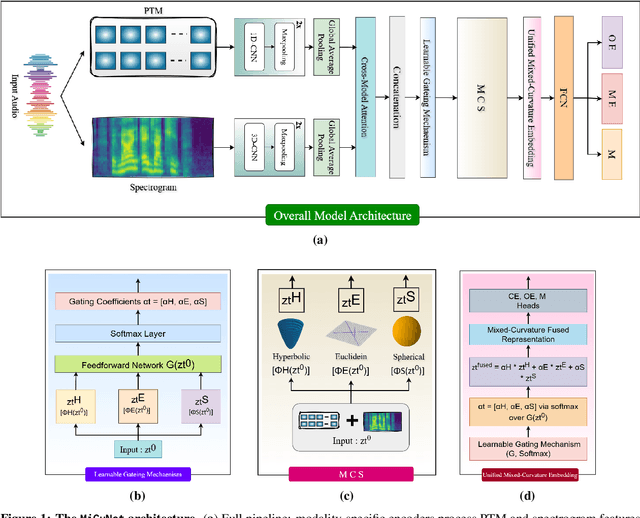
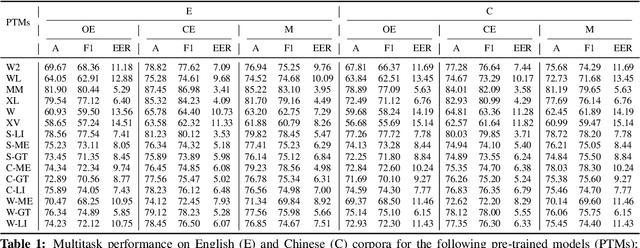
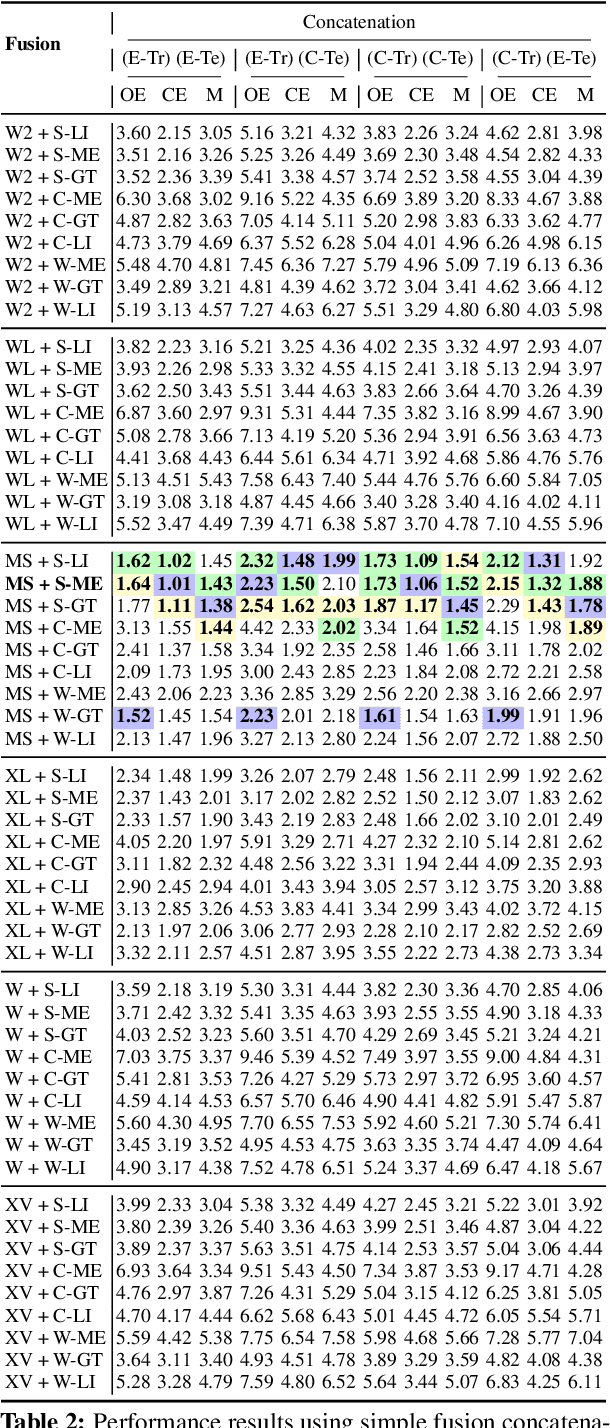
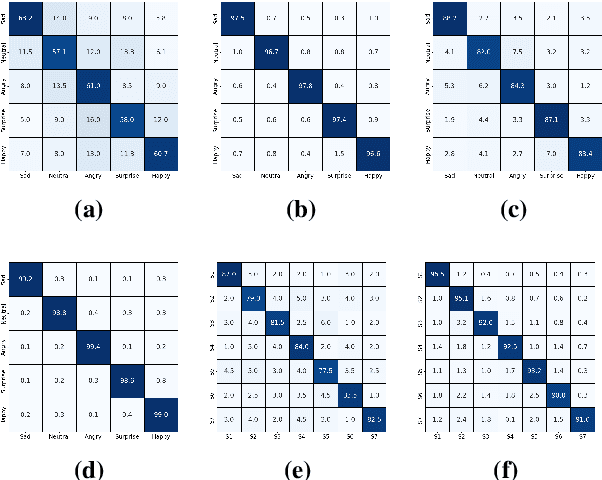
In this work, we address the problem of finegrained traceback of emotional and manipulation characteristics from synthetically manipulated speech. We hypothesize that combining semantic-prosodic cues captured by Speech Foundation Models (SFMs) with fine-grained spectral dynamics from auditory representations can enable more precise tracing of both emotion and manipulation source. To validate this hypothesis, we introduce MiCuNet, a novel multitask framework for fine-grained tracing of emotional and manipulation attributes in synthetically generated speech. Our approach integrates SFM embeddings with spectrogram-based auditory features through a mixed-curvature projection mechanism that spans Hyperbolic, Euclidean, and Spherical spaces guided by a learnable temporal gating mechanism. Our proposed method adopts a multitask learning setup to simultaneously predict original emotions, manipulated emotions, and manipulation sources on the EmoFake dataset (EFD) across both English and Chinese subsets. MiCuNet yields consistent improvements, consistently surpassing conventional fusion strategies. To the best of our knowledge, this work presents the first study to explore a curvature-adaptive framework specifically tailored for multitask tracking in synthetic speech.
Curved Worlds, Clear Boundaries: Generalizing Speech Deepfake Detection using Hyperbolic and Spherical Geometry Spaces
Nov 13, 2025In this work, we address the challenge of generalizable audio deepfake detection (ADD) across diverse speech synthesis paradigms-including conventional text-to-speech (TTS) systems and modern diffusion or flow-matching (FM) based generators. Prior work has mostly targeted individual synthesis families and often fails to generalize across paradigms due to overfitting to generation-specific artifacts. We hypothesize that synthetic speech, irrespective of its generative origin, leaves behind shared structural distortions in the embedding space that can be aligned through geometry-aware modeling. To this end, we propose RHYME, a unified detection framework that fuses utterance-level embeddings from diverse pretrained speech encoders using non-Euclidean projections. RHYME maps representations into hyperbolic and spherical manifolds-where hyperbolic geometry excels at modeling hierarchical generator families, and spherical projections capture angular, energy-invariant cues such as periodic vocoder artifacts. The fused representation is obtained via Riemannian barycentric averaging, enabling synthesis-invariant alignment. RHYME outperforms individual PTMs and homogeneous fusion baselines, achieving top performance and setting new state-of-the-art in cross-paradigm ADD.