 Add to Chrome
 Add to Firefox
 Add to Edge
Stimulus symmetries can confound representational similarity analyses
May 20, 2026
What can representational similarity matrices (RSMs) tell us about a neural code? As the popularity of these summary statistics grows, so too does the need for a more complete characterization of their properties. Here, we show that symmetries in network inputs can confound RSM-based analyses. Stimulus symmetries render many representations functionally equivalent, but these different configurations can lead to different RSMs. These different RSMs reflect qualitatively different representational geometries. We show that stochastic gradient descent or energetic regularization can generate sparse, drifting codes, leading in turn to drifting RSMs. Moreover, we demonstrate that these phenomena are present in networks trained to encode image data, where the symmetry is latent. Our results illustrate the challenges inherent in comparing nonlinear neural codes, when functionally-equivalent representations are not related by a simple rotation.

Contribution of task-irrelevant stimuli to drift of neural representations
Oct 24, 2025Biological and artificial learners are inherently exposed to a stream of data and experience throughout their lifetimes and must constantly adapt to, learn from, or selectively ignore the ongoing input. Recent findings reveal that, even when the performance remains stable, the underlying neural representations can change gradually over time, a phenomenon known as representational drift. Studying the different sources of data and noise that may contribute to drift is essential for understanding lifelong learning in neural systems. However, a systematic study of drift across architectures and learning rules, and the connection to task, are missing. Here, in an online learning setup, we characterize drift as a function of data distribution, and specifically show that the learning noise induced by task-irrelevant stimuli, which the agent learns to ignore in a given context, can create long-term drift in the representation of task-relevant stimuli. Using theory and simulations, we demonstrate this phenomenon both in Hebbian-based learning -- Oja's rule and Similarity Matching -- and in stochastic gradient descent applied to autoencoders and a supervised two-layer network. We consistently observe that the drift rate increases with the variance and the dimension of the data in the task-irrelevant subspace. We further show that this yields different qualitative predictions for the geometry and dimension-dependency of drift than those arising from Gaussian synaptic noise. Overall, our study links the structure of stimuli, task, and learning rule to representational drift and could pave the way for using drift as a signal for uncovering underlying computation in the brain.
* NeurIPS 2025
Stochastic Gradient Descent-induced drift of representation in a two-layer neural network
Feb 06, 2023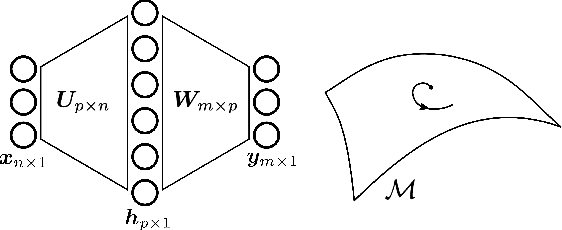
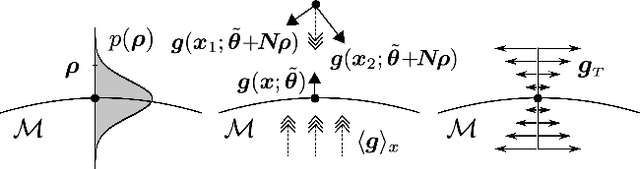
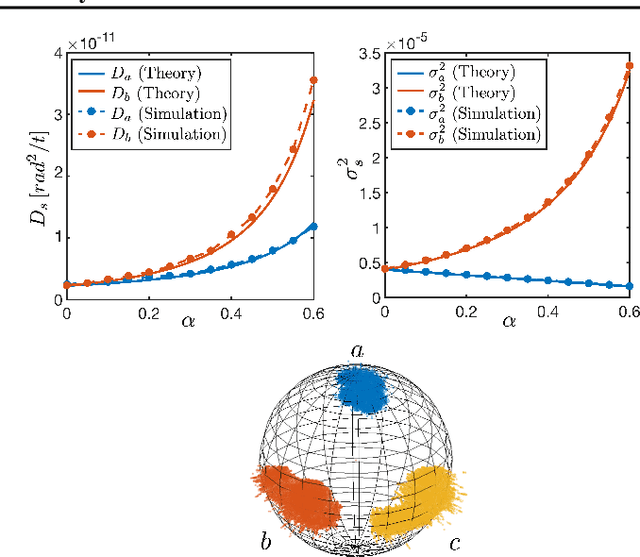
Representational drift refers to over-time changes in neural activation accompanied by a stable task performance. Despite being observed in the brain and in artificial networks, the mechanisms of drift and its implications are not fully understood. Motivated by recent experimental findings of stimulus-dependent drift in the piriform cortex, we use theory and simulations to study this phenomenon in a two-layer linear feedforward network. Specifically, in a continual learning scenario, we study the drift induced by the noise inherent in the Stochastic Gradient Descent (SGD). By decomposing the learning dynamics into the normal and tangent spaces of the minimum-loss manifold, we show the former correspond to a finite variance fluctuation, while the latter could be considered as an effective diffusion process on the manifold. We analytically compute the fluctuation and the diffusion coefficients for the stimuli representations in the hidden layer as a function of network parameters and input distribution. Further, consistent with experiments, we show that the drift rate is slower for a more frequently presented stimulus. Overall, our analysis yields a theoretical framework for better understanding of the drift phenomenon in biological and artificial neural networks.