 Add to Chrome
 Add to Firefox
 Add to Edge
Predicting Ethnicity from Names with rethnicity: Methodology and Application
Sep 30, 2021


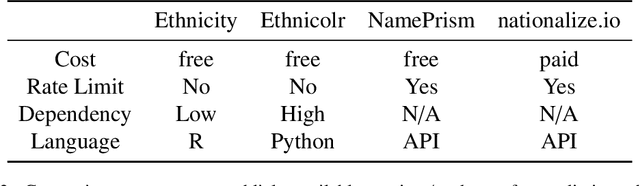
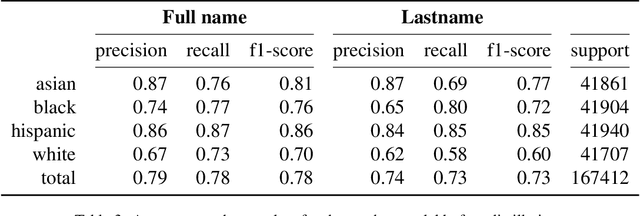
In this study, a new R package, \texttt{rethnicity} is provided for predicting ethnicity based on names. The Bidirectional LSTM and Florida Voter Registration were used as the model and training data, respectively. Special care was given for the accuracy of minority groups, by adjusting the imbalance in the dataset. The models were trained and exported to C++ and then integrated with R using Rcpp. Additionally, the availability, accuracy, and performance of the package were compared with other solutions.

Pruned Wasserstein Index Generation Model and wigpy Package
Apr 03, 2020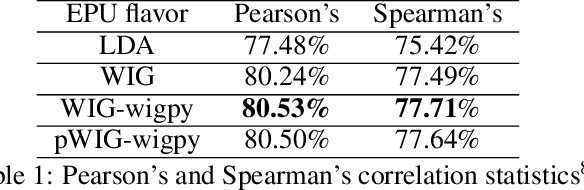
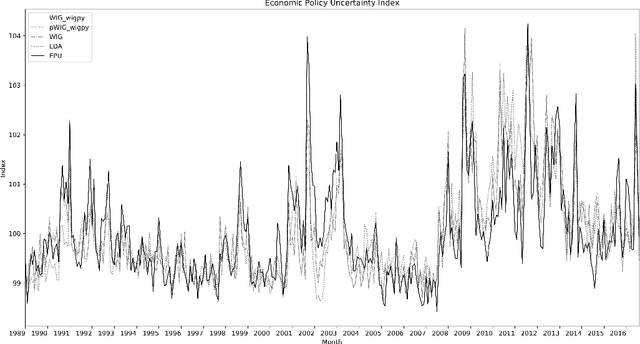
Recent proposal of Wasserstein Index Generation model (WIG) has shown a new direction for automatically generating indices. However, it is challenging in practice to fit large datasets for two reasons. First, the Sinkhorn distance is notoriously expensive to compute and suffers from dimensionality severely. Second, it requires to compute a full $N\times N$ matrix to be fit into memory, where $N$ is the dimension of vocabulary. When the dimensionality is too large, it is even impossible to compute at all. I hereby propose a Lasso-based shrinkage method to reduce dimensionality for the vocabulary as a pre-processing step prior to fitting the WIG model. After we get the word embedding from Word2Vec model, we could cluster these high-dimensional vectors by $k$-means clustering, and pick most frequent tokens within each cluster to form the "base vocabulary". Non-base tokens are then regressed on the vectors of base token to get a transformation weight and we could thus represent the whole vocabulary by only the "base tokens". This variant, called pruned WIG (pWIG), will enable us to shrink vocabulary dimension at will but could still achieve high accuracy. I also provide a \textit{wigpy} module in Python to carry out computation in both flavor. Application to Economic Policy Uncertainty (EPU) index is showcased as comparison with existing methods of generating time-series sentiment indices.
Wasserstein Index Generation Model: Automatic Generation of Time-series Index with Application to Economic Policy Uncertainty
Aug 12, 2019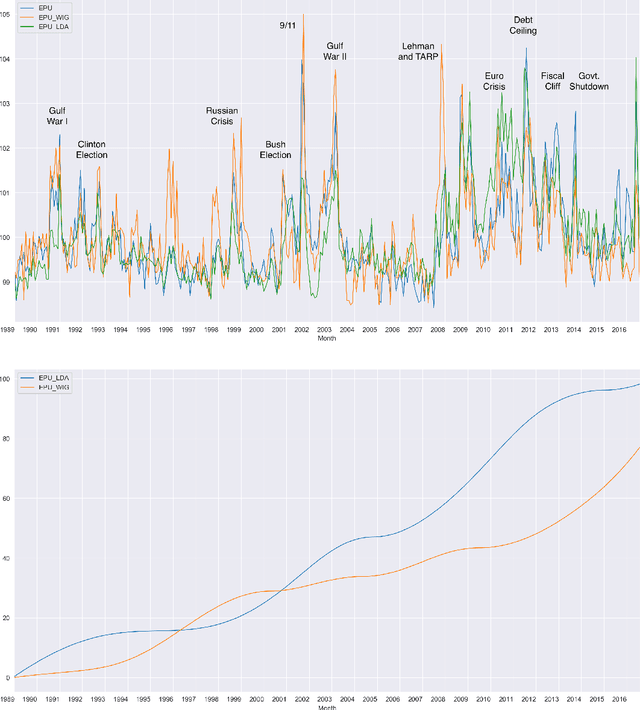

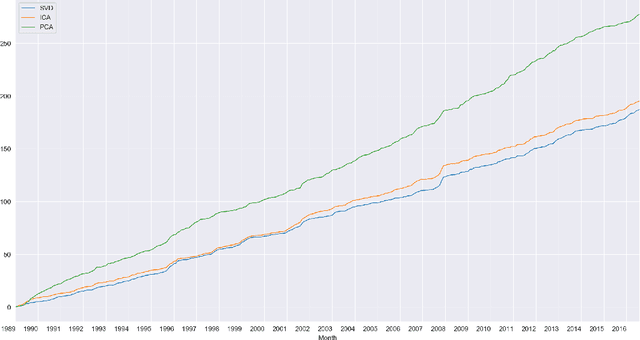
I propose a novel method, called the Wasserstein Index Generation model (WIG), to generate public sentiment index automatically. It can be performed off-the-shelf and is especially good at detecting sudden sentiment spikes. To test the model's effectiveness, an application to generate Economic Policy Uncertainty (EPU) index is showcased.