 Add to Chrome
 Add to Firefox
 Add to Edge
Bridging the Long-Tail Gap: Robust Retrieval-Augmented Relation Completion via Multi-Stage Paraphrase Infusion
Apr 24, 2026
Large language models (LLMs) struggle with relation completion (RC), both with and without retrieval-augmented generation (RAG), particularly when the required information is rare or sparsely represented. To address this, we propose a novel multi-stage paraphrase-guided relation-completion framework, RC-RAG, that systematically incorporates relation paraphrases across multiple stages. In particular, RC-RAG: (a) integrates paraphrases into retrieval to expand lexical coverage of the relation, (b) uses paraphrases to generate relation-aware summaries, and (c) leverages paraphrases during generation to guide reasoning for relation completion. Importantly, our method does not require any model fine-tuning. Experiments with five LLMs on two benchmark datasets show that RC-RAG consistently outperforms several RAG baselines. In long-tail settings, the best-performing LLM augmented with RC-RAG improves by 40.6 Exact Match (EM) points over its standalone performance and surpasses two strong RAG baselines by 16.0 and 13.8 EM points, respectively, while maintaining low computational overhead.

Dynamically Acquiring Text Content to Enable the Classification of Lesser-known Entities for Real-world Tasks
Apr 24, 2026Existing Natural Language Processing (NLP) resources often lack the task-specific information required for real-world problems and provide limited coverage of lesser-known or newly introduced entities. For example, business organizations and health care providers may need to be classified into a variety of different taxonomic schemes for specific application tasks. Our goal is to enable domain experts to easily create a task-specific classifier for entities by providing only entity names and gold labels as training data. Our framework then dynamically acquires descriptive text about each entity, which is subsequently used as the basis for producing a text-based classifier. We propose a novel text acquisition method that leverages both web and large language models (LLMs). We evaluate our proposed framework on two classification problems in distinct domains: (i) classifying organizations into Standard Industrial Classification (SIC) Codes, which categorize organizations based on their business activities; and (ii) classifying healthcare providers into healthcare provider taxonomy codes, which represent a provider's medical specialty and area of practice. Our best-performing model achieved macro-averaged F1-scores of 82.3% and 72.9% on the SIC code and healthcare taxonomy code classification tasks, respectively.
Towards Realistic Few-Shot Relation Extraction: A New Meta Dataset and Evaluation
Apr 05, 2024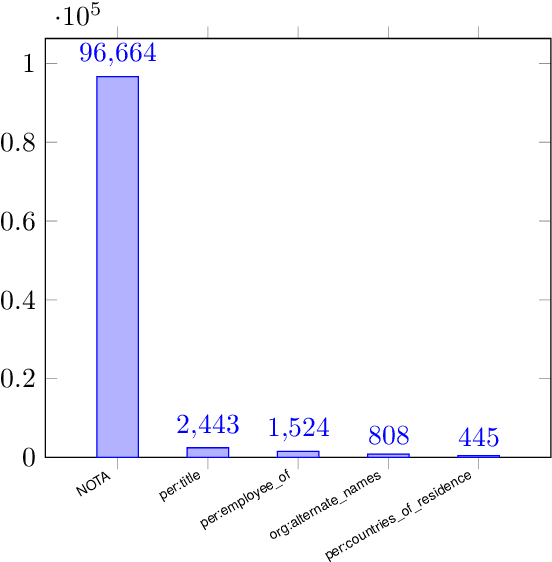
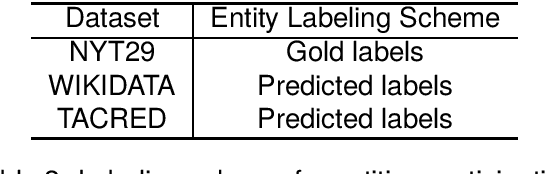

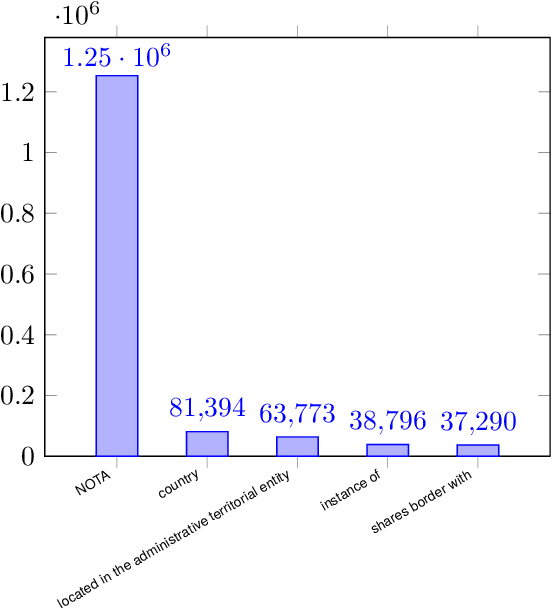
We introduce a meta dataset for few-shot relation extraction, which includes two datasets derived from existing supervised relation extraction datasets NYT29 (Takanobu et al., 2019; Nayak and Ng, 2020) and WIKIDATA (Sorokin and Gurevych, 2017) as well as a few-shot form of the TACRED dataset (Sabo et al., 2021). Importantly, all these few-shot datasets were generated under realistic assumptions such as: the test relations are different from any relations a model might have seen before, limited training data, and a preponderance of candidate relation mentions that do not correspond to any of the relations of interest. Using this large resource, we conduct a comprehensive evaluation of six recent few-shot relation extraction methods, and observe that no method comes out as a clear winner. Further, the overall performance on this task is low, indicating substantial need for future research. We release all versions of the data, i.e., both supervised and few-shot, for future research.
Best of Both Worlds: A Pliable and Generalizable Neuro-Symbolic Approach for Relation Classification
Mar 05, 2024
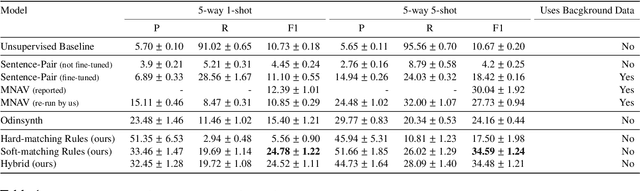

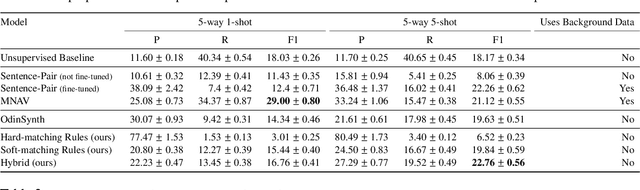
This paper introduces a novel neuro-symbolic architecture for relation classification (RC) that combines rule-based methods with contemporary deep learning techniques. This approach capitalizes on the strengths of both paradigms: the adaptability of rule-based systems and the generalization power of neural networks. Our architecture consists of two components: a declarative rule-based model for transparent classification and a neural component to enhance rule generalizability through semantic text matching. Notably, our semantic matcher is trained in an unsupervised domain-agnostic way, solely with synthetic data. Further, these components are loosely coupled, allowing for rule modifications without retraining the semantic matcher. In our evaluation, we focused on two few-shot relation classification datasets: Few-Shot TACRED and a Few-Shot version of NYT29. We show that our proposed method outperforms previous state-of-the-art models in three out of four settings, despite not seeing any human-annotated training data. Further, we show that our approach remains modular and pliable, i.e., the corresponding rules can be locally modified to improve the overall model. Human interventions to the rules for the TACRED relation \texttt{org:parents} boost the performance on that relation by as much as 26\% relative improvement, without negatively impacting the other relations, and without retraining the semantic matching component.