 Add to Chrome
 Add to Firefox
 Add to Edge
Temporal Order Matters for Agentic Memory: Segment Trees for Long-Horizon Agents
Jun 03, 2026
Long-horizon conversational agents need to interact with users through evolving events, tasks, and goals. Such histories are naturally temporal, yet many existing memory systems organize information primarily by topical similarity and may ignore the order in which events occur. We introduce Segment Tree Memory, or SegTreeMem, a memory architecture that represents conversation history as a temporally ordered Segment Tree over utterances. SegTreeMem incrementally inserts new utterances through an online rightmost-frontier update rule, preserving chronological order while forming hierarchical memory segments. For retrieval, SegTreeMem propagates relevance scores through the tree to combine local semantic matching with hierarchical temporal context. Across three long-horizon memory benchmarks and two LLM backbones, SegTreeMem improves answer quality over flat retrieval, graph-structured memory, and tree-structured memory baselines. Additional temporal-order permutation analysis shows that the performance gain depends on preserving temporal order during memory construction, supporting the claim that temporal order is a key structure for agentic memory.

CommonWhy: A Dataset for Evaluating Entity-Based Causal Commonsense Reasoning in Large Language Models
May 13, 2026To effectively interact with the real world, Large Language Models (LLMs) require entity-based commonsense reasoning, a challenging task that necessitates integrating factual knowledge about specific entities with commonsense inference. Existing datasets for evaluating LLM entity-based commonsense reasoning have largely focused on True/False or multiple-choice questions, leaving the explicit assessment of the model's ability in abductive reasoning about causes and effects and generating explanations largely unexamined. In this work, we introduce CommonWhy, a dataset of 15,000 why questions designed to evaluate entity-based commonsense reasoning about causal relationships in LLMs. CommonWhy also serves as a Knowledge Graph Question Answering (KGQA) benchmark, as all supporting knowledge required to answer its queries is available in the Wikidata knowledge graph. Unlike existing KGQA datasets, which primarily test fact retrieval, CommonWhy targets causal commonsense reasoning, establishing a new paradigm for KGQA evaluation. Experiments with state-of-the-art LLMs and LLM-based KGQA methods reveal their significant shortcomings, including frequent factual hallucinations and failures in causal reasoning.
Goal-Oriented Reasoning for RAG-based Memory in Conversational Agentic LLM Systems
May 12, 2026LLM-based conversational AI agents struggle to maintain coherent behavior over long horizons due to limited context. While RAG-based approaches are increasingly adopted to overcome this limitation by storing interactions in external memory modules and performing retrieval from them, their effectiveness in answering challenging questions (e.g., multi-hop, commonsense) ultimately depends on the agent's ability to reason over the retrieved information. However, existing methods typically retrieve memory based on semantic similarity to the raw user utterance, which lacks explicit reasoning about missing intermediate facts and often returns evidence that is irrelevant or insufficient for grounded reasoning. In this work, we introduce Goal-Mem, a goal-oriented reasoning framework for RAG-based agentic memory that performs explicit backward chaining from the user's utterance as a goal. Rather than progressively expanding from retrieved context, Goal-Mem decomposes each goal into atomic subgoals, performs targeted memory retrieval to satisfy each subgoal, and iteratively identifies what information from memory should be retrieved when intermediate goals cannot be resolved. We formalize this process in Natural Language Logic, a logical system that combines the verifiability of reasoning provided by FOL with the expressivity of natural language. Through extensive experiments on two datasets and comparing to nine strong memory baselines, we show that Goal-Mem consistently improves performance, particularly on tasks requiring multi-hop reasoning and implicit inference.
Power-Efficient Over-the-Air Aggregation with Receive Beamforming for Federated Learning
Jan 29, 2025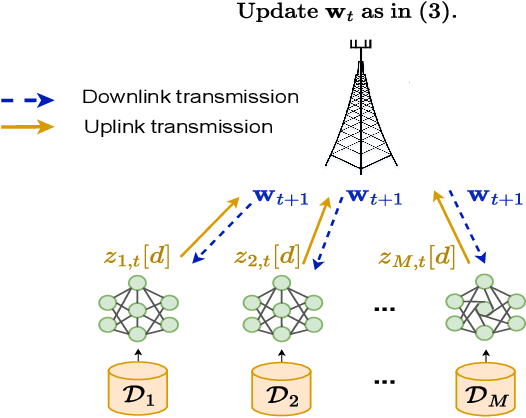
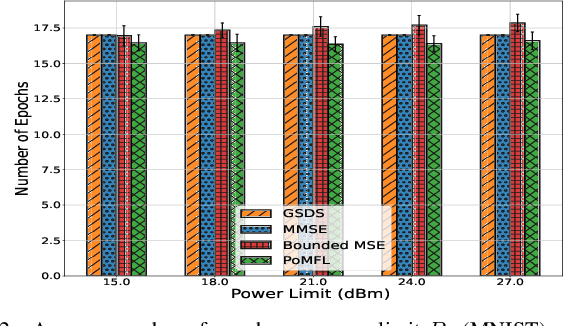
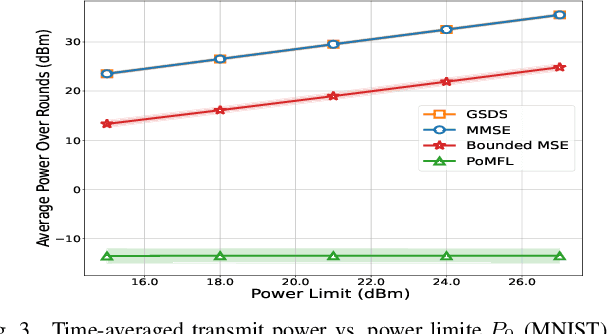
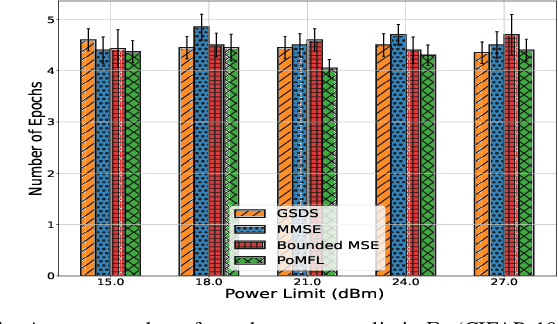
This paper studies power-efficient uplink transmission design for federated learning (FL) that employs over-the-air analog aggregation and multi-antenna beamforming at the server. We jointly optimize device transmit weights and receive beamforming at each FL communication round to minimize the total device transmit power while ensuring convergence in FL training. Through our convergence analysis, we establish sufficient conditions on the aggregation error to guarantee FL training convergence. Utilizing these conditions, we reformulate the power minimization problem into a unique bi-convex structure that contains a transmit beamforming optimization subproblem and a receive beamforming feasibility subproblem. Despite this unconventional structure, we propose a novel alternating optimization approach that guarantees monotonic decrease of the objective value, to allow convergence to a partial optimum. We further consider imperfect channel state information (CSI), which requires accounting for the channel estimation errors in the power minimization problem and FL convergence analysis. We propose a CSI-error-aware joint beamforming algorithm, which can substantially outperform one that does not account for channel estimation errors. Simulation with canonical classification datasets demonstrates that our proposed methods achieve significant power reduction compared to existing benchmarks across a wide range of parameter settings, while attaining the same target accuracy under the same convergence rate.
Joint Beamforming and Device Selection in Federated Learning with Over-the-air Aggregation
Feb 28, 2023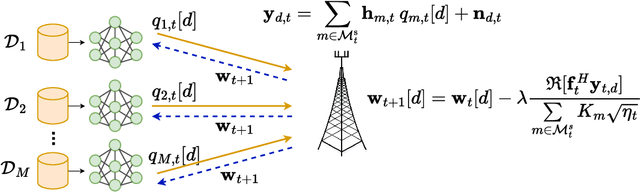
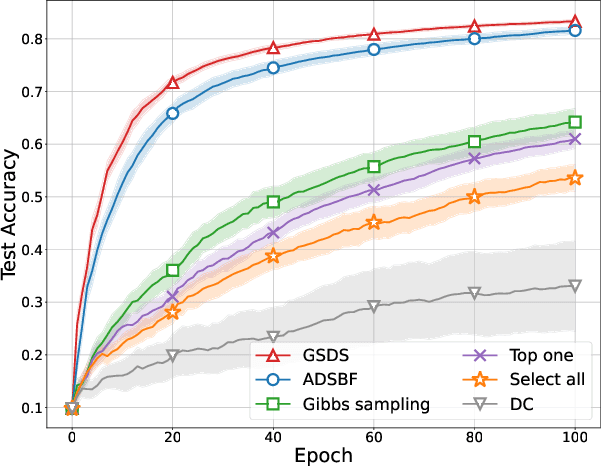
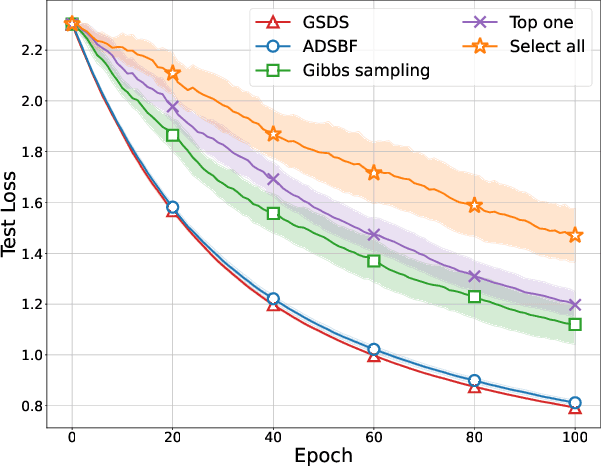
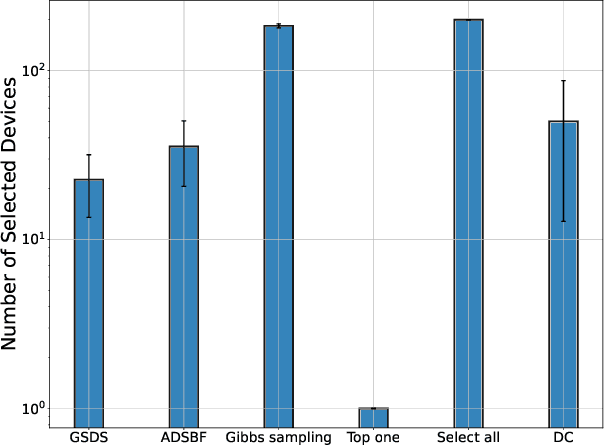
Federated Learning (FL) with over-the-air computation is susceptible to analog aggregation error due to channel conditions and noise. Excluding devices with weak channels can reduce the aggregation error, but also decreases the amount of training data in FL. In this work, we jointly design the uplink receiver beamforming and device selection in over-the-air FL to maximize the training convergence rate. We propose a new method termed JBFDS, which takes into account the impact of receiver beamforming and device selection on the global loss function at each training round. Our simulation results with real-world image classification demonstrate that the proposed method achieves faster convergence with significantly lower computational complexity than existing alternatives.