 Add to Chrome
 Add to Firefox
 Add to Edge
Federated continual learning: A comprehensive survey on lifelong and privacy-preserving learning over distributed and non-stationary data
Jun 09, 2026
Federated Learning (FL) enables collaborative and privacy-preserving model training across distributed clients, but most existing FL systems implicitly assume data stationarity. In real-world settings-such as healthcare, industrial IoT (IIOT), cybersecurity, and smart cities-data streams are inherently non-stationary, leading classical FL methods to suffer from performance degradation, instability, and catastrophic forgetting. Continual Learning (CL) addresses learning under evolving data distributions but has been largely studied in centralized settings, overlooking key constraints of federated systems, including privacy, limited communication, and client heterogeneity. Federated Continual Learning (FCL) emerges at the intersection of FL and CL, aiming to support lifelong, adaptive, and privacy-aware learning over distributed and non-stationary data. This survey provides a comprehensive and systematic overview of FCL. We first present a formal definition of the FCL problem and clarify its distinctive characteristics. We then analyze the limitations of classical FL under non-stationary conditions, highlighting how CL principles support long-term adaptation. To organize the rapidly growing literature, we propose a multi-dimensional taxonomy of FCL approaches. Furthermore, we review representative application domains and data modalities, summarize commonly used evaluation metrics, and discuss experimental perspectives for assessing long-term performance and forgetting. Finally, we highlight key open challenges, including handling extreme heterogeneity under temporal drift, designing scalable and privacy-preserving memory mechanisms, and establishing standardized benchmarks. This survey aims to serve as a reference and a roadmap for advancing FCL toward robust and deployable real-world systems.
* 77 pages, 8 figures

Condition monitoring and early diagnostics methodologies for hydropower plants
Nov 13, 2019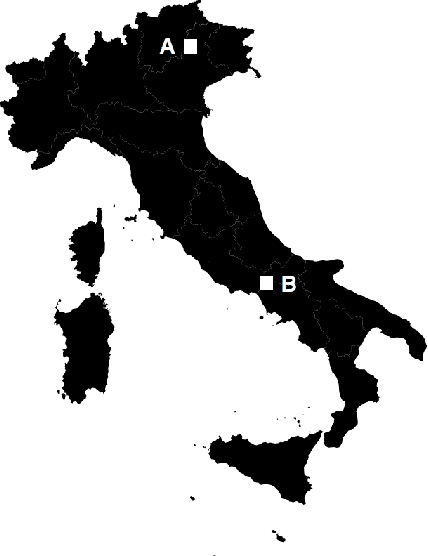
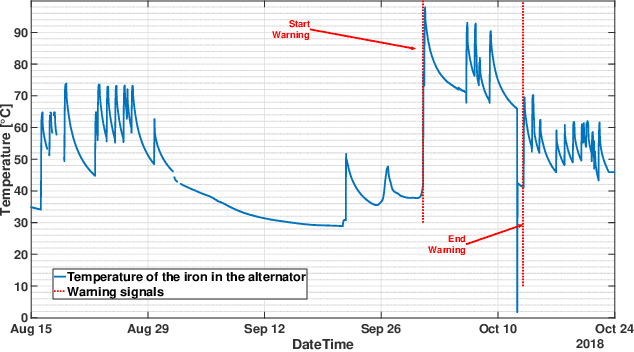
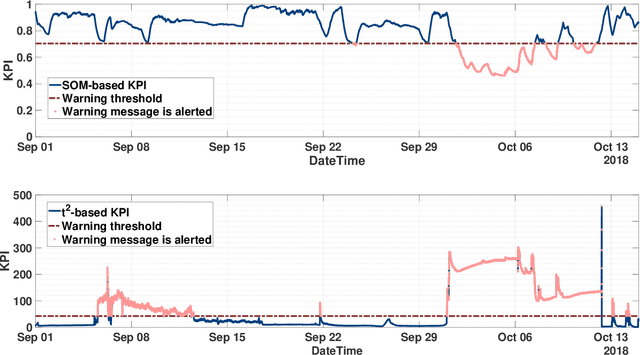
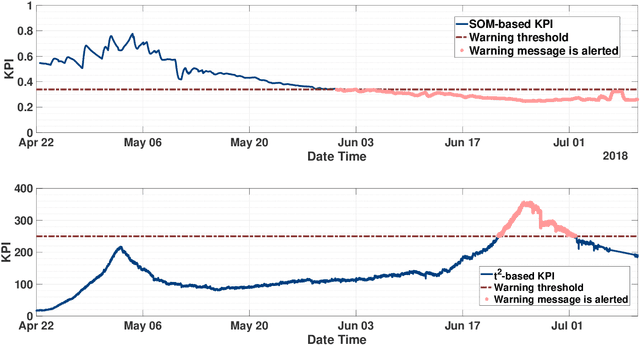
Hydropower plants are one of the most convenient option for power generation, as they generate energy exploiting a renewable source, they have relatively low operating and maintenance costs, and they may be used to provide ancillary services, exploiting the large reservoirs of available water. The recent advances in Information and Communication Technologies (ICT) and in machine learning methodologies are seen as fundamental enablers to upgrade and modernize the current operation of most hydropower plants, in terms of condition monitoring, early diagnostics and eventually predictive maintenance. While very few works, or running technologies, have been documented so far for the hydro case, in this paper we propose a novel Key Performance Indicator (KPI) that we have recently developed and tested on operating hydropower plants. In particular, we show that after more than one year of operation it has been able to identify several faults, and to support the operation and maintenance tasks of plant operators. Also, we show that the proposed KPI outperforms conventional multivariable process control charts, like the Hotelling $t_2$ index.
Predictive Maintenance in Photovoltaic Plants with a Big Data Approach
Jan 29, 2019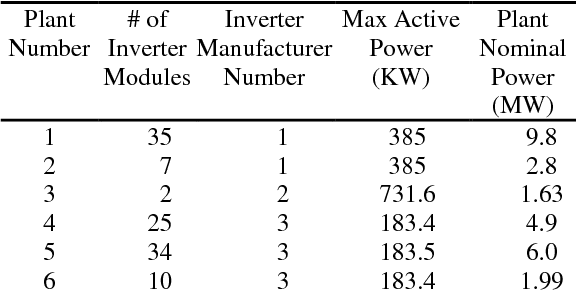
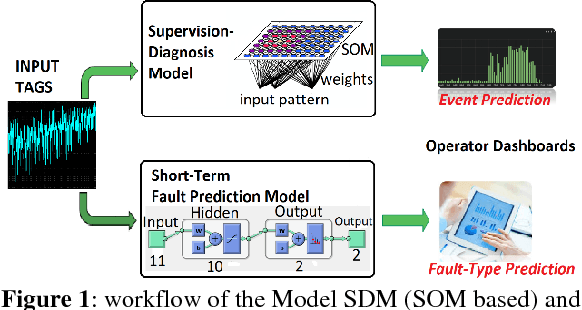
This paper presents a novel and flexible solution for fault prediction based on data collected from SCADA system. Fault prediction is offered at two different levels based on a data-driven approach: (a) generic fault/status prediction and (b) specific fault class prediction, implemented by means of two different machine learning based modules built on an unsupervised clustering algorithm and a Pattern Recognition Neural Network, respectively. Model has been assessed on a park of six photovoltaic (PV) plants up to 10 MW and on more than one hundred inverter modules of three different technology brands. The results indicate that the proposed method is effective in (a) predicting incipient generic faults up to 7 days in advance with sensitivity up to 95% and (b) anticipating damage of specific fault classes with times ranging from few hours up to 7 days. The model is easily deployable for on-line monitoring of anomalies on new PV plants and technologies, requiring only the availability of historical SCADA and fault data, fault taxonomy and inverter electrical datasheet. Keywords: Data Mining, Fault Prediction, Inverter Module, Key Performance Indicator, Lost Production
* Preprint of the 33rd EUPVSEC Proceeding, 25-29 September 2017, Amsterdam. Plenary Presentation