 Add to Chrome
 Add to Firefox
 Add to Edge
Quantifying Full-Body Immersion
May 21, 2026
Humanity is at the forefront of yet another digital revolution, where the lines between real and virtual worlds are dissolving, reshaping how we perceive and interact with our surroundings. In this context, we introduce a transformative paradigm for immersive virtual experiences centered around whole-body kinetic interactions. Our approach redefines immersion through three distinct levels: audio-visual immersion, capturing sensory realism; physical immersion, delivering haptic feedback; and full-body immersion (FBI), where dynamic bodily interaction integrates seamlessly with virtual environments. At the core of this innovation lies a scalable, distributable platform based on modular robotic surface units inspired by the adaptive designs of nature. These units enable the rendering of immersive environments at any scale, from intimate personal experiences to expansive multi-user settings, dynamically adapting to interactions in real-time. The modular system distributes force, shape, and motion feedback throughout entire spaces, replicating the physical characteristics of the environment and enabling new depth of engagement through FBI. By combining scalability, adaptability, and dynamic physical engagement, this framework bridges the gap between real and virtual worlds. It offers an unprecedented level of immersion where users can engage their entire bodies in symbiotic interactions with the virtual space. This work not only advances immersive technology but also redefines how humans and virtual environments coexist, setting a foundation for a new era of human-environment synthesis.

Surface-Based Manipulation
Feb 26, 2025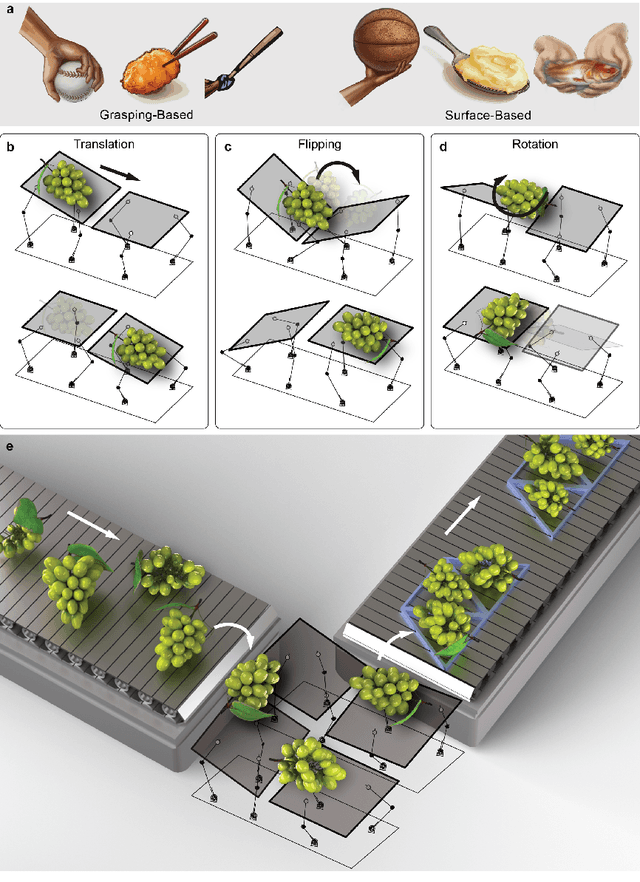
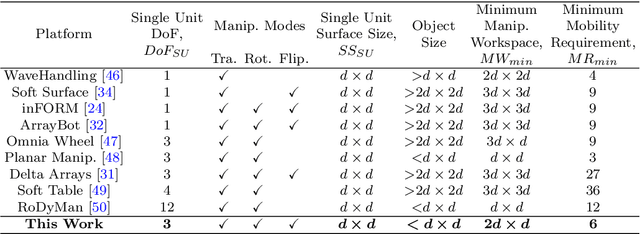
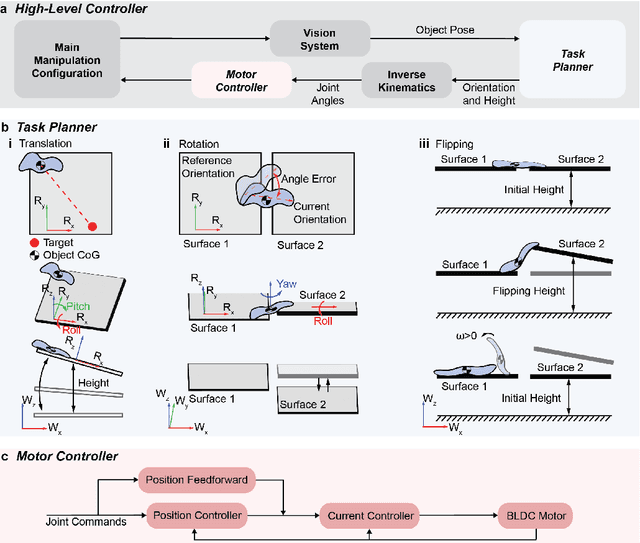
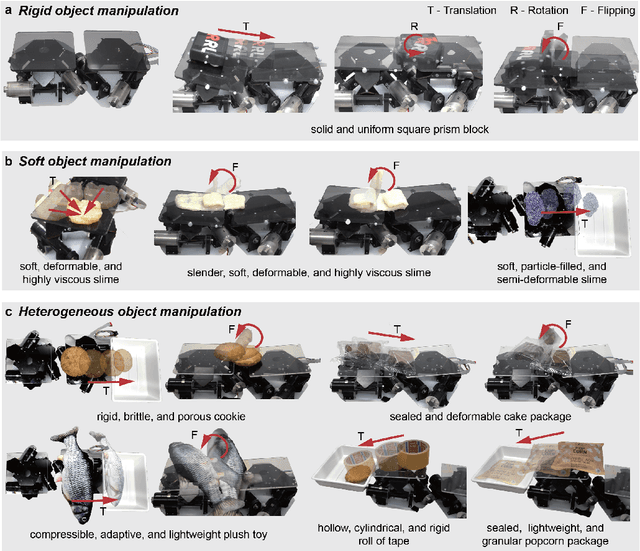
Intelligence lies not only in the brain but in the body. The shape of our bodies can influence how we think and interact with the physical world. In robotics research, interacting with the physical world is crucial as it allows robots to manipulate objects in various real-life scenarios. Conventional robotic manipulation strategies mainly rely on finger-shaped end effectors. However, achieving stable grasps on fragile, deformable, irregularly shaped, or slippery objects is challenging due to difficulties in establishing stable force or geometric constraints. Here, we present surface-based manipulation strategies that diverge from classical grasping approaches, using with flat surfaces as minimalist end-effectors. By changing the position and orientation of these surfaces, objects can be translated, rotated and even flipped across the surface using closed-loop control strategies. Since this method does not rely on stable grasp, it can adapt to objects of various shapes, sizes, and stiffness levels, even enabling the manipulation the shape of deformable objects. Our results provide a new perspective for solving complex manipulation problems.