 Add to Chrome
 Add to Firefox
 Add to Edge
Integrated Identification of Collaborative Robots for Robot Assisted 3D Printing Processes
Apr 02, 2026
In recent years, the integration of additive manufacturing (AM) and industrial robotics has opened new perspectives for the production of complex components, particularly in the automotive sector. Robot-assisted additive manufacturing processes overcome the dimensional and kinematic limitations of traditional Cartesian systems, enabling non-planar deposition and greater geometric flexibility. However, the increasing dynamic complexity of robotic manipulators introduces challenges related to precision, control, and error prediction. This work proposes a model-based approach equipped with an integrated identification procedure of the system's parameters, including the robot, the actuators and the controllers. We show that the integrated modeling procedure allows to obtain a reliable dynamic model even in the presence of sensory and programming limitations typical of collaborative robots. The manipulator's dynamic model is identified through an integrated five step methodology: starting with geometric and inertial analysis, followed by friction and controller parameters identification, all the way to the remaining parameters identification. The proposed procedure intrinsically ensures the physical consistency of the identified parameters. The identification approach is validated on a real world case study involving a 6-Degrees-Of-Freedom (DoFs) collaborative robot used in a thermoplastic extrusion process. The very good matching between the experimental results given by actual robot and those given by the identified model shows the potential enhancement of precision, control, and error prediction in Robot Assisted 3D Printing Processes.

A Minimum-Energy Control Approach for Redundant Mobile Manipulators in Physical Human-Robot Interaction Applications
Mar 26, 2026Research on mobile manipulation systems that physically interact with humans has expanded rapidly in recent years, opening the way to tasks which could not be performed using fixed-base manipulators. Within this context, developing suitable control methodologies is essential since mobile manipulators introduce additional degrees of freedom, making the design of control approaches more challenging and more prone to performance optimization. This paper proposes a control approach for a mobile manipulator, composed of a mobile base equipped with a robotic arm mounted on the top, with the objective of minimizing the overall kinetic energy stored in the whole-body mobile manipulator in physical human-robot interaction applications. The approach is experimentally tested with reference to a peg-in-hole task, and the results demonstrate that the proposed approach reduces the overall kinetic energy stored in the whole-body robotic system and improves the system performance compared with the benchmark method.
Optimizing Design and Control Methods for Using Collaborative Robots in Upper-Limb Rehabilitation
Jul 26, 2024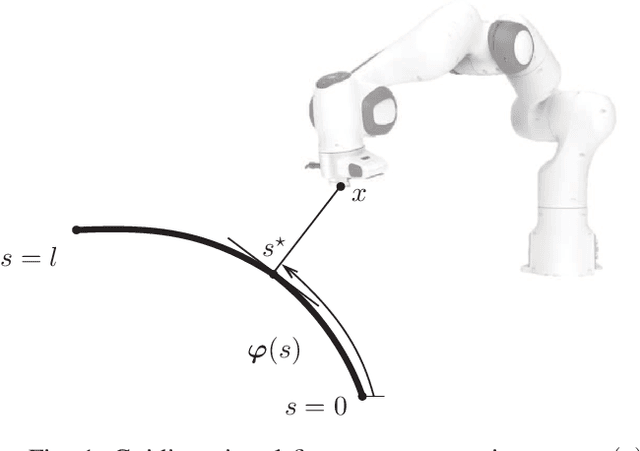
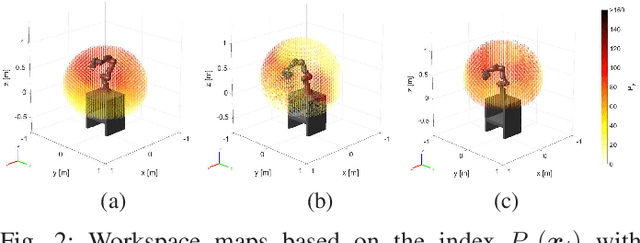
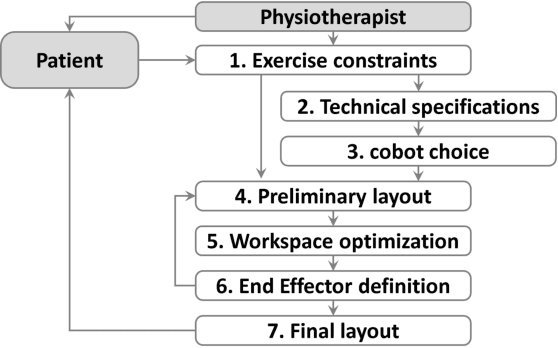
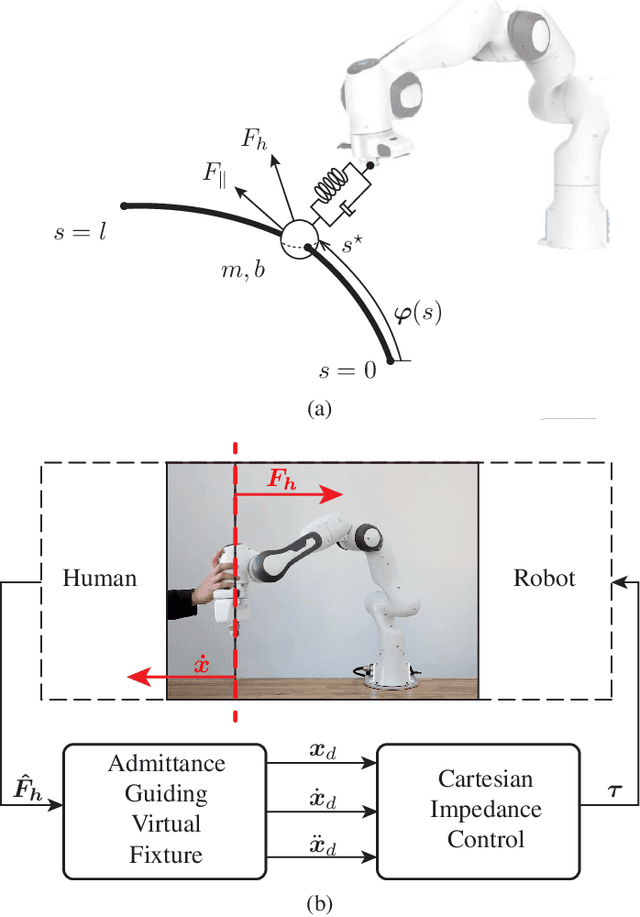
In this paper, we address the development of a robotic rehabilitation system for the upper limbs based on collaborative end-effector solutions. The use of commercial collaborative robots offers significant advantages for this task, as they are optimized from an engineering perspective and ensure safe physical interaction with humans. However, they also come with noticeable drawbacks, such as the limited range of sizes available on the market and the standard control modes, which are primarily oriented towards industrial or service applications. To address these limitations, we propose an optimization-based design method to fully exploit the capability of the cobot in performing rehabilitation tasks. Additionally, we introduce a novel control architecture based on an admittance-type Virtual Fixture method, which constrains the motion of the robot along a prescribed path. This approach allows for an intuitive definition of the task to be performed via Programming by Demonstration and enables the system to operate both passively and actively. In passive mode, the system supports the patient during task execution with additional force, while in active mode, it opposes the motion with a braking force. Experimental results demonstrate the effectiveness of the proposed method.