 Add to Chrome
 Add to Firefox
 Add to Edge
A Mean Field Games Perspective on Evolutionary Clustering
Mar 28, 2026
We propose a control-theoretic framework for evolutionary clustering based on Mean Field Games (MFG). Moving beyond static or heuristic approaches, we formulate the problem as a population dynamics game governed by a coupled Hamilton-Jacobi-Bellman and Fokker-Planck system. Driven by a variational cost functional rather than predefined statistical shapes, this continuous-time formulation provides a flexible basis for non-parametric cluster evolution. To validate the framework, we analyze the setting of time-dependent Gaussian mixtures, showing that the MFG dynamics recover the trajectories of the classical Expectation-Maximization (EM) algorithm while ensuring mass conservation. Furthermore, we introduce time-averaged log-likelihood functionals to regularize temporal fluctuations. Numerical experiments illustrate the stability of our approach and suggest a path toward more general non-parametric clustering applications where traditional EM methods may face limitations.

A Mean Field Games model for finite mixtures of Bernoulli distributions
Apr 17, 2020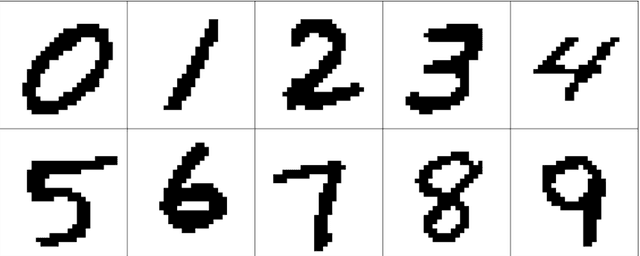

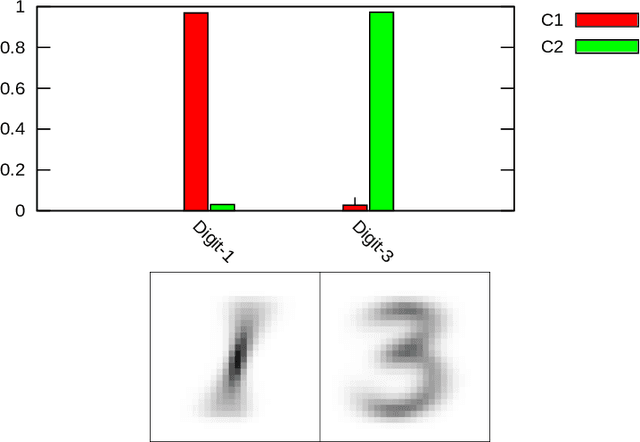
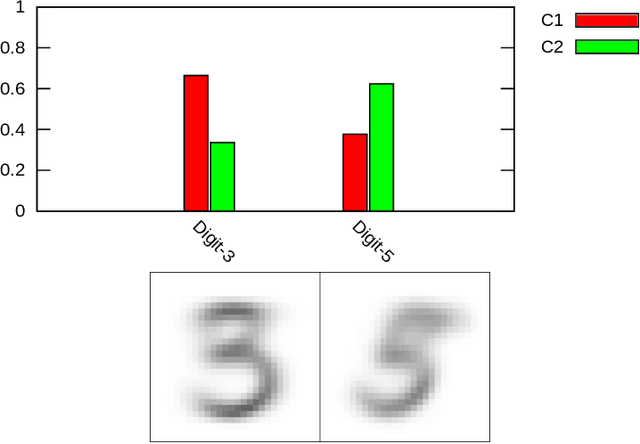
Finite mixture models are an important tool in the statistical analysis of data, for example in data clustering. The optimal parameters of a mixture model are usually computed by maximizing the log-likelihood functional via the Expectation-Maximization algorithm. We propose an alternative approach based on the theory of Mean Field Games, a class of differential games with an infinite number of agents. We show that the solution of a finite state space multi-population Mean Field Games system characterizes the critical points of the log-likelihood functional for a Bernoulli mixture. The approach is then generalized to mixture models of categorical distributions. Hence, the Mean Field Games approach provides a method to compute the parameters of the mixture model, and we show its application to some standard examples in cluster analysis.