 Add to Chrome
 Add to Firefox
 Add to Edge
Self-adapting Robotic Agents through Online Continual Reinforcement Learning with World Model Feedback
Mar 04, 2026
As learning-based robotic controllers are typically trained offline and deployed with fixed parameters, their ability to cope with unforeseen changes during operation is limited. Biologically inspired, this work presents a framework for online Continual Reinforcement Learning that enables automated adaptation during deployment. Building on DreamerV3, a model-based Reinforcement Learning algorithm, the proposed method leverages world model prediction residuals to detect out-of-distribution events and automatically trigger finetuning. Adaptation progress is monitored using both task-level performance signals and internal training metrics, allowing convergence to be assessed without external supervision and domain knowledge. The approach is validated on a variety of contemporary continuous control problems, including a quadruped robot in high-fidelity simulation, and a real-world model vehicle. Relevant metrics and their interpretation are presented and discussed, as well as resulting trade-offs described. The results sketch out how autonomous robotic agents could once move beyond static training regimes toward adaptive systems capable of self-reflection and -improvement during operation, just like their biological counterparts.

World Models for Anomaly Detection during Model-Based Reinforcement Learning Inference
Mar 04, 2025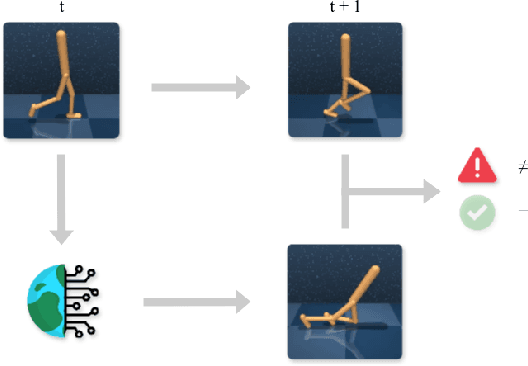
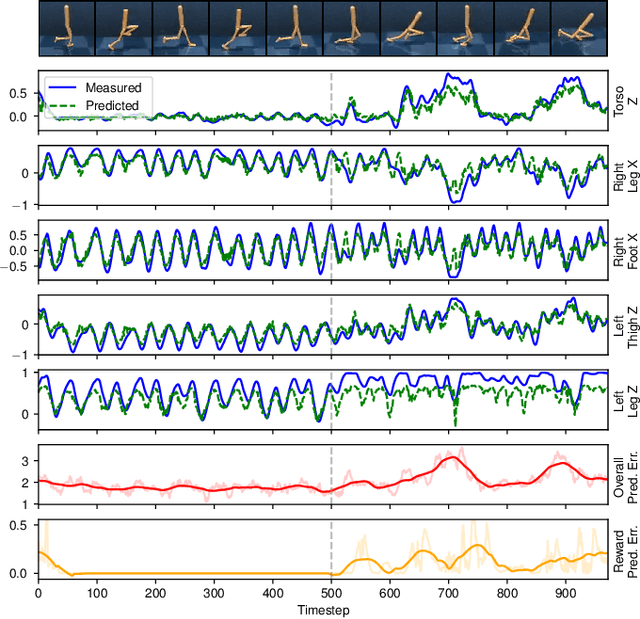
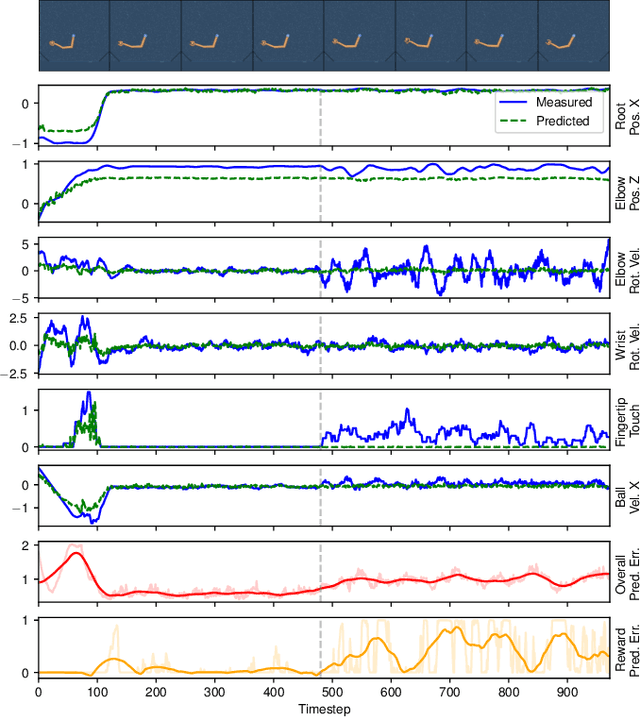
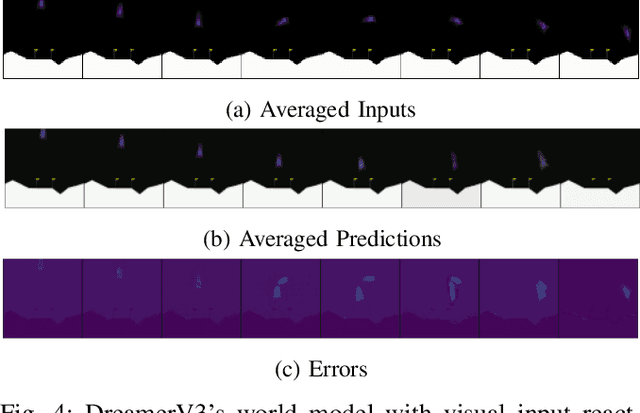
Learning-based controllers are often purposefully kept out of real-world applications due to concerns about their safety and reliability. We explore how state-of-the-art world models in Model-Based Reinforcement Learning can be utilized beyond the training phase to ensure a deployed policy only operates within regions of the state-space it is sufficiently familiar with. This is achieved by continuously monitoring discrepancies between a world model's predictions and observed system behavior during inference. It allows for triggering appropriate measures, such as an emergency stop, once an error threshold is surpassed. This does not require any task-specific knowledge and is thus universally applicable. Simulated experiments on established robot control tasks show the effectiveness of this method, recognizing changes in local robot geometry and global gravitational magnitude. Real-world experiments using an agile quadcopter further demonstrate the benefits of this approach by detecting unexpected forces acting on the vehicle. These results indicate how even in new and adverse conditions, safe and reliable operation of otherwise unpredictable learning-based controllers can be achieved.