 Add to Chrome
 Add to Firefox
 Add to Edge
RL-ASL: A Dynamic Listening Optimization for TSCH Networks Using Reinforcement Learning
Apr 08, 2026
Time Slotted Channel Hopping (TSCH) is a widely adopted Media Access Control (MAC) protocol within the IEEE 802.15.4e standard, designed to provide reliable and energy-efficient communication in Industrial Internet of Things (IIoT) networks. However, state-of-the-art TSCH schedulers rely on static slot allocations, resulting in idle listening and unnecessary power consumption under dynamic traffic conditions. This paper introduces RL-ASL, a reinforcement learning-driven adaptive listening framework that dynamically decides whether to activate or skip a scheduled listening slot based on real-time network conditions. By integrating learning-based slot skipping with standard TSCH scheduling, RL-ASL reduces idle listening while preserving synchronization and delivery reliability. Experimental results on the FIT IoT-LAB testbed and Cooja network simulator show that RL-ASL achieves up to 46% lower power consumption than baseline scheduling protocols, while maintaining near-perfect reliability and reducing average latency by up to 96% compared to PRIL-M. Its link-based variant, RL-ASL-LB, further improves delay performance under high contention with similar energy efficiency. Importantly, RL-ASL performs inference on constrained motes with negligible overhead, as model training is fully performed offline. Overall, RL-ASL provides a practical, scalable, and energy-aware scheduling mechanism for next-generation low-power IIoT networks.

A Centralized Reinforcement Learning Framework for Adaptive Clustering with Low Control Overhead in IoT Networks
Jan 28, 2024
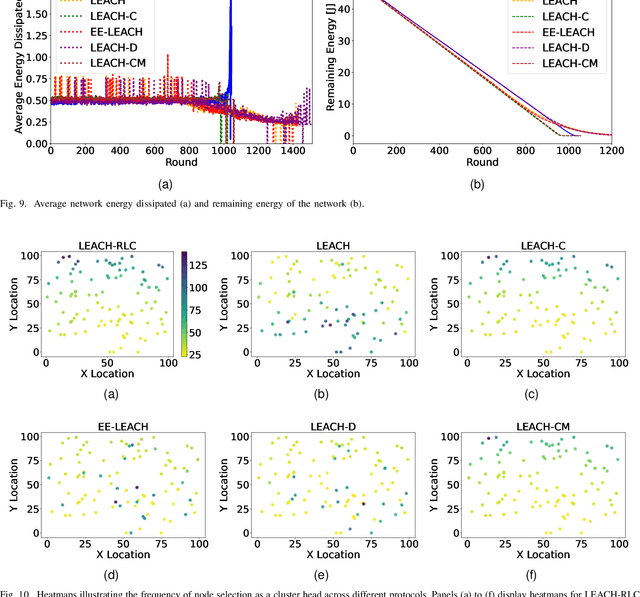

Wireless Sensor Networks (WSNs) play a pivotal role in enabling Internet of Things (IoT) devices with sensing and actuation capabilities. Operating in remote and resource-constrained environments, these IoT devices face challenges related to energy consumption, crucial for network longevity. Clustering protocols have emerged as an effective solution to alleviate energy burdens on IoT devices. This paper introduces Low-Energy Adaptive Clustering Hierarchy with Reinforcement Learning-based Controller (LEACH-RLC), a novel clustering protocol that employs a Mixed Integer Linear Programming (MILP) for strategic selection of cluster heads (CHs) and node-to-cluster assignments. Additionally, it integrates a Reinforcement Learning (RL) agent to minimize control overhead by learning optimal timings for generating new clusters. Addressing key research questions, LEACH-RLC seeks to balance control overhead reduction without compromising overall network performance. Through extensive simulations, this paper investigates the frequency and opportune moments for generating new clustering solutions. Results demonstrate the superior performance of LEACH-RLC over conventional LEACH and LEACH-C, showcasing enhanced network lifetime, reduced average energy consumption, and minimized control overhead. The proposed protocol contributes to advancing the efficiency and adaptability of WSNs, addressing critical challenges in IoT deployments.