 Add to Chrome
 Add to Firefox
 Add to Edge
SpurCon: Weighted Supervised Contrastive Learning for Mitigating Spurious Cues in Medical Imaging
Aug 18, 2026
Despite the rapid progress of deep neural networks in visual recognition, their adoption in high-risk medical applications remains limited due to reliability and robustness concerns. Models may exploit spurious correlations, particularly in medical imaging, where devices or treatment artifacts often co-occur with pathology. In small or imbalanced datasets, such cues further reduce worst-group performance and undermine clinical trust. To solve these issues, two major challenges should be addressed: identifying dataset-specific spurious cues, which typically require domain knowledge, and mitigating reliance on them. To tackle both, we propose SpurCon, a lightweight framework based on a novel supervised contrastive loss formulation that leverages available metadata and predicted spurious labels to enhance robustness. We introduce a fast few-shot procedure, without network training, to estimate spurious labels using a small number of expert-annotated samples. We then propose a weighted supervised contrastive objective, WtSupCon, that reshapes the representation geometry by assigning sample-specific weights that depend on the [pathology, spurious, metadata] combination. For example, the highest weight is assigned to samples that differ only in their spurious label. This yields highly similar representations for images with the same metadata and pathology, differing only in the predicted spurious label. Our method operates on pretrained image encoders (such as BiomedCLIP) and trains only a lightweight projection head. We evaluate SpurCon on a synthetic setting and on Waterbirds, CheXpert, a chest X-ray classification dataset, and ISIC 2020, a skin cancer classification dataset. Our approach delivers the best spurious-mitigation performance, balancing well worst-group and overall accuracy on multiple datasets.

A Classifier-Agnostic Zero-Shot Adversarial Attack Detection via CLIP
Jun 30, 2026Adversarial attacks pose a challenge to the reliability of deep learning models, motivating effective detection methods. Existing techniques often rely on attack-specific assumptions, access to adversarial samples, or knowledge of the underlying classifier (white-box). We propose $A^4D$ Attack- and Architecture-Agnostic Adversarial Detector, a completely black-box, zero-shot adversarial attack detection framework that utilizes prompt-based similarity scores derived from CLIP. To the best of our knowledge this is the first attempt to utilize CLIP for such a task. The method is based on two key observations: (i) CLIP is sensitive even to small imperceptible non-semantic perturbations; (ii) The shift in CLIP embedding space is not arbitrary and can be used as a robust attack indicator. Experiments across multiple attacks, datasets and classifiers validate that $A^4D$ achieves SOTA detection results in the attack-agnostic and classifier-agnostic setting.
The Universal Normal Embedding
Mar 23, 2026Generative models and vision encoders have largely advanced on separate tracks, optimized for different goals and grounded in different mathematical principles. Yet, they share a fundamental property: latent space Gaussianity. Generative models map Gaussian noise to images, while encoders map images to semantic embeddings whose coordinates empirically behave as Gaussian. We hypothesize that both are views of a shared latent source, the Universal Normal Embedding (UNE): an approximately Gaussian latent space from which encoder embeddings and DDIM-inverted noise arise as noisy linear projections. To test our hypothesis, we introduce NoiseZoo, a dataset of per-image latents comprising DDIM-inverted diffusion noise and matching encoder representations (CLIP, DINO). On CelebA, linear probes in both spaces yield strong, aligned attribute predictions, indicating that generative noise encodes meaningful semantics along linear directions. These directions further enable faithful, controllable edits (e.g., smile, gender, age) without architectural changes, where simple orthogonalization mitigates spurious entanglements. Taken together, our results provide empirical support for the UNE hypothesis and reveal a shared Gaussian-like latent geometry that concretely links encoding and generation. Code and data are available https://rbetser.github.io/UNE/
InfoNCE Induces Gaussian Distribution
Feb 27, 2026Contrastive learning has become a cornerstone of modern representation learning, allowing training with massive unlabeled data for both task-specific and general (foundation) models. A prototypical loss in contrastive training is InfoNCE and its variants. In this work, we show that the InfoNCE objective induces Gaussian structure in representations that emerge from contrastive training. We establish this result in two complementary regimes. First, we show that under certain alignment and concentration assumptions, projections of the high-dimensional representation asymptotically approach a multivariate Gaussian distribution. Next, under less strict assumptions, we show that adding a small asymptotically vanishing regularization term that promotes low feature norm and high feature entropy leads to similar asymptotic results. We support our analysis with experiments on synthetic and CIFAR-10 datasets across multiple encoder architectures and sizes, demonstrating consistent Gaussian behavior. This perspective provides a principled explanation for commonly observed Gaussianity in contrastive representations. The resulting Gaussian model enables principled analytical treatment of learned representations and is expected to support a wide range of applications in contrastive learning.
A Pseudo-Inverse for Nonlinear Operators
Nov 21, 2021
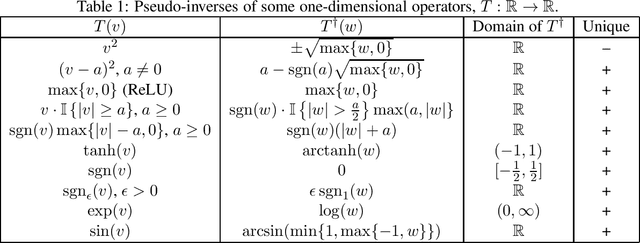

The Moore-Penrose inverse is widely used in physics, statistics and various fields of engineering. Among other characteristics, it captures well the notion of inversion of linear operators in the case of overcomplete data. In data science, nonlinear operators are extensively used. In this paper we define and characterize the fundamental properties of a pseudo-inverse for nonlinear operators. The concept is defined broadly. First for general sets, and then a refinement for normed spaces. Our pseudo-inverse for normed spaces yields the Moore-Penrose inverse when the operator is a matrix. We present conditions for existence and uniqueness of a pseudo-inverse and establish theoretical results investigating its properties, such as continuity, its value for operator compositions and projection operators, and others. Analytic expressions are given for the pseudo-inverse of some well-known, non-invertible, nonlinear operators, such as hard- or soft-thresholding and ReLU. Finally, we analyze a neural layer and discuss relations to wavelet thresholding and to regularized loss minimization.
Experts with Lower-Bounded Loss Feedback: A Unifying Framework
Dec 17, 2020The most prominent feedback models for the best expert problem are the full information and bandit models. In this work we consider a simple feedback model that generalizes both, where on every round, in addition to a bandit feedback, the adversary provides a lower bound on the loss of each expert. Such lower bounds may be obtained in various scenarios, for instance, in stock trading or in assessing errors of certain measurement devices. For this model we prove optimal regret bounds (up to logarithmic factors) for modified versions of Exp3, generalizing algorithms and bounds both for the bandit and the full-information settings. Our second-order unified regret analysis simulates a two-step loss update and highlights three Hessian or Hessian-like expressions, which map to the full-information regret, bandit regret, and a hybrid of both. Our results intersect with those for bandits with graph-structured feedback, in that both settings can accommodate feedback from an arbitrary subset of experts on each round. However, our model also accommodates partial feedback at the single-expert level, by allowing non-trivial lower bounds on each loss.
Adaptive LiDAR Sampling and Depth Completion using Ensemble Variance
Jul 27, 2020
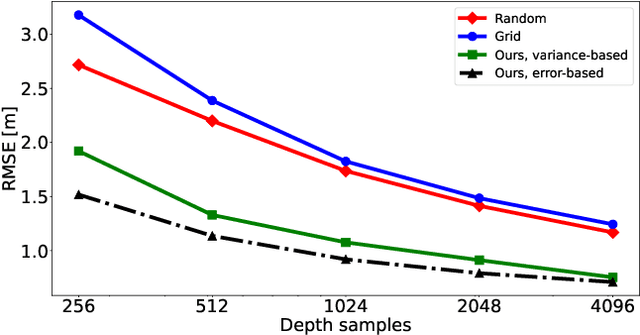
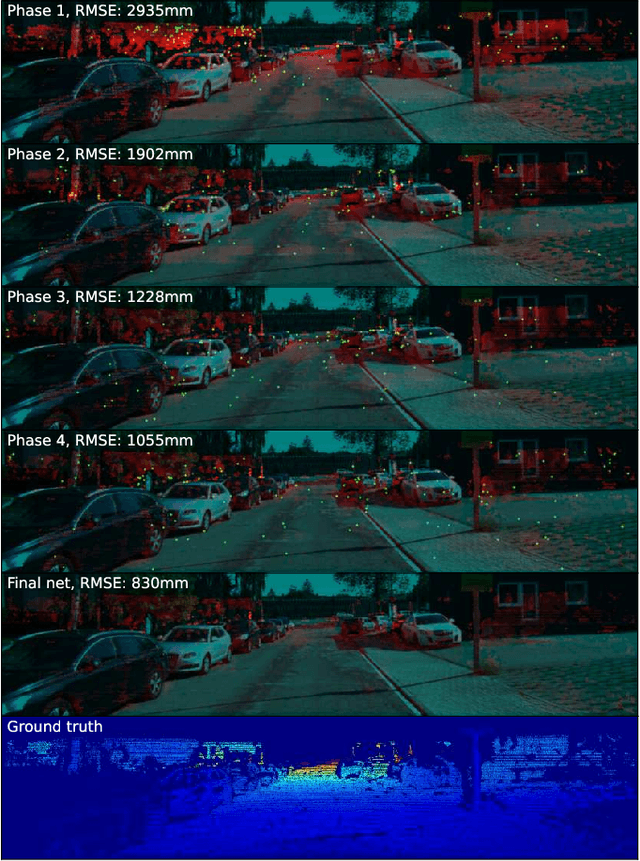
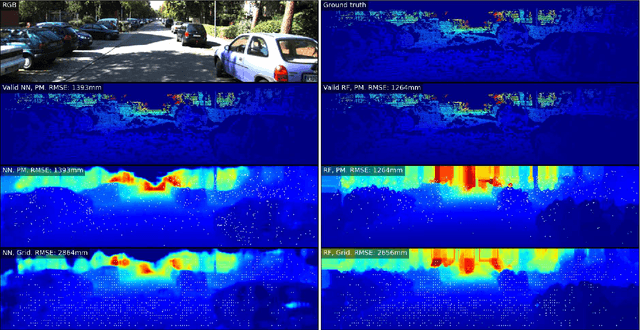
This work considers the problem of depth completion, with or without image data, where an algorithm may measure the depth of a prescribed limited number of pixels. The algorithmic challenge is to choose pixel positions strategically and dynamically to maximally reduce overall depth estimation error. This setting is realized in daytime or nighttime depth completion for autonomous vehicles with a programmable LiDAR. Our method uses an ensemble of predictors to define a sampling probability over pixels. This probability is proportional to the variance of the predictions of ensemble members, thus highlighting pixels that are difficult to predict. By additionally proceeding in several prediction phases, we effectively reduce redundant sampling of similar pixels. Our ensemble-based method may be implemented using any depth-completion learning algorithm, such as a state-of-the-art neural network, treated as a black box. In particular, we also present a simple and effective Random Forest-based algorithm, and similarly use its internal ensemble in our design. We conduct experiments on the KITTI dataset, using the neural network algorithm of Ma et al. and our Random Forest based learner for implementing our method. The accuracy of both implementations exceeds the state of the art. Compared with a random or grid sampling pattern, our method allows a reduction by a factor of 4-10 in the number of measurements required to attain the same accuracy.