 Add to Chrome
 Add to Firefox
 Add to Edge
Semantic Space Search Trajectory Networks
Jul 27, 2026
Search Trajectory Networks (STNs) are a graph-based tool for visualizing and characterizing the behavior of optimization algorithms. STNs' reliance on discretization of the search space has largely confined them to low-dimensional or combinatorial settings. We introduce a methodology for constructing STNs in semantic spaces, defined as the space of a model's predictions on a fixed sample set. Our approach discretizes semantic vectors and aggregates them into network nodes via agglomerative clustering with complete linkage under a normalized Hamming distance. Since any predictor can be summarized by its semantic vector, this method enables comparison of learning dynamics across otherwise incomparable algorithm families. We apply semantic space STNs to classification and regression tasks solved using different machine learning algorithms, recovering known qualitative differences between them. Additionally, we use semantic space STNs to study neural network generalization by contrasting standard training with the label randomization regime of Zhang et al. (2017). The resulting STNs exhibit consistent structural differences, training on real labels produces denser, more efficient and more centralized graphs than training on shuffled labels. Together, our results show that semantic space STNs capture functional training dynamics arising from the interaction between learning algorithms and data, providing a tool for analyzing and comparing learning dynamics across machine learning models and training regimes.

Evaluation of Interactive Machine Learning Systems
Jan 24, 2018


The evaluation of interactive machine learning systems remains a difficult task. These systems learn from and adapt to the human, but at the same time, the human receives feedback and adapts to the system. Getting a clear understanding of these subtle mechanisms of co-operation and co-adaptation is challenging. In this chapter, we report on our experience in designing and evaluating various interactive machine learning applications from different domains. We argue for coupling two types of validation: algorithm-centered analysis, to study the computational behaviour of the system; and human-centered evaluation, to observe the utility and effectiveness of the application for end-users. We use a visual analytics application for guided search, built using an interactive evolutionary approach, as an exemplar of our work. Our observation is that human-centered design and evaluation complement algorithmic analysis, and can play an important role in addressing the "black-box" effect of machine learning. Finally, we discuss research opportunities that require human-computer interaction methodologies, in order to support both the visible and hidden roles that humans play in interactive machine learning.
Applying Evolutionary Optimisation to Robot Obstacle Avoidance
Oct 25, 2005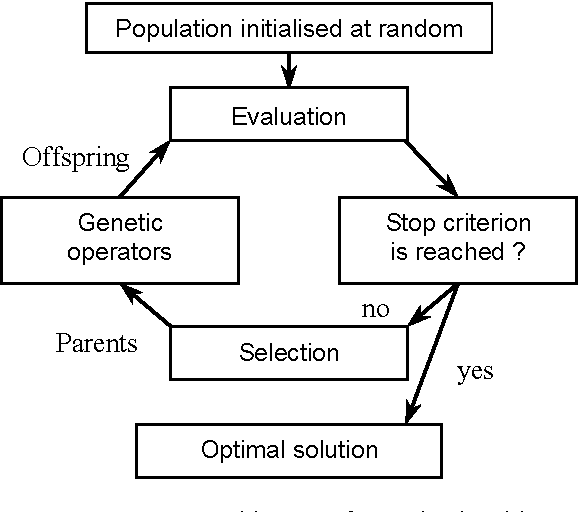
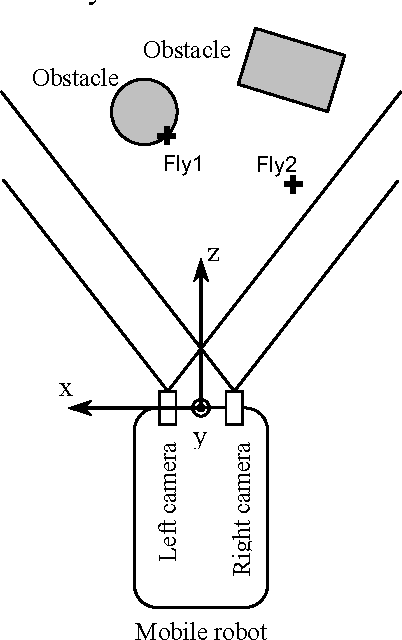
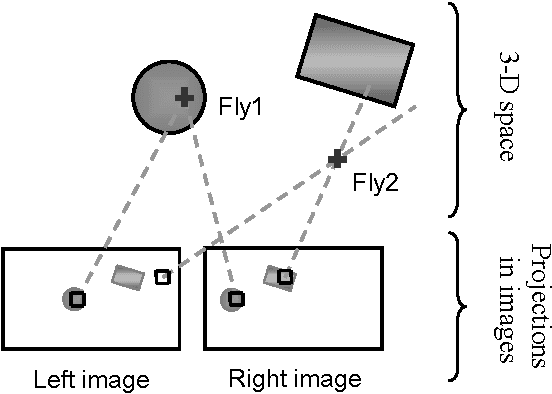
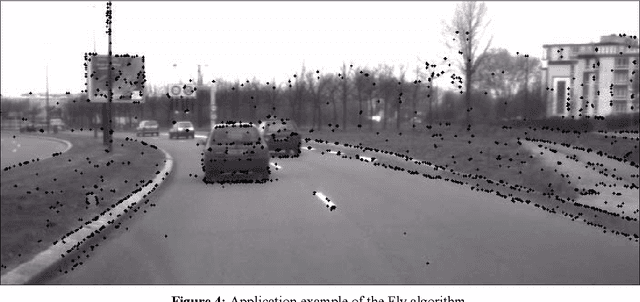
This paper presents an artificial evolutionbased method for stereo image analysis and its application to real-time obstacle detection and avoidance for a mobile robot. It uses the Parisian approach, which consists here in splitting the representation of the robot's environment into a large number of simple primitives, the "flies", which are evolved following a biologically inspired scheme and give a fast, low-cost solution to the obstacle detection problem in mobile robotics.