 Add to Chrome
 Add to Firefox
 Add to Edge
Measuring Embedding Sensitivity to Authorial Style in French: Comparing Literary Texts with Language Model Rewritings
May 11, 2026
Large language models (LLMs) can convincingly imitate human writing styles, yet it remains unclear how much stylistic information is encoded in embeddings from any language model and retained after LLM rewriting. We investigate these questions in French, using a controlled literary dataset to quantify the effect of stylistic variation via changes in embedding dispersion. We observe that embeddings reliably capture authorial stylistic features and that these signals persist after rewriting, while also exhibiting LLM-specific patterns. These analytical results offer promising directions for authorship imitation detection in the era of language models.

From Noise to Signal: When Outliers Seed New Topics
Mar 18, 2026Outliers in dynamic topic modeling are typically treated as noise, yet we show that some can serve as early signals of emerging topics. We introduce a temporal taxonomy of news-document trajectories that defines how documents relate to topic formation over time. It distinguishes anticipatory outliers, which precede the topics they later join, from documents that either reinforce existing topics or remain isolated. By capturing these trajectories, the taxonomy links weak-signal detection with temporal topic modeling and clarifies how individual articles anticipate, initiate, or drift within evolving clusters. We implement it in a cumulative clustering setting using document embeddings from eleven state-of-the-art language models and evaluate it retrospectively on HydroNewsFr, a French news corpus on the hydrogen economy. Inter-model agreement reveals a small, high-consensus subset of anticipatory outliers, increasing confidence in these labels. Qualitative case studies further illustrate these trajectories through concrete topic developments.
From Outliers to Topics in Language Models: Anticipating Trends in News Corpora
Sep 26, 2025This paper examines how outliers, often dismissed as noise in topic modeling, can act as weak signals of emerging topics in dynamic news corpora. Using vector embeddings from state-of-the-art language models and a cumulative clustering approach, we track their evolution over time in French and English news datasets focused on corporate social responsibility and climate change. The results reveal a consistent pattern: outliers tend to evolve into coherent topics over time across both models and languages.
Embedding Style Beyond Topics: Analyzing Dispersion Effects Across Different Language Models
Jan 01, 2025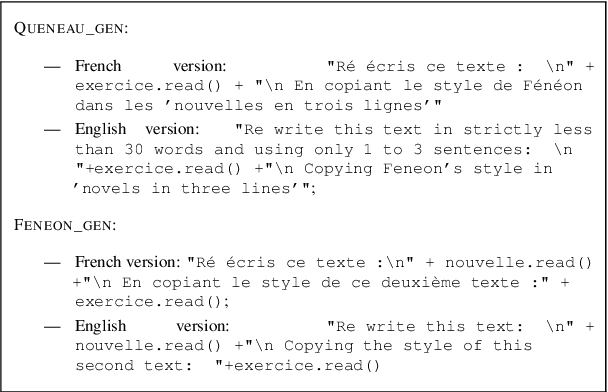
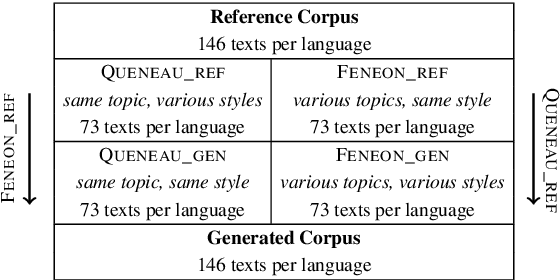
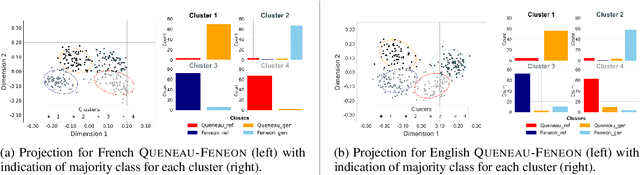
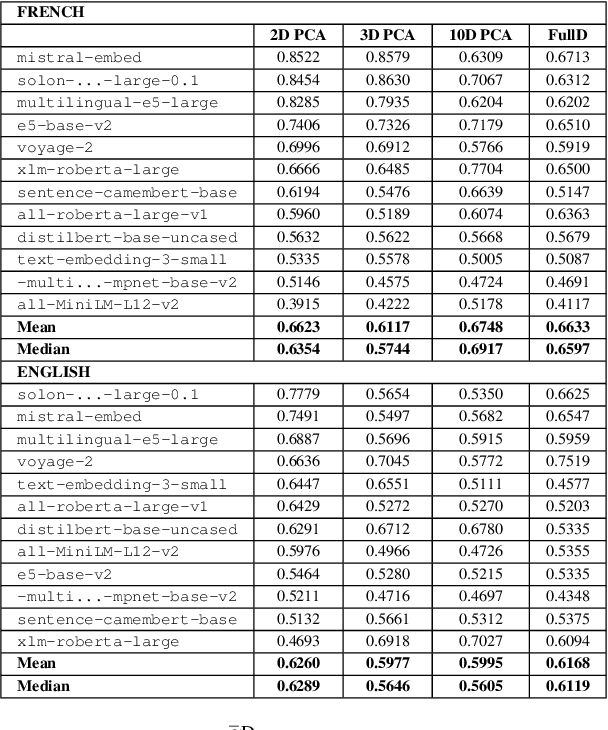
This paper analyzes how writing style affects the dispersion of embedding vectors across multiple, state-of-the-art language models. While early transformer models primarily aligned with topic modeling, this study examines the role of writing style in shaping embedding spaces. Using a literary corpus that alternates between topics and styles, we compare the sensitivity of language models across French and English. By analyzing the particular impact of style on embedding dispersion, we aim to better understand how language models process stylistic information, contributing to their overall interpretability.