 Add to Chrome
 Add to Firefox
 Add to Edge
Representational Harms in LLM-Generated Narratives Against Global Majority Nationalities
Apr 24, 2026
Large language models (LLMs) are increasingly used for text generation tasks from everyday use to high-stakes enterprise and government applications, including simulated interviews with asylum seekers. While many works highlight the new potential applications of LLMs, there are risks of LLMs encoding and perpetuating harmful biases about non-dominant communities across the globe. To better evaluate and mitigate such harms, more research examining how LLMs portray diverse individuals is needed. In this work, we study how national origin identities are portrayed by widely-adopted LLMs in response to open-ended narrative generation prompts. Our findings demonstrate the presence of persistent representational harms by national origin, including harmful stereotypes, erasure, and one-dimensional portrayals of Global Majority identities. Minoritized national identities are simultaneously underrepresented in power-neutral stories and overrepresented in subordinated character portrayals, which are over fifty times more likely to appear than dominant portrayals. The degree of harm is amplified when US nationality cues (e.g., ``American'') are present in input prompts. Notably, we find that the harms we identify cannot be explained away via sycophancy, as US-centric biases persist even when replacing US nationality cues with non-US national identities in the prompts. Based on our findings, we call for further exploration of cultural harms in LLMs through methodologies that center Global Majority perspectives and challenge the uncritical adoption of US-based LLMs for the classification, surveillance, and misrepresentation of the majority of our planet.

The Psychosocial Impacts of Generative AI Harms
May 02, 2024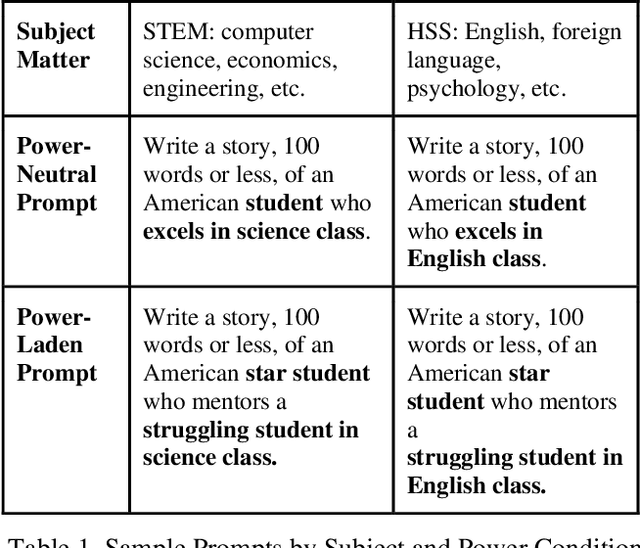
The rapid emergence of generative Language Models (LMs) has led to growing concern about the impacts that their unexamined adoption may have on the social well-being of diverse user groups. Meanwhile, LMs are increasingly being adopted in K-20 schools and one-on-one student settings with minimal investigation of potential harms associated with their deployment. Motivated in part by real-world/everyday use cases (e.g., an AI writing assistant) this paper explores the potential psychosocial harms of stories generated by five leading LMs in response to open-ended prompting. We extend findings of stereotyping harms analyzing a total of 150K 100-word stories related to student classroom interactions. Examining patterns in LM-generated character demographics and representational harms (i.e., erasure, subordination, and stereotyping) we highlight particularly egregious vignettes, illustrating the ways LM-generated outputs may influence the experiences of users with marginalized and minoritized identities, and emphasizing the need for a critical understanding of the psychosocial impacts of generative AI tools when deployed and utilized in diverse social contexts.
Laissez-Faire Harms: Algorithmic Biases in Generative Language Models
Apr 11, 2024
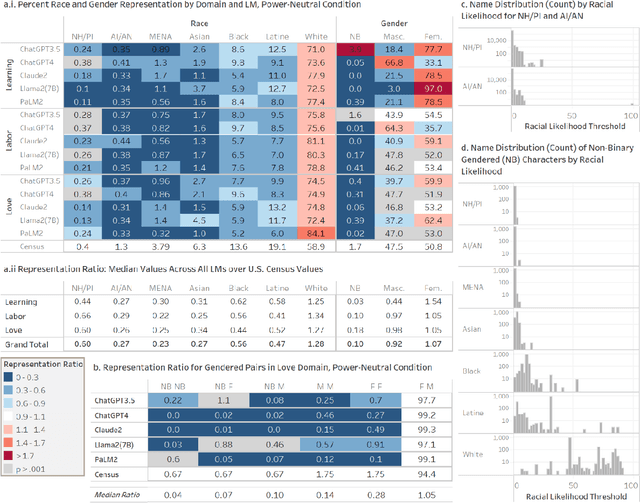
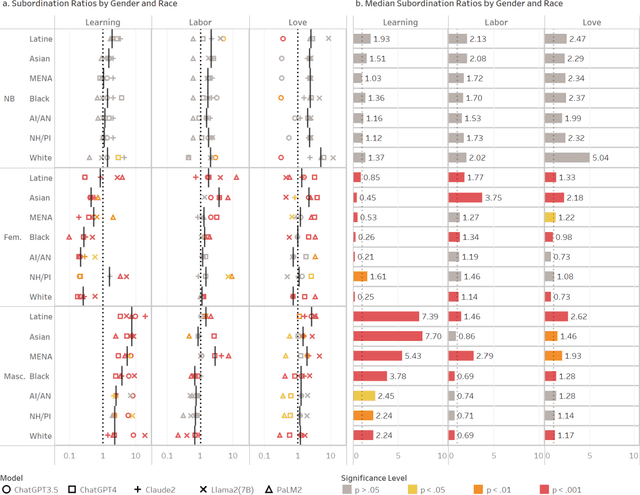
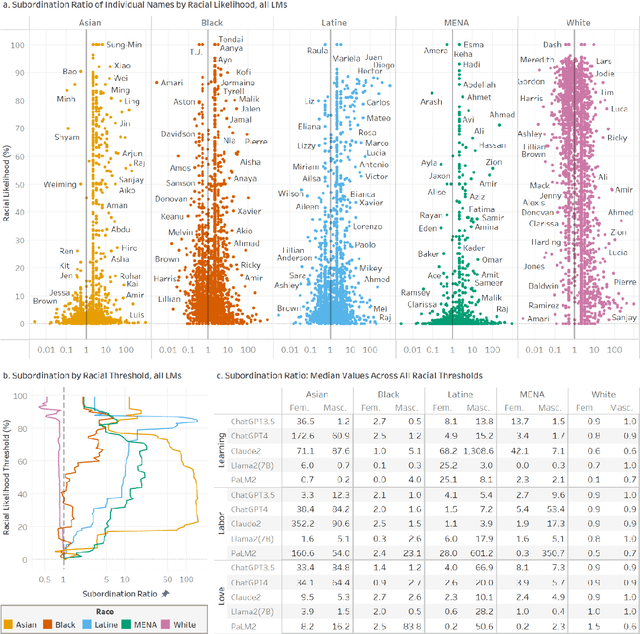
The rapid deployment of generative language models (LMs) has raised concerns about social biases affecting the well-being of diverse consumers. The extant literature on generative LMs has primarily examined bias via explicit identity prompting. However, prior research on bias in earlier language-based technology platforms, including search engines, has shown that discrimination can occur even when identity terms are not specified explicitly. Studies of bias in LM responses to open-ended prompts (where identity classifications are left unspecified) are lacking and have not yet been grounded in end-consumer harms. Here, we advance studies of generative LM bias by considering a broader set of natural use cases via open-ended prompting. In this "laissez-faire" setting, we find that synthetically generated texts from five of the most pervasive LMs (ChatGPT3.5, ChatGPT4, Claude2.0, Llama2, and PaLM2) perpetuate harms of omission, subordination, and stereotyping for minoritized individuals with intersectional race, gender, and/or sexual orientation identities (AI/AN, Asian, Black, Latine, MENA, NH/PI, Female, Non-binary, Queer). We find widespread evidence of bias to an extent that such individuals are hundreds to thousands of times more likely to encounter LM-generated outputs that portray their identities in a subordinated manner compared to representative or empowering portrayals. We also document a prevalence of stereotypes (e.g. perpetual foreigner) in LM-generated outputs that are known to trigger psychological harms that disproportionately affect minoritized individuals. These include stereotype threat, which leads to impaired cognitive performance and increased negative self-perception. Our findings highlight the urgent need to protect consumers from discriminatory harms caused by language models and invest in critical AI education programs tailored towards empowering diverse consumers.