 Add to Chrome
 Add to Firefox
 Add to Edge
Quantum Reinforcement Learning with Transformers for the Capacitated Vehicle Routing Problem
Feb 05, 2026
This paper addresses the Capacitated Vehicle Routing Problem (CVRP) by comparing classical and quantum Reinforcement Learning (RL) approaches. An Advantage Actor-Critic (A2C) agent is implemented in classical, full quantum, and hybrid variants, integrating transformer architectures to capture the relationships between vehicles, clients, and the depot through self- and cross-attention mechanisms. The experiments focus on multi-vehicle scenarios with capacity constraints, considering 20 clients and 4 vehicles, and are conducted over ten independent runs. Performance is assessed using routing distance, route compactness, and route overlap. The results show that all three approaches are capable of learning effective routing policies. However, quantum-enhanced models outperform the classical baseline and produce more robust route organization, with the hybrid architecture achieving the best overall performance across distance, compactness, and route overlap. In addition to quantitative improvements, qualitative visualizations reveal that quantum-based models generate more structured and coherent routing solutions. These findings highlight the potential of hybrid quantum-classical reinforcement learning models for addressing complex combinatorial optimization problems such as the CVRP.

Application of Tensor Neural Networks to Pricing Bermudan Swaptions
Apr 18, 2023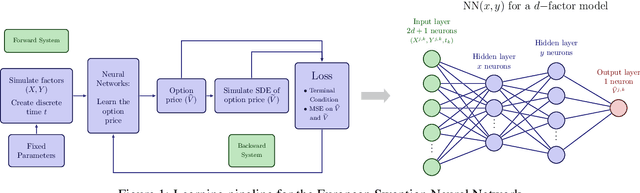

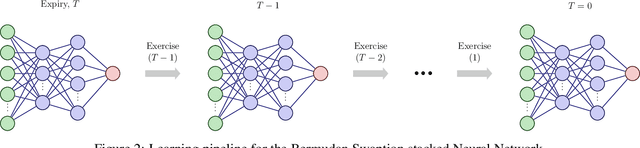
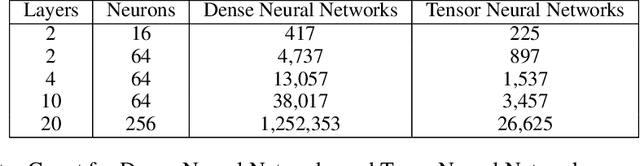
The Cheyette model is a quasi-Gaussian volatility interest rate model widely used to price interest rate derivatives such as European and Bermudan Swaptions for which Monte Carlo simulation has become the industry standard. In low dimensions, these approaches provide accurate and robust prices for European Swaptions but, even in this computationally simple setting, they are known to underestimate the value of Bermudan Swaptions when using the state variables as regressors. This is mainly due to the use of a finite number of predetermined basis functions in the regression. Moreover, in high-dimensional settings, these approaches succumb to the Curse of Dimensionality. To address these issues, Deep-learning techniques have been used to solve the backward Stochastic Differential Equation associated with the value process for European and Bermudan Swaptions; however, these methods are constrained by training time and memory. To overcome these limitations, we propose leveraging Tensor Neural Networks as they can provide significant parameter savings while attaining the same accuracy as classical Dense Neural Networks. In this paper we rigorously benchmark the performance of Tensor Neural Networks and Dense Neural Networks for pricing European and Bermudan Swaptions, and we show that Tensor Neural Networks can be trained faster than Dense Neural Networks and provide more accurate and robust prices than their Dense counterparts.