 Add to Chrome
 Add to Firefox
 Add to Edge
Event Burst Trigger: An Availability Backdoor Attack on Event-Based SNN Object Detection
Jul 13, 2026
Event-based vision and spiking neural networks (SNNs) are increasingly adopted for edge intelligence under strict latency and energy constraints. However, the vulnerability of event-based SNN object detection models to availability backdoor attacks remains insufficiently studied. This paper presents Event Burst Trigger (EBT), an availability backdoor attack targeting SNN-based object detection models. EBT injects carefully crafted event-based triggers into the training data, which induce temporally concentrated event streams during inference. These burst-like activations increase the number of phantom (i.e., spurious) object candidates, and consequently inflate the computational cost of the post-processing stage, particularly Non-Maximum Suppression (NMS). We evaluate EBT on SpikeYOLO, the state-of-the-art SNN-based object detector, under a poison-only threat model that does not require modifications to the model architecture, loss function, or inference pipeline. Experimental results show that while detection accuracy remains largely preserved, with mAP@0.5 decreasing by less than 0.099, the latency of the NMS stage increases by up to 38%. This indicates that NMS can become a dominant availability bottleneck in event-based SNN object detection. Experiments on an edge platform further show that the proposed attack elevates baseline resource utilization and reduces scheduling slack without inducing conspicuous peaks in resource usage. In addition, STRIP-based backdoor detection fails to reliably distinguish the proposed attack from benign inputs. These results characterize a previously underexplored availability backdoor threat in event-based SNN object detection systems.

Digital-to-Physical Transfer of Adversarial Patches for Aerial Vehicle Detection
May 29, 2026Deep neural network (DNN)-based object detectors are widely used for analyzing aerial and satellite imagery in applications such as environmental monitoring and urban analytics. Despite their strong performance, these models are known to be vulnerable to adversarial examples, and physical adversarial attacks using printable patterns pose realistic security threats. In this paper, we evaluate physical adversarial patch attacks against an aerial vehicle detector by bridging digital optimization and real-world deployment. Adversarial patches are optimized in the digital domain using a loss function that minimizes the maximum objectness score while incorporating non-printability score (NPS) and total variation (TV) constraints to ensure both printability and spatial smoothness. The optimized patches are printed and deployed in three configurations: ON, OFF, and OFF-Side. Experiments using a YOLOv3 detector show that while the OFF patch achieves the highest effectiveness in the digital domain (85.51% Average Objectness Reduction Rate (AORR)), the ON patch demonstrates superior robustness in physical environments (0.197-0.343 Objectness Score Ratio (OSR)) due to its consistent visibility. Furthermore, our results indicate that weather-based augmentation does not necessarily improve patch optimization in this domain. These findings provide critical insights into the practical vulnerabilities of aerial object detection systems.
AT-SNN: Adaptive Tokens for Vision Transformer on Spiking Neural Network
Aug 22, 2024
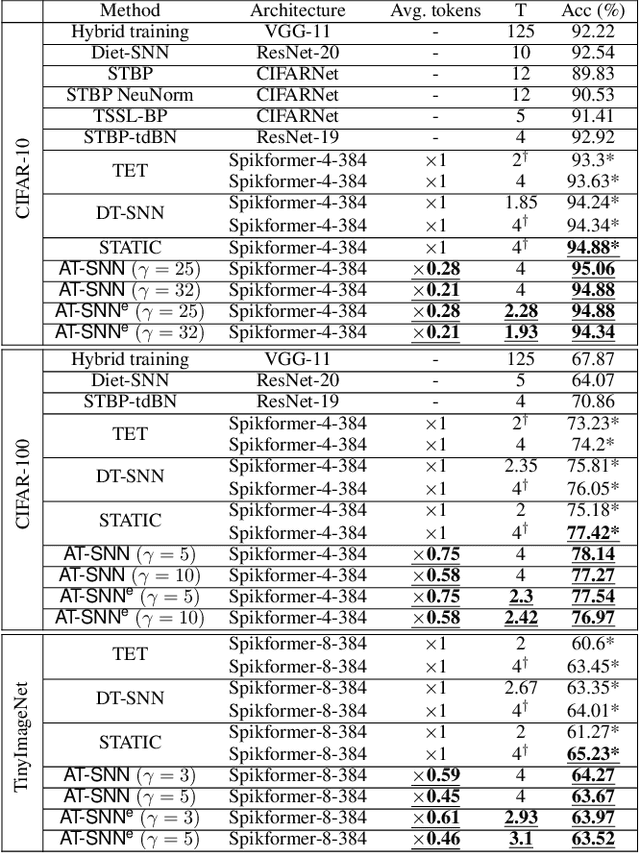


In the training and inference of spiking neural networks (SNNs), direct training and lightweight computation methods have been orthogonally developed, aimed at reducing power consumption. However, only a limited number of approaches have applied these two mechanisms simultaneously and failed to fully leverage the advantages of SNN-based vision transformers (ViTs) since they were originally designed for convolutional neural networks (CNNs). In this paper, we propose AT-SNN designed to dynamically adjust the number of tokens processed during inference in SNN-based ViTs with direct training, wherein power consumption is proportional to the number of tokens. We first demonstrate the applicability of adaptive computation time (ACT), previously limited to RNNs and ViTs, to SNN-based ViTs, enhancing it to discard less informative spatial tokens selectively. Also, we propose a new token-merge mechanism that relies on the similarity of tokens, which further reduces the number of tokens while enhancing accuracy. We implement AT-SNN to Spikformer and show the effectiveness of AT-SNN in achieving high energy efficiency and accuracy compared to state-of-the-art approaches on the image classification tasks, CIFAR10, CIFAR-100, and TinyImageNet. For example, our approach uses up to 42.4% fewer tokens than the existing best-performing method on CIFAR-100, while conserving higher accuracy.