 Add to Chrome
 Add to Firefox
 Add to Edge
CIDER: A Dataset of Contextual Disclosure Boundaries for Privacy Preference Alignment
Aug 10, 2026
Aligning large language models (LLMs) with human privacy preferences requires capturing individuals' disclosure boundaries beyond general privacy norms. However, a gap remains in eliciting such nuanced preferences to evaluate alignment in realistic settings. We introduce CIDER, a dataset of 14,850 human annotations from 169 users, forming 1,650 contextual disclosure boundary sets across 60 interpersonal communication scenarios involving information sharing that violates privacy norms. Each boundary represents a real user's disclosure decisions over 9 sharing variants in a scenario, for a given communication role and AI-mediated condition. We formulate a task in which models predict a user's disclosure decision from historical boundaries, with varying levels of contextual information. Across 12 open and proprietary models, in-context personalization improves prediction accuracy by up to 11.41 percentage points using only 6 historical examples. Larger models such as GPT-5.4 (with medium reasoning effort) and Claude Sonnet 4.6 are better at leveraging semantic context to understand user-specific, context-dependent disclosure preferences for more accurate predictions, while smaller models tend to rely on structured heuristics based on disclosure granularity and identifiability. Personalization generally improves prediction accuracy, but the improvement is often accompanied by imbalanced shifts in false-positive and false-negative rates across models, with only Claude Sonnet 4.6 achieving balanced improvements in both. Our findings reveal both the promise and limitations of inference-time personalization for privacy preference modeling and position CIDER as a resource for advancing personalized privacy alignment.

From Fragmentation to Integration: Exploring the Design Space of AI Agents for Human-as-the-Unit Privacy Management
Feb 04, 2026Managing one's digital footprint is overwhelming, as it spans multiple platforms and involves countless context-dependent decisions. Recent advances in agentic AI offer ways forward by enabling holistic, contextual privacy-enhancing solutions. Building on this potential, we adopted a ''human-as-the-unit'' perspective and investigated users' cross-context privacy challenges through 12 semi-structured interviews. Results reveal that people rely on ad hoc manual strategies while lacking comprehensive privacy controls, highlighting nine privacy-management challenges across applications, temporal contexts, and relationships. To explore solutions, we generated nine AI agent concepts and evaluated them via a speed-dating survey with 116 US participants. The three highest-ranked concepts were all post-sharing management tools with half or full agent autonomy, with users expressing greater trust in AI accuracy than in their own efforts. Our findings highlight a promising design space where users see AI agents bridging the fragments in privacy management, particularly through automated, comprehensive post-sharing remediation of users' digital footprints.
Rescriber: Smaller-LLM-Powered User-Led Data Minimization for Navigating Privacy Trade-offs in LLM-Based Conversational Agent
Oct 10, 2024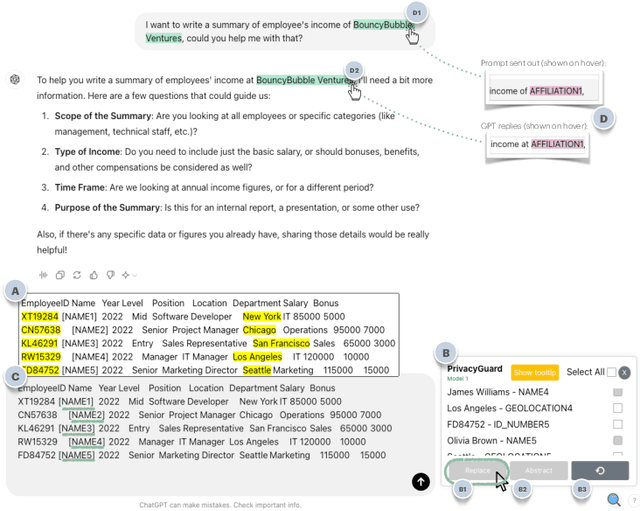
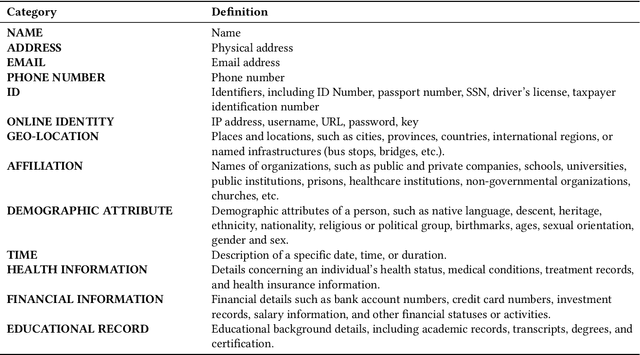
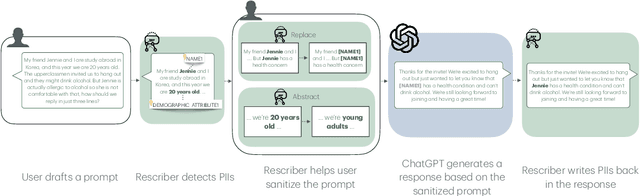

The proliferation of LLM-based conversational agents has resulted in excessive disclosure of identifiable or sensitive information. However, existing technologies fail to offer perceptible control or account for users' personal preferences about privacy-utility tradeoffs due to the lack of user involvement. To bridge this gap, we designed, built, and evaluated Rescriber, a browser extension that supports user-led data minimization in LLM-based conversational agents by helping users detect and sanitize personal information in their prompts. Our studies (N=12) showed that Rescriber helped users reduce unnecessary disclosure and addressed their privacy concerns. Users' subjective perceptions of the system powered by Llama3-8B were on par with that by GPT-4. The comprehensiveness and consistency of the detection and sanitization emerge as essential factors that affect users' trust and perceived protection. Our findings confirm the viability of smaller-LLM-powered, user-facing, on-device privacy controls, presenting a promising approach to address the privacy and trust challenges of AI.