 Add to Chrome
 Add to Firefox
 Add to Edge
Neuromorphic Dual-channel Encoding of Luminance and Contrast
Dec 26, 2024
There is perceptual and physiological evidence that the retina registers and signals luminance and luminance contrast using dual-channel mechanisms. This process begins in the retina, wherein the luminance of a uniform zone and differentials of luminance in neighboring zones determine the degree of brightness or darkness of the zones. The neurons that process the information can be classified as "bright" or "dark" channels. The present paper provides an overview of these retinal mechanisms along with evidence that they provide brightness judgments that are log-linear across roughly seven orders of magnitude.

An evolutionary perspective on the design of neuromorphic shape filters
Aug 30, 2020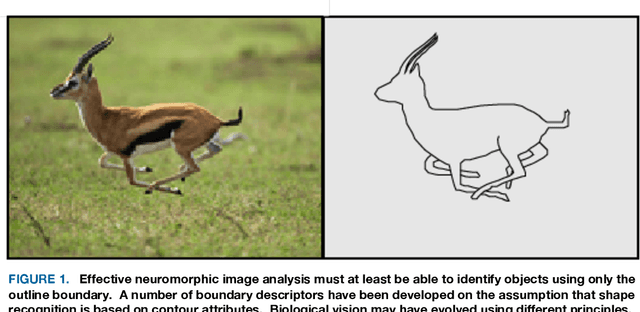
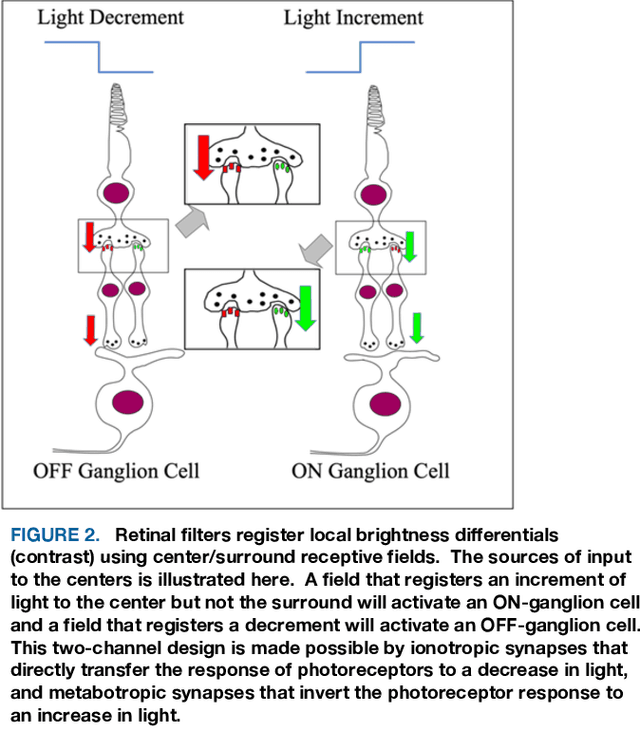
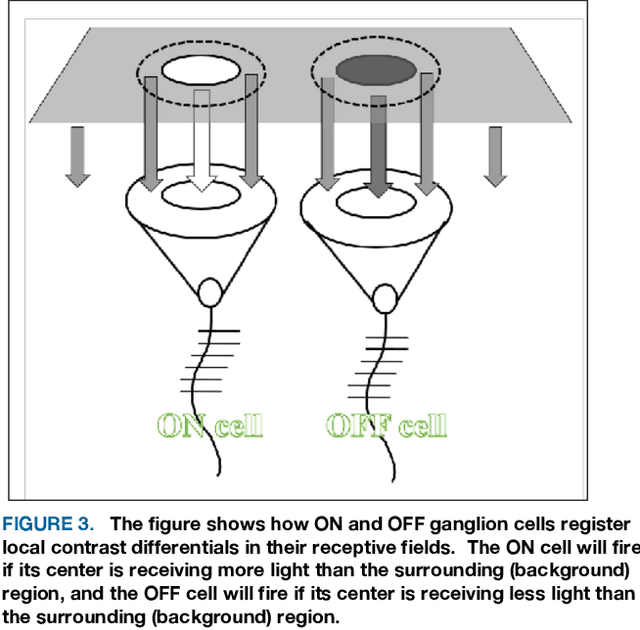
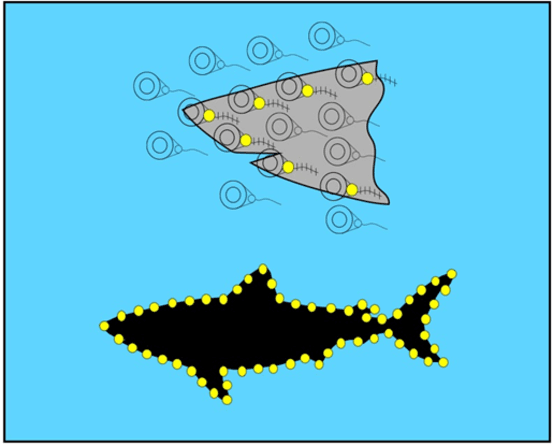
A substantial amount of time and energy has been invested to develop machine vision using connectionist (neural network) principles. Most of that work has been inspired by theories advanced by neuroscientists and behaviorists for how cortical systems store stimulus information. Those theories call for information flow through connections among several neuron populations, with the initial connections being random (or at least non-functional). Then the strength or location of connections are modified through training trials to achieve an effective output, such as the ability to identify an object. Those theories ignored the fact that animals that have no cortex, e.g., fish, can demonstrate visual skills that outpace the best neural network models. Neural circuits that allow for immediate effective vision and quick learning have been preprogrammed by hundreds of millions of years of evolution and the visual skills are available shortly after hatching. Cortical systems may be providing advanced image processing, but most likely are using design principles that had been proven effective in simpler systems. The present article provides a brief overview of retinal and cortical mechanisms for registering shape information, with the hope that it might contribute to the design of shape-encoding circuits that more closely match the mechanisms of biological vision.