 Add to Chrome
 Add to Firefox
 Add to Edge
A Causal Language Modeling Detour Improves Encoder Continued Pretraining
May 12, 2026
When adapting an encoder to a new domain, the standard approach is to continue training with Masked Language Modeling (MLM). We show that temporarily switching to Causal Language Modeling (CLM) followed by a short MLM decay improves downstream performance. On biomedical texts with ModernBERT, this CLM detour outperforms MLM baselines trained on identical data and compute across 8 French and 11 English biomedical tasks, by +1.2-2.8pp and +0.3-0.8pp respectively, depending on model size. We investigate the reasons for these gains. We find that CLM's dense supervision impacts low transformer layers (0-7) far more than MLM does. Freezing low layers during CLM eliminates the downstream benefit; freezing mid layers preserves it. The representational changes persist through the MLM decay phase, even when it matches the CLM phase in length, and they scale with model capacity. We release ModernCamemBERT-bio and ModernBERT-bio as state-of-the-art biomedical encoders in Base and Large sizes.

CamemBERT-bio: a Tasty French Language Model Better for your Health
Jun 27, 2023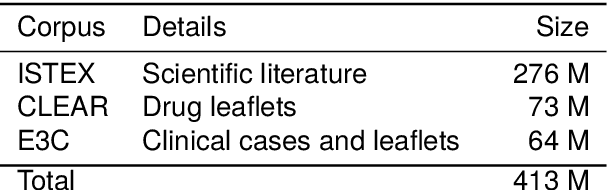
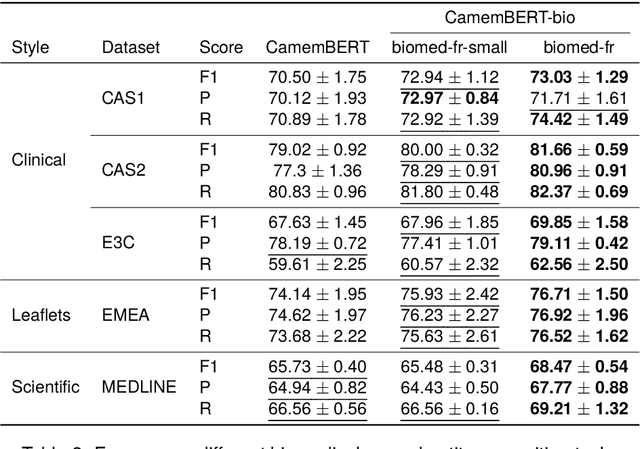
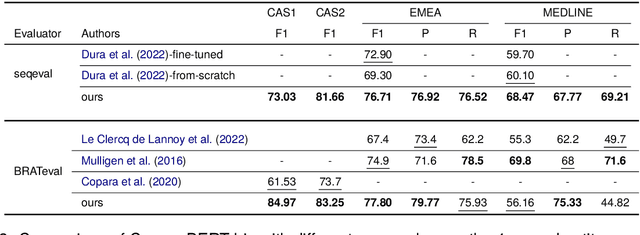
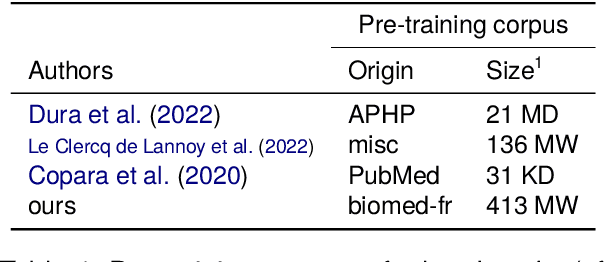
Clinical data in hospitals are increasingly accessible for research through clinical data warehouses, however these documents are unstructured. It is therefore necessary to extract information from medical reports to conduct clinical studies. Transfer learning with BERT-like models such as CamemBERT has allowed major advances, especially for named entity recognition. However, these models are trained for plain language and are less efficient on biomedical data. This is why we propose a new French public biomedical dataset on which we have continued the pre-training of CamemBERT. Thus, we introduce a first version of CamemBERT-bio, a specialized public model for the French biomedical domain that shows 2.54 points of F1 score improvement on average on different biomedical named entity recognition tasks.