 Add to Chrome
 Add to Firefox
 Add to Edge
Uncertainty-Aware Multimodal Emotion Recognition through Dirichlet Parameterization
Feb 09, 2026
In this work, we present a lightweight and privacy-preserving Multimodal Emotion Recognition (MER) framework designed for deployment on edge devices. To demonstrate framework's versatility, our implementation uses three modalities - speech, text and facial imagery. However, the system is fully modular, and can be extended to support other modalities or tasks. Each modality is processed through a dedicated backbone optimized for inference efficiency: Emotion2Vec for speech, a ResNet-based model for facial expressions, and DistilRoBERTa for text. To reconcile uncertainty across modalities, we introduce a model- and task-agnostic fusion mechanism grounded in Dempster-Shafer theory and Dirichlet evidence. Operating directly on model logits, this approach captures predictive uncertainty without requiring additional training or joint distribution estimation, making it broadly applicable beyond emotion recognition. Validation on five benchmark datasets (eNTERFACE05, MEAD, MELD, RAVDESS and CREMA-D) show that our method achieves competitive accuracy while remaining computationally efficient and robust to ambiguous or missing inputs. Overall, the proposed framework emphasizes modularity, scalability, and real-world feasibility, paving the way toward uncertainty-aware multimodal systems for healthcare, human-computer interaction, and other emotion-informed applications.

SteloCoder: a Decoder-Only LLM for Multi-Language to Python Code Translation
Oct 24, 2023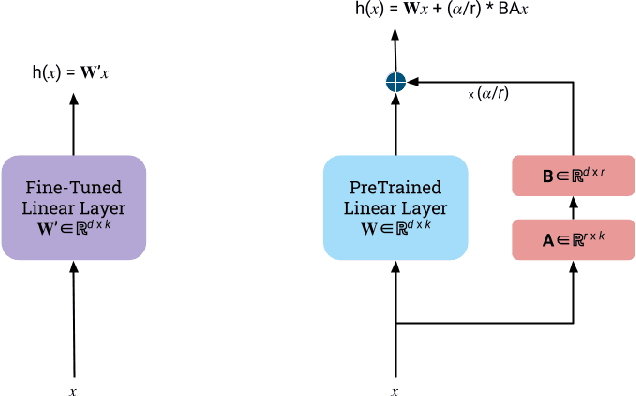
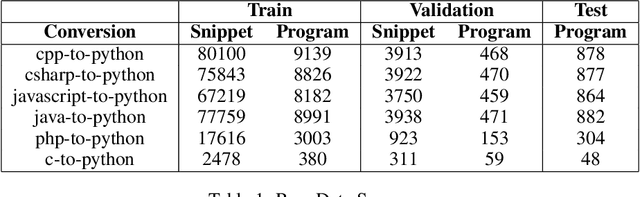
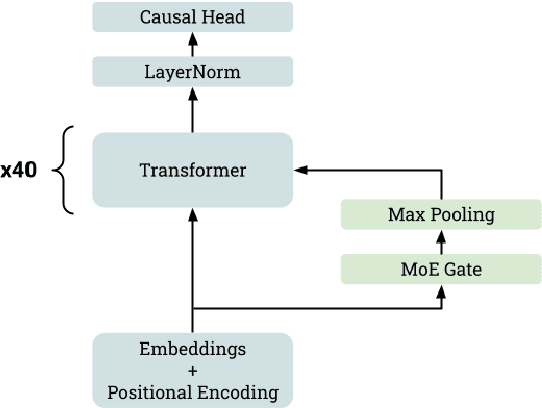
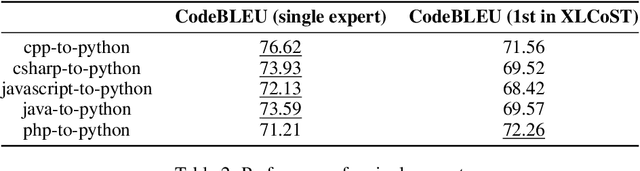
With the recent focus on Large Language Models (LLMs), both StarCoder (Li et al., 2023) and Code Llama (Rozi\`ere et al., 2023) have demonstrated remarkable performance in code generation. However, there is still a need for improvement in code translation functionality with efficient training techniques. In response to this, we introduce SteloCoder, a decoder-only StarCoder-based LLM designed specifically for multi-programming language-to-Python code translation. In particular, SteloCoder achieves C++, C#, JavaScript, Java, or PHP-to-Python code translation without specifying the input programming language. We modified StarCoder model architecture by incorporating a Mixture-of-Experts (MoE) technique featuring five experts and a gating network for multi-task handling. Experts are obtained by StarCoder fine-tuning. Specifically, we use a Low-Rank Adaptive Method (LoRA) technique, limiting each expert size as only 0.06% of number of StarCoder's parameters. At the same time, to enhance training efficiency in terms of time, we adopt curriculum learning strategy and use self-instruct data for efficient fine-tuning. As a result, each expert takes only 6 hours to train on one single 80Gb A100 HBM. With experiments on XLCoST datasets, SteloCoder achieves an average of 73.76 CodeBLEU score in multi-programming language-to-Python translation, surpassing the top performance from the leaderboard by at least 3.5. This accomplishment is attributed to only 45M extra parameters with StarCoder as the backbone and 32 hours of valid training on one 80GB A100 HBM. The source code is release here: https://github.com/sade-adrien/SteloCoder.