 Add to Chrome
 Add to Firefox
 Add to Edge
On the Impact of Gas-Line Absorption in Long-Haul C+L-Band Hollow-Core Fibre Transmission
Aug 03, 2026
We numerically investigate gas-line absorption in hollow-core fibre C+L-band transmission. Results show limited C-band but severe L-band performance degradation. Ideal suppression enables a 1.5$\times$ higher L-band throughput, reaching 59.1 Tb/s over 1000 km, while reducing repeater number by up to 3.3$\times$.

GPU-Accelerated Optimisation of Symmetric Bidirectional Ultrawideband Coherent Transmission Under Launch Power Constraints
Jul 14, 2026We optimise bidirectional OESCL-band coherent transmission under total fibre power constraints using a GPU-accelerated boundary-value Raman solver and launch-power optimisation. While no gain is observed without power constraints, for an 18-dBm limit 3-span transmission reversing the O-band direction increases aggregate capacity by up to 24.5%
One Terahertz Full-Field Digital Back-Propagation over 3000 km
Jun 24, 2026We implement full-field digital back-propagation with a 1-THz receiver using 20 synchronous frequency-adjacent coherent receivers with digital stitching and a frequency-comb local oscillator. Relative to electronic dispersion compensation, per-channel DBP and full-field DBP achieve throughput gains of 2.2\% and 5.4\%, respectively.
On the Optimum Energy-per-bit Launch Power in Coherent Hollow-core Fibre Transmission Systems
Jun 16, 2026We investigate the optimum energy per bit in hollow-core-fibre transmission systems. We show that a 1000 km C-band link can achieve a 41.5% reduction in total power consumption when operating at the minimum energy-per-bit launch power with only 2.2% throughput penalty.
423.7 + 426.5 Tb/s GMI Bi-Directional HCF Transmission
May 06, 2026We demonstrate OESCL-band same-wavelength bi-directional transmission over 60 km HCF with 42.5 THz bandwidth, achieving GMIs comparable with the highest unidirectional SMF data-rates in both directions, with an aggregate of 423.7 + 426.5 Tb/s.
Gas Line Absorption Mitigation in Hollow-Core Fibre using Spectral Pre-Equalisation
Feb 10, 2026We study the impact of CO 2 absorption on hollow-core fibre transmission. Using spectral pre-equalisation, we digitally post-compensate gas-line absorption and show a 5.5 dB reduction in Q-factor penalty, outperforming a 383-tap equaliser by 1.3 dB.
Ultra-Wideband Transmission Systems From an Energy Perspective: Which Band is Next?
Jan 08, 2026Measuring the power efficiency of the state-of-the-art OESCL-band amplifiers, we show that 1000 km OESCL-band systems can achieve 2.98x greater throughput for +48% higher energy-per-bit compared to CL-band transmission only.
Measurement and Analysis of the Power Consumption of Hybrid-Amplified SCL-band Links
Jul 30, 2025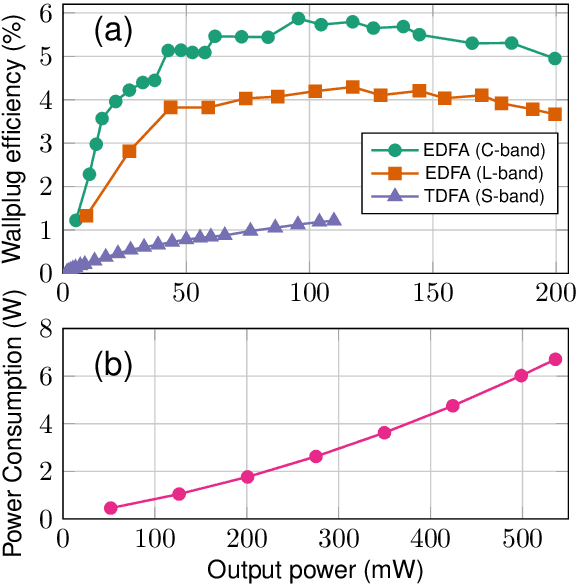
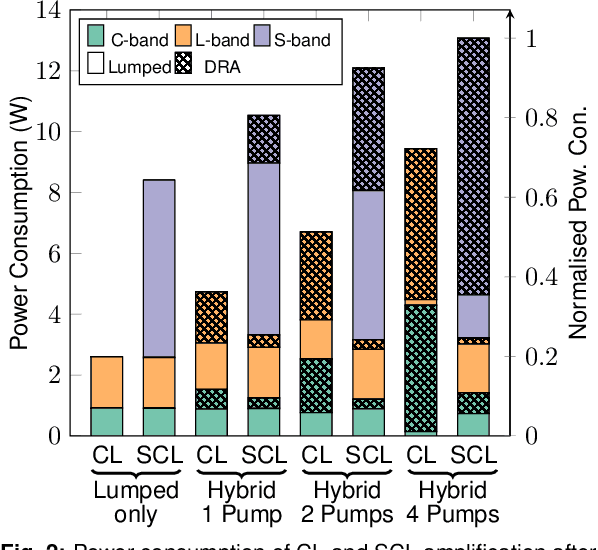
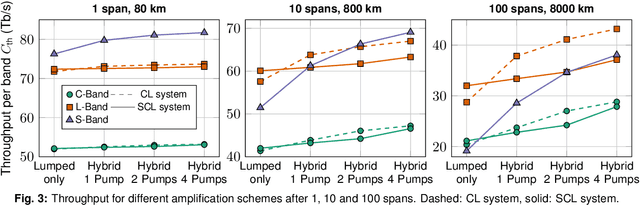

We studied the power consumption of hybrid-amplified SCL-band links using commercial benchtop amplifiers and Raman pumps. We show a reduction in energy per bit for multi-span hybrid Raman amplified links of up to 26% versus lumped amplification.
Ultrawideband optical fibre throughput in the presence of total optical power constraints from C to OESCLU spectral bands
Jul 19, 2024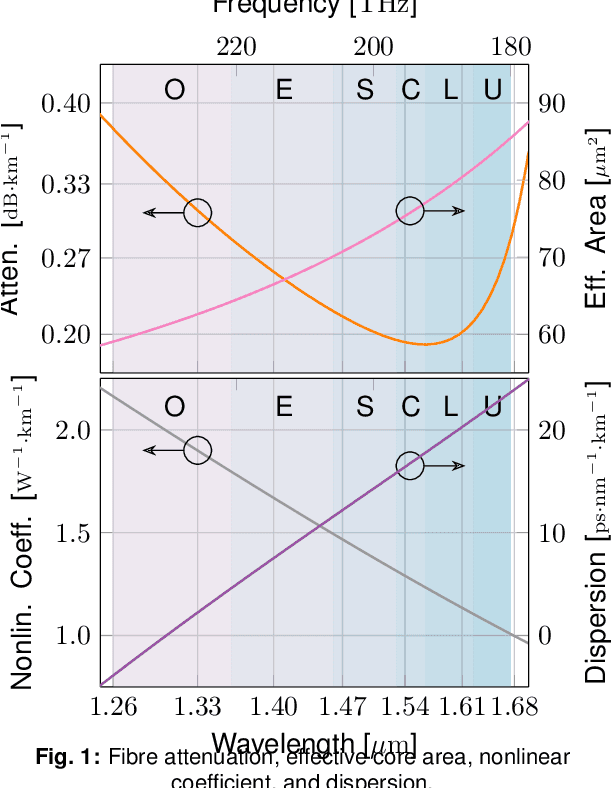
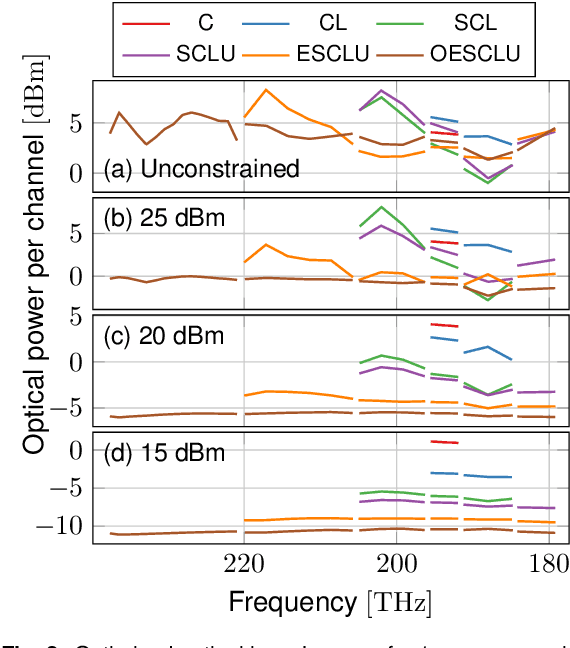
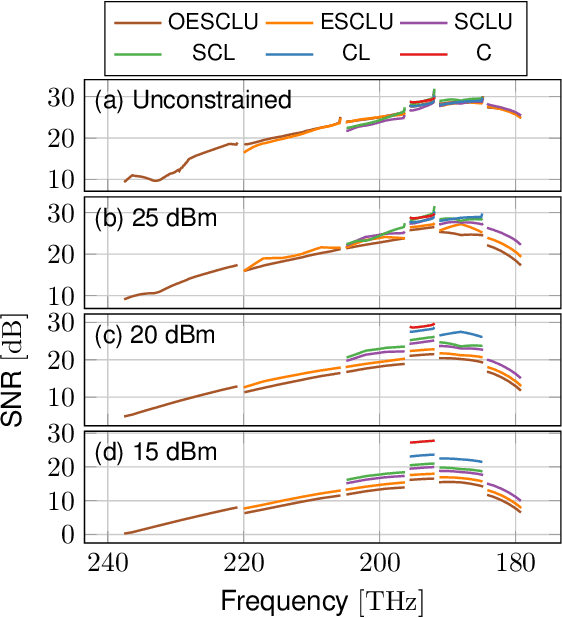
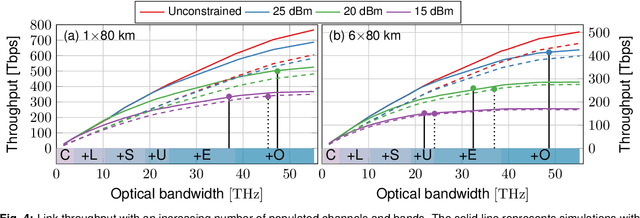
Using a recently developed fast integral ultrawideband Gaussian noise model, we quantify the achievable throughput under total optical power constraints for systems ranging from C-band to fully populated OESCLU bands using optimum launch powers, showing conditions when expanding bandwidth provides no additional throughput.
Optimising O-to-U Band Transmission Using Fast ISRS Gaussian Noise Numerical Integral Model
Jan 31, 2024
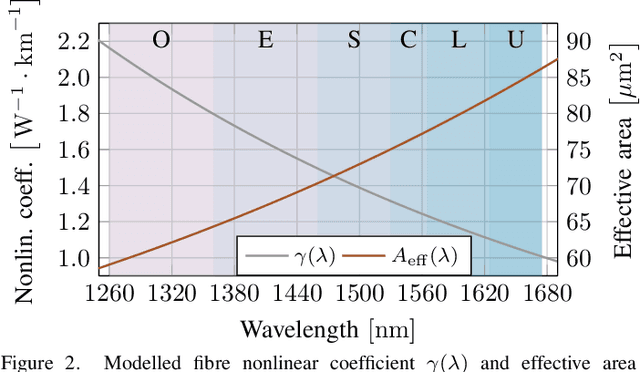
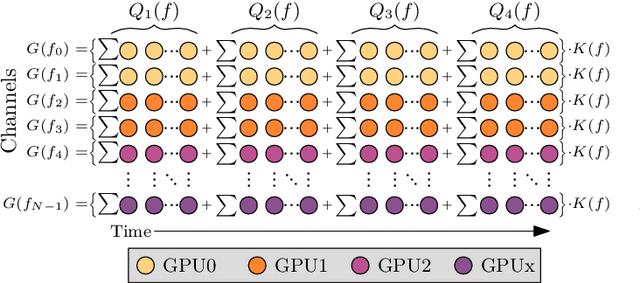
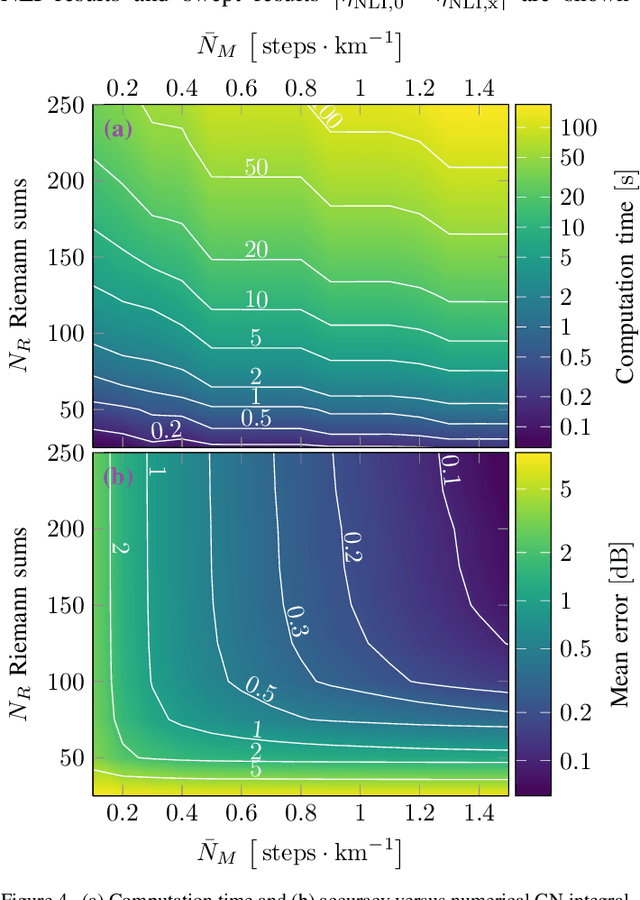
We model the transmission of ultrawideband (UWB) signals, including wavelength-dependent fibre parameters: dispersion, nonlinear coefficient and effective fibre core area. To that end, the inter-channel stimulated Raman scattering Gaussian noise (ISRS GN) integral model is extended to include these parameters. The integrals involved in this frequency-domain model are numerically solved in hyperbolic coordinates using a Riemann sum. The model implementation is designed to work on parallel graphics processing units (GPUs) and is optimised for fast computational time. The model is valid for Gaussian-distributed signals and is compared with the split-step Fourier method (SSFM), for transmission over standard single-mode fibre (SSMF) in the O-band (wavelengths around the zero-dispersion wavelength), showing reasonable agreement. Further, we demonstrated SNR evaluation over an 80 km SSFM single-span transmission using 589$\times$96 GBaud channels, corresponding to almost 59 THz optical bandwidth, fully populating the O, E, S, C, L and U bands (1260$-$1675 nm). The SNR evaluation is completed in just 3.6 seconds using four Nvidia V100 16GB PCIe GPUs. Finally, we used this model to find the optimum launch power profile for this system achieving 747 Tbps of potential throughput over 80 km fibre and demonstrating its suitability for UWB optimisation routines.