 Add to Chrome
 Add to Firefox
 Add to Edge
From Detection to Prevention: Explaining Security-Critical Code to Avoid Vulnerabilities
Jan 31, 2026
Security vulnerabilities often arise unintentionally during development due to a lack of security expertise and code complexity. Traditional tools, such as static and dynamic analysis, detect vulnerabilities only after they are introduced in code, leading to costly remediation. This work explores a proactive strategy to prevent vulnerabilities by highlighting code regions that implement security-critical functionality -- such as data access, authentication, and input handling -- and providing guidance for their secure implementation. We present an IntelliJ IDEA plugin prototype that uses code-level software metrics to identify potentially security-critical methods and large language models (LLMs) to generate prevention-oriented explanations. Our initial evaluation on the Spring-PetClinic application shows that the selected metrics identify most known security-critical methods, while an LLM provides actionable, prevention-focused insights. Although these metrics capture structural properties rather than semantic aspects of security, this work lays the foundation for code-level security-aware metrics and enhanced explanations.

Explaining Software Vulnerabilities with Large Language Models
Nov 06, 2025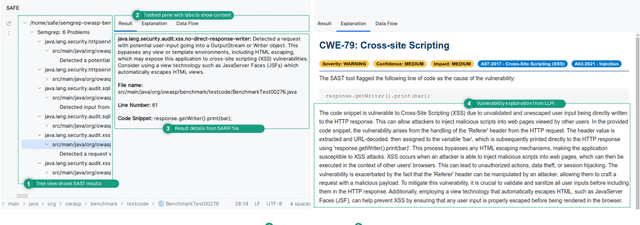
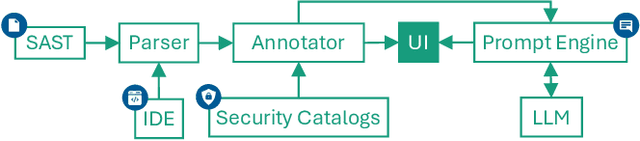
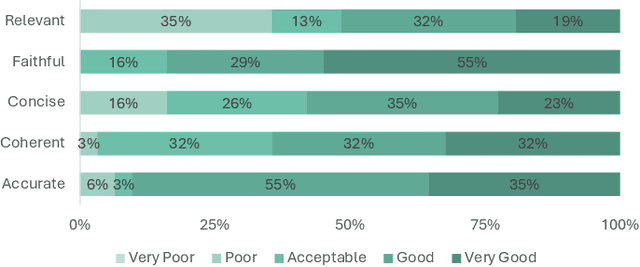
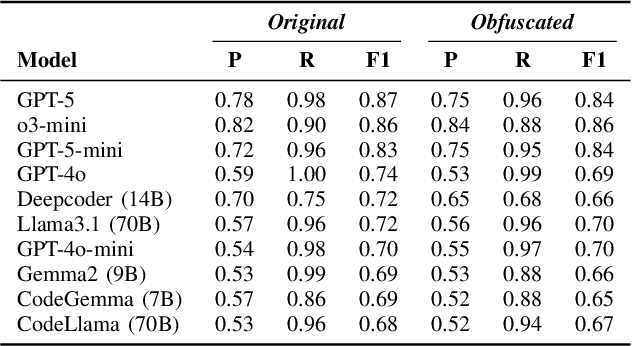
The prevalence of security vulnerabilities has prompted companies to adopt static application security testing (SAST) tools for vulnerability detection. Nevertheless, these tools frequently exhibit usability limitations, as their generic warning messages do not sufficiently communicate important information to developers, resulting in misunderstandings or oversight of critical findings. In light of recent developments in Large Language Models (LLMs) and their text generation capabilities, our work investigates a hybrid approach that uses LLMs to tackle the SAST explainability challenges. In this paper, we present SAFE, an Integrated Development Environment (IDE) plugin that leverages GPT-4o to explain the causes, impacts, and mitigation strategies of vulnerabilities detected by SAST tools. Our expert user study findings indicate that the explanations generated by SAFE can significantly assist beginner to intermediate developers in understanding and addressing security vulnerabilities, thereby improving the overall usability of SAST tools.
Detecting Security-Relevant Methods using Multi-label Machine Learning
Mar 12, 2024To detect security vulnerabilities, static analysis tools need to be configured with security-relevant methods. Current approaches can automatically identify such methods using binary relevance machine learning approaches. However, they ignore dependencies among security-relevant methods, over-generalize and perform poorly in practice. Additionally, users have to nevertheless manually configure static analysis tools using the detected methods. Based on feedback from users and our observations, the excessive manual steps can often be tedious, error-prone and counter-intuitive. In this paper, we present Dev-Assist, an IntelliJ IDEA plugin that detects security-relevant methods using a multi-label machine learning approach that considers dependencies among labels. The plugin can automatically generate configurations for static analysis tools, run the static analysis, and show the results in IntelliJ IDEA. Our experiments reveal that Dev-Assist's machine learning approach has a higher F1-Measure than related approaches. Moreover, the plugin reduces and simplifies the manual effort required when configuring and using static analysis tools.